
Table of Contents
- 1. The Warrior-King’s Inscription
- 2. The Temple of the Sun and the Roman Throne
- 3. A Legacy of Continuity
- 4. Why This Discovery Changes Everything
- 5. Frequently Asked Questions
- 5.1. Why is the Temple of the Sun so important?
- 5.2. What does the inscription actually say?
- 5.3. Does this discovery prove the mosque is built on the temple?
- 5.4. What is the “Syriac” linguistic background mentioned?
- 5.5. Is the site open to the public?
Hidden beneath Homs: Does a New Discovery Unveil the Sun Temple?
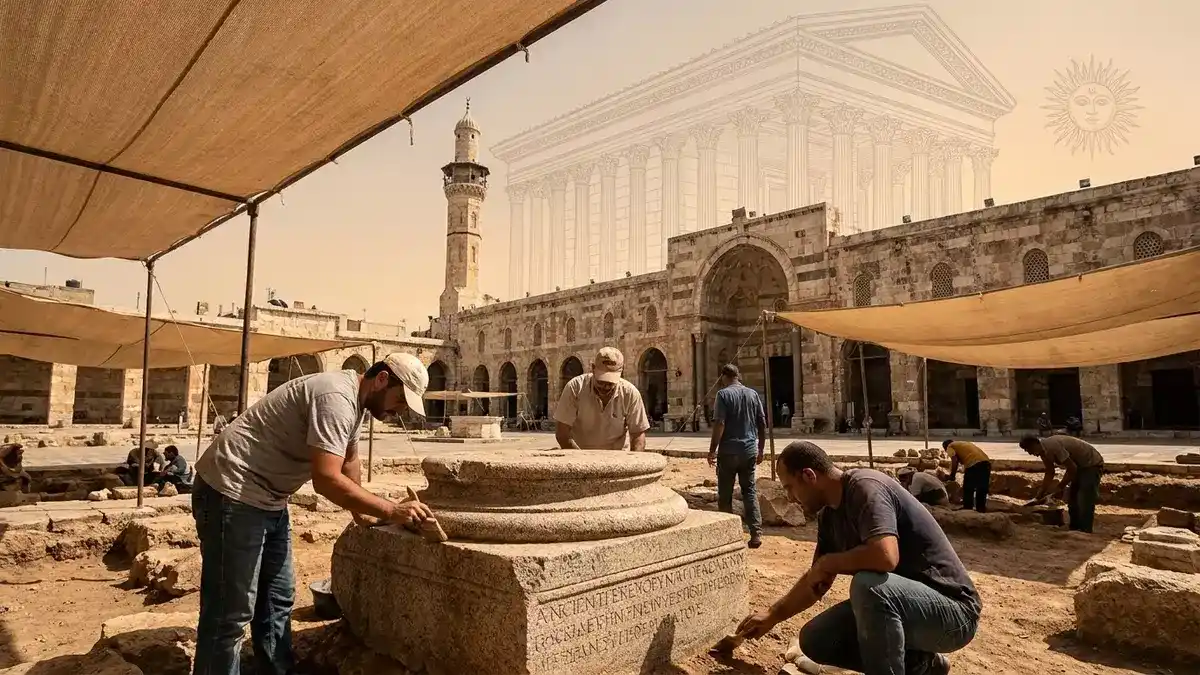
Deep beneath the floors of the Great Mosque of Homs in western Syria lies one of the greatest mysteries of Roman antiquity: the location of the legendary Temple of the Sun. For decades, historians have debated whether this iconic sanctuary, dedicated to the solar deity Elagabalus, rests directly under the mosque’s foundations. Now, a newly analyzed Greek inscription uncovered during recent restoration work provides the most compelling evidence yet that this sacred site has been hiding in plain sight for centuries.
Hidden beneath Homs Does a New Discovery Unveil the Sun Temple
The Warrior-King’s Inscription
The artifact in question is a robust, one-meter-by-one-meter granite column base. On its front, nearly 75 centimeters of stone are covered in formal, symmetrical Greek lettering. Originally brought to light in 2016, the inscription underwent years of delay for study due to regional instability.
The text is striking for its tone. It commemorates a ruler in heroic, militaristic language, comparing the king to a “leopard” and the “storm.” While the Greek is formal, it contains subtle grammatical irregularities characteristic of the Roman-era Levant, where the local population’s Aramaic (Syriac) linguistic background often influenced their second-language Greek. This linguistic “fingerprint” is vital, as it confirms the inscription is a local product of the Roman period rather than a later medieval reuse of foreign stone.
The Temple of the Sun and the Roman Throne
The stakes of this archaeological debate are high. In ancient Emesa (modern Homs), the Temple of the Sun was not just a religious building—it was a center of political gravity. The high priest of this cult, Varius Avitus Bassianus, famously rose to the Roman throne in 218 CE, ruling as the Emperor Elagabalus. His attempt to elevate his Syrian sun god above the traditional pantheon of Rome is one of the most famous cultural clashes in imperial history.
Historians have long known the temple was the city’s heart, but physical evidence of its footprint has remained elusive. The Great Mosque of Homs sits on a site that has served as a center of worship for nearly 2,000 years. If the column base is indeed part of the original temple structure, it proves that the mosque was built directly atop the Roman sanctuary, marking a rare example of “architectural layering” where sacred ground remained sacred across pagan, Christian, and Islamic eras.
A Legacy of Continuity
Professor Maamoun Saleh Abdulkarim of the University of Sharjah argues that this inscription is the “missing link” in the city’s religious history. His study suggests a theme of continuity rather than displacement. According to this theory, successive communities in Homs didn’t look for new ground to build their temples, churches, and mosques; they reshaped the existing sacred center.
This narrative aligns with accounts from medieval Arab historians, who described the conversion and adaptation of earlier religious buildings within Homs. The Great Mosque’s rectangular layout differs from the oval sanctuary described in ancient texts, but in the Levant, it was standard practice to recycle earlier foundations and materials. By re-using columns and stones from the older temple, the builders of the church and later the mosque essentially anchored their new structures to the city’s ancient symbolic core.
Why This Discovery Changes Everything
The discovery of the inscription narrows the field of doubt for archaeologists. While previous theories suggested the temple might have stood on the nearby mound where the Islamic Citadel now sits, the physical presence of this inscribed Roman-era granite base inside the mosque’s walls points to a location at the mosque itself.
Each Roman-era fragment found within the mosque adds a data point to the map of ancient Emesa. It reveals a city that was a major crossroads of the Levant, where seasonal solar festivals and political authority were inextricably linked. While the stone does not reveal every detail of the lost temple, it provides a physical foundation for the theory that the “House of the Sun” still rests beneath the feet of those who visit the Great Mosque today.
Frequently Asked Questions
Why is the Temple of the Sun so important?
The temple was the home of the cult of Elagabalus, a solar deity whose influence was so great that its high priest became a Roman Emperor. It was the religious and political center of ancient Emesa, anchoring the city’s identity for generations.
What does the inscription actually say?
The text is a commemorative dedication to a warrior-king. It uses heroic imagery, comparing the monarch to a leopard and a storm, and emphasizes his authority in defeating enemies and exacting tribute.
Does this discovery prove the mosque is built on the temple?
It provides the strongest evidence yet. While it doesn’t give us a full map of the ancient temple, finding a Roman-era inscribed column base in situ supports the theory of “architectural layering,” where the mosque was built using the foundations and materials of the earlier sanctuary.
What is the “Syriac” linguistic background mentioned?
The ancient population of Homs spoke Aramaic (Syriac) in their daily lives. When they wrote in Greek for formal purposes, their native grammar often “bled” into the Greek text, which helps archaeologists prove the inscription was made locally in Syria rather than being imported.
Is the site open to the public?
The Great Mosque of Homs is an active place of worship. While research and restoration continue, the findings highlight the mosque’s role as a living museum, where thousands of years of religious history are preserved layer by layer.