
Table of Contents
- 1. Mapping a Monumental City of the Dead
- 2. Tracing the Scattered Treasures of the Steppe
- 3. Inside the Central Sacrificial Pit
- 4. Global Steppe Networks: A Melting Pot of Styles
- 5. Post-Burial Feasts and Living Memory
- 6. Conclusion: Mounds as Living Sacred Centers
- 7. Frequently Asked Questions
- 7.1. Where exactly was this nomadic complex discovered?
- 7.2. Who built these massive burial mounds?
- 7.3. What was the significance of horses in these rituals?
- 7.4. How do the artifacts prove ancient international trade?
- 7.5. What happened at the mounds after the initial burial?
Elite Nomadic Rituals Exposed at Massive Sacrificial Complex in Southern Urals
An extraordinary archaeological campaign in the Orenburg region of Russia has exposed one of the largest and most intricate sacrificial complexes ever documented in the early nomadic necropolises of the Southern Urals. The monumental discovery provides an unprecedented look into the spiritual lives, elite funerary practices, and sprawling international connections of the ancient horse lords who dominated the Eurasian steppes nearly 2,500 years ago.
The excavations, conducted by the Pre-Urals Expedition of the Institute of Archaeology of the Russian Academy of Sciences, focused on the highly revered Vysokaya Mogila–Studenikin Mar burial complex. The team’s findings reveal that these massive earthen mounds were not mere static tombs, but dynamic, long-term ceremonial centers where complex tribal rituals and lavish offerings continued for generations.
Elite Nomadic Rituals Exposed at Massive Sacrificial Complex in Southern Urals
Mapping a Monumental City of the Dead
The necropolis is a massive, highly organized ancient landscape. It features five distinct burial mound groups arranged in a precise, straight east-to-west geographic alignment that stretches across more than six kilometers of the steppe.
The fieldwork centered heavily on the heart of the complex, specifically investigating the vast terrain surrounding Mound 1—a monumental royal burial structure that towers over seven meters high. While an adjacent burial shaft (Mound 19) was found to be entirely empty, the open spaces surrounding the primary seven-meter giant yielded a staggering, dense concentration of high-status ritual offerings.
Tracing the Scattered Treasures of the Steppe
Centuries of modern agricultural plowing had unfortunately disturbed the upper layers of the site, scattering precious artifacts across the fields. However, meticulous metal-detecting and topsoil screening successfully recovered elite items distributed on both sides of the great royal mound:
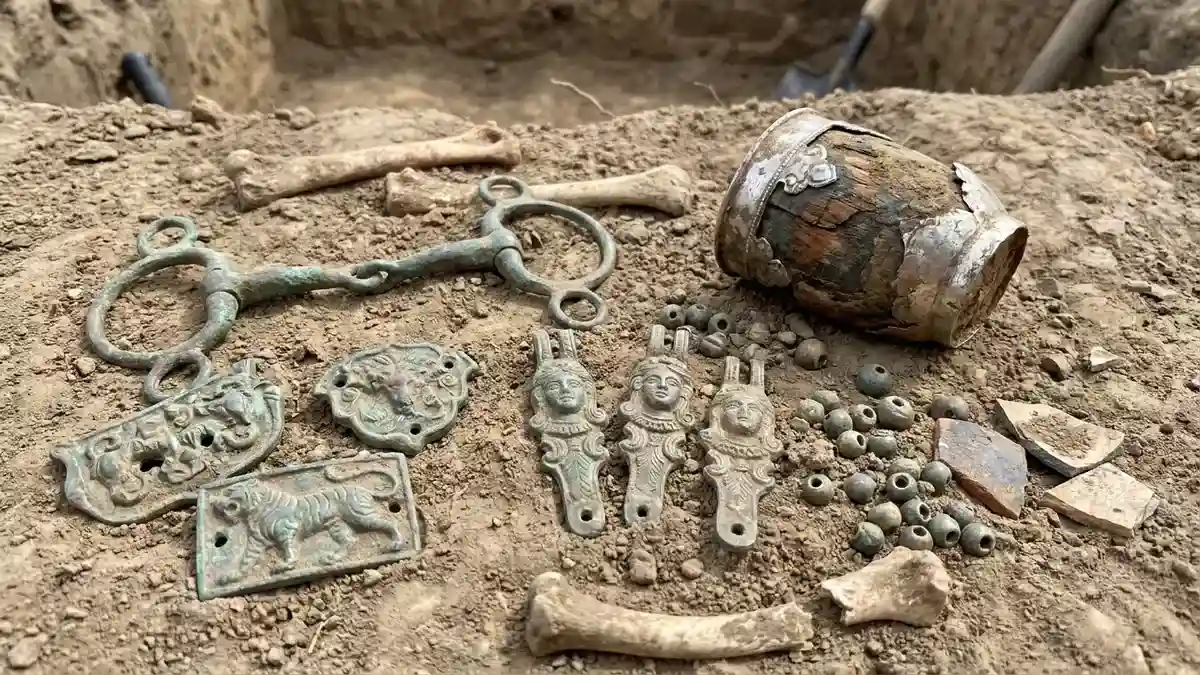
The Eastern Sector: Yielded scattered iron horse bits, decorative metal cheekpieces, an elite horse browband featuring a unique hooked terminal, a masterfully crafted silver fitting from a ceremonial wooden vessel, and a stunning gold plaque depicting a tiger’s head and forepaw.
The Western Sector: Discovered fragments of a massive bronze sacrificial cauldron, a beautifully cast bronze pouring ladle, and dozens of individual horse harness components.
Inside the Central Sacrificial Pit
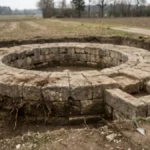
The crown jewel of the entire excavation was an intact, shallow circular pit located near the royal mound. This sacred repository contained an unparalleled hoard of over 100 horse-harness components and hundreds of individual ritual ornaments, highlighting the immense spiritual and economic value placed on the horse in nomadic society.
                  [Central Royal Mound 1]
                             │
            ┌────────────────┴────────────────┐
            ▼                                 ▼
[Scattered Topsoil Finds]           [Intact Circular Pit Hoard]
• Gold tiger plaque                 • 100+ Complete bridle sets
• Silver vessel fittings            • 500+ Miniature bronze beads
• Bronze cauldron fragments         • 17 Rare bronze plate browbands
• Iron bits & cheekpieces           • Unique human-faced strap dividers
The pit contained complete, pristine sets of bridles, iron bits, finely carved horn cheekpieces, and over 500 miniature bronze beads. Among the most spectacular individual items recovered were 17 rare bronze plate browbands, 30 openwork plaques, and an array of decorative round plates stamped with dot patterns, wild birds, mythological beasts, and traditional swastika motifs.
Most notably, the hoard yielded unique cast-bronze strap dividers shaped explicitly in the likeness of human faces—an incredibly rare stylistic choice for the region—alongside a sacred wooden ritual bowl wrapped in heavy silver mounts.
Global Steppe Networks: A Melting Pot of Styles
While a significant portion of the recovered gear perfectly matches the locally known “animal-style” art of the Southern Urals dating to the 4th and early 3rd centuries BCE, many pieces were entirely foreign to the region.
Several of the bronze ornaments, shield-shaped plaques, and weapon fittings display undeniable stylistic parallels to artifacts recovered thousands of miles away in the North Caucasus, the Don River Basin, and the Northern Black Sea coast. This rich blend of familiar and exotic luxury goods proves that the nomadic elites of the Urals were not isolated steppe herders. Instead, they sat at the very center of a sophisticated, highly efficient intercontinental trade network that linked the frontiers of Europe, the Mediterranean world, and deep Asia.
| Artifact Class | Artistic / Regional Style | Cultural Significance |
| Tiger Plaque & Horn Gear | Local Ural “Animal-Style” | Reflects traditional indigenous steppe mythology and hunting culture. |
| Human-Faced Dividers | Western Steppe / Don Basin Influence | Demonstrates direct trade or marital alliances with distant western tribes. |
| Silver-Mounted Bowls | Filippovka Elite Culture | Marks the grave as belonging to a supreme chieftain or powerful shaman. |
| Cauldron & Ladle | Inter-Regional Ceremonial | Used to brew communal ritual beverages during post-burial feasts. |
Post-Burial Feasts and Living Memory
The discovery of shattered, handmade ceramic vessels, charred animal remains (specifically wild boar jaws), and the silver-mounted wooden bowl points directly to complex, multi-stage post-burial rituals.
Nomadic tribes regularly returned to the monumental mounds of their fallen leaders to conduct ancestor-worship ceremonies, sacrifice high-value warhorses, and hold grand communal feasts. The broken pottery and animal bones indicate that these gatherings took place directly on top of and around the sealed tombs, reinforcing the social status and political legitimacy of the surviving elite family lines.
While small-scale sacrificial deposits have been recorded at other famous elite Filippovka-type mounds, this newly exposed site stands entirely alone due to its sheer scale, thematic diversity, and the unprecedented volume of precious international imports.
Conclusion: Mounds as Living Sacred Centers
The completion of the 2025 field season at Vysokaya Mogila fundamentally alters how historians interpret ancient nomadic architecture. These massive earthworks were far more than simple, solitary graves designed to hide a corpse away in the earth. Instead, they functioned as vibrant, living open-air cathedrals and political centers. By shifting their focus to the expansive spaces between the mounds, archaeologists are finally unlocking the true complexity of the rituals, trade alliances, and spiritual beliefs that united the ancient masters of the Eurasian steppe.
Frequently Asked Questions
Where exactly was this nomadic complex discovered?
The complex was discovered in the Orenburg region of Russia, located within the Southern Urals. The excavations took place at a renowned ancient cemetery site known as the Vysokaya Mogila–Studenikin Mar necropolis.
Who built these massive burial mounds?
The mounds were constructed by early nomadic pastoralist societies—frequently associated with the broader Scythian and Sarmatian cultural horizons—who dominated the vast grasslands of Eurasia during the Iron Age.
What was the significance of horses in these rituals?
To steppe nomads, horses were the absolute bedrock of daily life, warfare, and wealth. Sacrificing high-value horses and burying complete sets of elaborately decorated bridles, bits, and gold or bronze harness ornaments near a chieftain’s grave was the ultimate display of respect, wealth, and spiritual devotion.
How do the artifacts prove ancient international trade?
While many items feature local Ural designs, numerous plaques, browbands, and strap dividers match styles native to the North Caucasus and the Black Sea region. This proves that these nomadic elites maintained far-reaching commercial, political, and cultural trade routes spanning thousands of miles across Europe and Asia.
What happened at the mounds after the initial burial?
The mounds served as long-term ceremonial hubs. Long after a leader was buried, the tribe would routinely return to the site to hold grand memorial feasts, sacrifice animals, break pottery, and bury new hoards of luxury goods to honor their ancestors and reinforce tribal unity.