
Table of Contents
**Ancient Canarian Farmers Used Stone Tools for Cereal Harvesting 1,000 Years Ago**
Archaeologists have uncovered the earliest direct proof of cereal harvesting by the Indigenous people of the Canary Islands, revealing sophisticated farming practices long before European contact. This exciting discovery from a cave complex on Gran Canaria sheds new light on the daily lives, agricultural skills, and cultural traditions of ancient Canarian communities.
The findings challenge previous assumptions about pre-conquest island societies and highlight how these Amazigh-descended populations adapted to their volcanic environment through clever resource use and innovative tool-making.
Ancient Canarian Farmers Used Stone Tools for Cereal Harvesting 1,000 Years Ago
### The Significant Discovery at Roque Bentayga
Researchers focused their efforts on cave complex C008 at Bentayga, a major archaeological site on the southern slopes of Roque Bentayga in Tejeda, Gran Canaria. This volcanic monolith rises dramatically to 1,414 meters above sea level and served as a central hub for the island’s original inhabitants.
The caves, carved into soft volcanic tuff, functioned first as granaries between the 10th and 13th centuries CE. Later, during the 12th and 13th centuries, parts of the complex were repurposed as collective burial spaces. Radiocarbon dating confirms this timeline, offering a clear view of how the same location served evolving community needs over several centuries.
Dry, stable conditions inside the caves preserved a remarkable array of organic materials. Archaeologists recovered barley ears, seeds, reed mats, leather fragments, wood pieces, and even delicate animal tissues. This exceptional preservation allowed scientists to connect stone tools directly with their intended uses.
### Advanced Stone Tool Analysis Reveals Harvesting Techniques
The team examined 218 stone artifacts from the site, selecting 46 for in-depth functional analysis. Using high-powered microscopes with up to 400x magnification and ultrasonic cleaning methods, researchers identified wear patterns despite the challenges of working with rough volcanic rocks like basalt, trachyte, and obsidian.
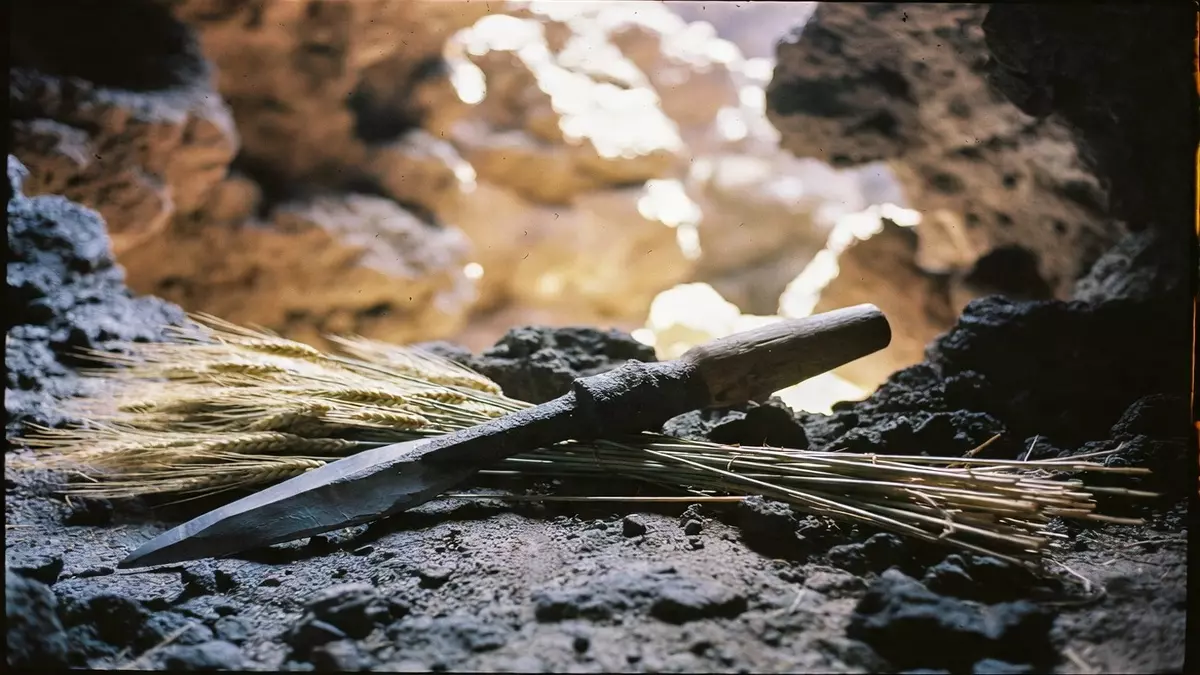
A small basalt blade emerged as the star find. Its edge displayed a distinctive bright sheen and fine parallel scratches—classic microscopic signatures of repeated cutting through silica-rich cereal stems. This represents the first physical evidence of dedicated cereal harvesting tools in the pre-European archaeology of the Canary Islands.
Until now, knowledge of ancient Canarian agriculture relied heavily on indirect clues such as crop remains, weed seeds, and later European historical accounts. Some written descriptions suggested that Indigenous people simply pulled grain heads by hand, leaving stalks standing. The new tool evidence paints a more complete and technologically advanced picture.
**Key Artifacts and Their Uses:**
– Basalt blade with cereal harvesting wear traces
– Stone picks and scrapers used for cave maintenance
– Tools linked to crop processing and food preparation
– Obsidian flakes showing meat processing signatures
Bundles of barley stems found in the caves showed clean cut marks on their upper sections, confirming that people used sharp tools—likely similar to small sickles—to separate grain from stalks efficiently.
### Life in the Bentayga Cave Complex: From Storage to Burial
The C008 complex consisted of multiple artificial chambers. Initially designed for food storage, the caves also hosted on-site grain processing activities. Large stone tools bore marks from striking and scraping volcanic rock, indicating they helped shape and maintain the cave walls over time.
This multi-purpose use demonstrates practical resource management. Ancient Canarians maximized limited spaces in their rugged, mountainous terrain. The granaries protected vital food supplies from pests and weather fluctuations, crucial for survival on an isolated island.
In later phases, the complex took on a sacred role. Archaeologists found adult and perinatal human remains in a central chamber. Bodies were carefully wrapped in plant fiber shrouds and leather, consistent with Indigenous Gran Canarian burial practices. Stone flakes near the burials showed wear from scraping dry hide and cutting reeds, likely used to prepare these wrappings during funerary rituals rather than as grave offerings.
An obsidian tool with traces of meat processing suggests that food preparation or storage of preserved meats also occurred within the complex, blending practical and ceremonial functions in one location.
### Cultural and Historical Context of Ancient Canarians
The Indigenous people of Gran Canaria were of Amazigh (Berber) origin from North Africa. They developed a rich society adapted to the Canary Islands’ unique volcanic landscapes long before the Castilian conquest in the 15th century.
Roque Bentayga held special importance, with over 100 caves carved into its slopes serving residential, storage, and ritual purposes. At 1,100 meters above sea level, the C008 complex offered protection and favorable conditions for preserving organic materials that rarely survive elsewhere.
Cereal agriculture, particularly barley, formed a cornerstone of their economy. The ability to harvest, process, and store grains effectively supported population growth and social organization. This new evidence of systematic harvesting tools indicates a level of agricultural sophistication previously underappreciated in Canary Island archaeology.
The shift from granary to burial site reflects changing community needs and possibly responses to environmental or social pressures. Such adaptive reuse of sacred or functional spaces was common among ancient societies facing limited resources.
### Why Use-Wear Analysis Matters in Volcanic Regions
Studying wear patterns on stone tools—known as use-wear analysis—has proven especially valuable here. Volcanic rocks dominate the Canary Islands, making traditional flint-based methods less applicable. The research team’s success despite rough surfaces opens new doors for similar studies across other volcanic archaeological regions worldwide.
This methodological advancement strengthens the reliability of the findings. By combining microscopic analysis with well-preserved organic remains, researchers created a robust chain of evidence linking tools directly to specific activities like cereal harvesting.
### Implications for Understanding Pre-Conquest Canary Island Society
This discovery enriches our knowledge of daily life among ancient Canarians. It shows they employed a varied harvesting system that included cutting tools rather than relying solely on manual methods. Such innovations would have improved efficiency and reduced labor during critical harvest seasons.
The findings also emphasize the caves’ central role in both economic and spiritual life. Food security and proper burial practices were clearly intertwined, reflecting a holistic worldview where practical survival and cultural beliefs supported each other.
As one of the most isolated populations in the medieval world, the ancient Canarians developed unique solutions to environmental challenges. Their stone tool technologies, adapted to local materials, demonstrate ingenuity and deep environmental knowledge passed down through generations.
### Broader Significance for Archaeology and Heritage
The study, published in the *Journal of Archaeological Science: Reports*, highlights the ongoing importance of cave sites in revealing hidden aspects of the past. Exceptional preservation conditions like those at Bentayga are rare treasures for researchers.
These insights arrive at a time of growing interest in Indigenous histories and pre-colonial societies. By focusing on scientific analysis rather than solely historical texts, archaeologists are giving voice to communities whose stories were often marginalized after European arrival.
Future research may explore similar cave complexes across Gran Canaria and other islands to map the spread of these harvesting techniques and burial customs. Genetic and isotopic studies could further illuminate the diets and movements of these ancient populations.
### Conclusion: A Deeper Look at Ancient Canarian Resilience
The earliest evidence of cereal harvesting tools from Gran Canaria offers a fascinating window into the sophisticated world of the Canary Islands’ Indigenous inhabitants. These ancient farmers skillfully worked with volcanic stone to secure their food supply, maintain their living spaces, and honor their dead—all within the same remarkable cave complex.
This discovery not only pushes back the timeline of confirmed harvesting technology but also humanizes the people who thrived in a challenging island environment for centuries. Their story of adaptation, innovation, and cultural continuity deserves recognition as an important chapter in human history.
As archaeologists continue to explore sites like Roque Bentayga, we gain greater appreciation for the resilience and creativity of pre-conquest Canarian society. These findings remind us that even in relative isolation, human communities developed remarkable solutions to meet their needs and express their values.
The preserved barley stems and carefully crafted basalt blades stand as powerful connections to the past, inviting us to reflect on the universal human drive to cultivate, create, and remember.
### FAQ: Questions About Ancient Canarian Cereal Harvesting Discovery
**What makes this finding the earliest evidence of cereal harvesting in the Canary Islands?**
The basalt blade with microscopic wear traces from cutting cereal stems provides the first direct physical proof. Previous knowledge relied on indirect evidence or later historical accounts dating to the 10th-13th centuries CE.
**Where was the discovery made and why is the location important?**
Archaeologists found the tools and plant remains in cave complex C008 at Roque Bentayga on Gran Canaria. The high-altitude, dry volcanic caves offered ideal preservation conditions and held cultural significance for Indigenous communities.
**How did ancient Canarians harvest cereals?**
They used stone blades to make clean cuts on barley stems, as shown by both tool wear patterns and actual plant remains. This method was more efficient than simply pulling heads by hand, indicating organized agricultural practices.
**What other activities took place in the Bentayga caves?**
The complex served as a granary for storage and processing, a workspace for tool maintenance and food preparation, and later as a collective burial site with carefully wrapped remains.
**Why is studying volcanic stone tools challenging?**
Volcanic rocks like basalt and obsidian have rough surfaces that hide microscopic wear traces compared to smoother materials like flint. Advanced microscopic and cleaning techniques were required for accurate analysis.
**How does this discovery change our view of pre-conquest Canarian society?**
It demonstrates greater technological sophistication in agriculture and multi-functional use of spaces than previously understood, highlighting the ingenuity of Amazigh-descended communities before the Castilian conquest.
**What materials were preserved that helped confirm the findings?**
Exceptional preservation included barley stems with cut marks, reed mats, leather, and other organics, allowing direct correlation between tools and their specific uses.