
Table of Contents
**2,000-Year-Old Bullet Taunts Foes with Greek Warning**
Archaeologists have uncovered a remarkable piece of ancient psychological warfare: a 2,000-year-old lead sling bullet inscribed with a sharp Greek message that essentially tells enemies, “Learn your lesson.”
This small but powerful artifact, found at the historic city of Hippos overlooking Israel’s Sea of Galilee, offers a rare personal glimpse into the conflicts that shaped the Hellenistic and Roman Near East. The discovery highlights how soldiers used wit and defiance alongside brute force on ancient battlefields.
2,000-Year-Old Bullet Taunts Foes with Greek Warning

### The Discovery at Hippos: A Window into Hellenistic Warfare
During 2025 fieldwork near a riverbed close to an ancient necropolis, researchers from the University of Haifa recovered the inscribed projectile. Hippos, a prominent member of the Decapolis league, sat strategically on a hilltop with commanding views over key trade and military routes east of the Sea of Galilee.
The city’s history reflects centuries of power struggles. After Alexander the Great’s conquests, his successors established Hellenistic settlements across the region. Hippos changed hands between Ptolemaic and Seleucid forces, notably after the Battle of Paneion around 199 BCE. Later Roman administration further strengthened its importance.

This sling bullet emerged amid 26 years of systematic excavations that have already yielded dozens of similar artifacts, painting a vivid picture of repeated military activity in the area.
### Inside the Artifact: Design, Damage, and Deadly Purpose
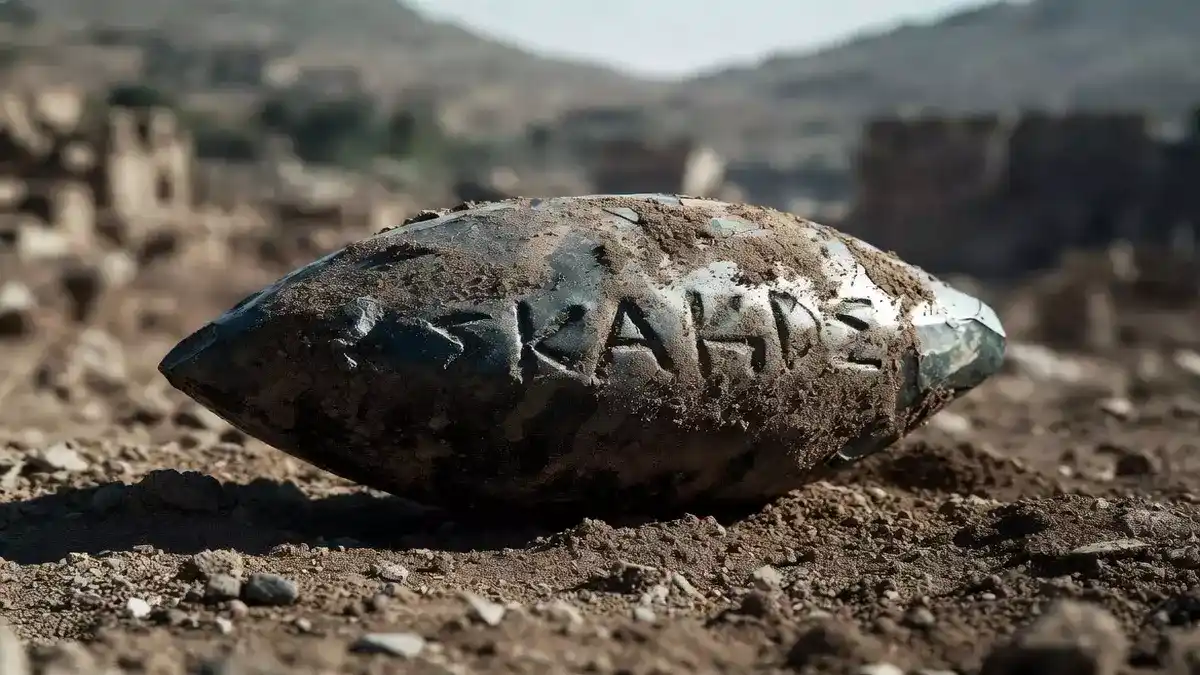
Measuring just over one inch (about 3.2 centimeters) long and weighing roughly 45 grams, the almond-shaped lead bullet represents standard Hellenistic military ammunition. Craftsmen created these projectiles by pouring molten lead into molds, allowing rapid production during times of conflict.

One side shows clear impact damage, suggesting it struck its target at high speed. A trained slinger could hurl these bullets up to 300 meters, delivering devastating force capable of piercing armor or causing fatal injuries. The weapon system was inexpensive, portable, and highly effective—qualities that made slingers valuable assets in ancient armies.
What sets this particular bullet apart is the inscription carefully engraved on its surface before firing.
### Decoding the Message: “ΜΑΘΟΥ” – Learn Your Lesson
The Greek letters ΜΑΘΟΥ appear prominently on the artifact. Scholars connect this to the verb *mathaíno*, meaning “to learn.” In context, the grammatical form creates an imperative that translates roughly as “Learn!” or more naturally, “Learn your lesson.”
Lead researcher Michael Eisenberg from the University of Haifa describes the inscription as a sarcastic taunt aimed at opposing forces. Rather than a simple identification mark, it carried psychological weight—mocking enemies in the heat of battle. This type of provocative messaging fits broader patterns found on ancient ammunition across the Levant.
The phrasing uses a sophisticated middle voice construction in Greek, blending action and consequence in a single pointed expression. This linguistic nuance adds intensity, making the warning feel both personal and inevitable.
### Psychological Warfare in the Ancient World
Ancient warriors frequently used inscriptions and symbols to intimidate opponents. Many sling bullets from the region feature scorpions, lightning bolts, or references to gods and commanders. Other examples bear short aggressive phrases like “Take a taste” or “Receive this.”
At Hippos alone, archaeologists have recovered 69 sling bullets. Most date to the second century BCE, a period of significant regional instability. The new inscribed example stands out for its direct, conversational tone and unusual grammatical structure, offering fresh insight into the mindset of defenders protecting their city.
These messages served multiple purposes: boosting morale among friendly troops, demoralizing enemies, and creating memorable battlefield moments that could be retold later. In an era before modern propaganda, such small details humanized the otherwise brutal reality of ancient combat.
### Historical Context: Hippos and the Decapolis
Hippos thrived as part of the Decapolis, a network of ten cities that blended Greek culture with local traditions under Roman oversight. Its elevated position provided both defensive advantages and control over surrounding agricultural lands and trade routes.
The area witnessed shifting control between major Hellenistic powers. Ptolemaic Egypt initially fortified the site, but Seleucid forces from Syria eventually seized it. These transitions often involved sieges and open battles where sling bullets would have flown in large numbers.
The discovery near a necropolis and riverbed suggests the bullet may relate to a specific defensive action. While pinpointing the exact conflict remains challenging, it aligns with known periods of tension in the late Hellenistic era.
### Why This Find Matters for Understanding Ancient Conflict
Most archaeological evidence of ancient warfare comes from large-scale remains like fortifications, destroyed buildings, or mass weapon caches. The Hippos sling bullet provides something rarer: a direct voice from the battlefield, preserved in a single small object fired nearly two millennia ago.
It demonstrates that even common soldiers or their commanders engaged in creative expression during war. The sarcastic tone reveals confidence, defiance, and perhaps a touch of dark humor—qualities that resonate across cultures and time periods.
This artifact also enriches our knowledge of lead sling bullet technology. While often overlooked compared to swords or spears, these projectiles played crucial roles in many historical conflicts, from Greek city-states to Roman campaigns.
### Broader Implications for Hellenistic and Roman Studies
The find contributes to ongoing research into the Decapolis cities and their role in the cultural transformation of the Near East. As Greek language and customs spread following Alexander’s conquests, local populations adapted them in unique ways—including on everyday military equipment.
The bullet’s sophisticated Greek inscription suggests educated individuals were involved in its creation, or at least that such phrases were commonly understood among troops. This points to higher levels of literacy and cultural fluency than might be expected in frontline combat units.
Future studies may compare this example with similar inscribed projectiles from other sites in Israel, Jordan, and Syria to map patterns of psychological tactics across different armies and eras.
### Modern Techniques Reveal Ancient Secrets
Advanced archaeological methods, including careful metal detector surveys and detailed linguistic analysis, made this discovery possible. Modern scholars can now extract far more information from small artifacts than previous generations could.
The publication of the findings in the journal *Palestine Exploration Quarterly* ensures that researchers worldwide can examine the evidence and build upon it. Such collaborative efforts continue to reshape our understanding of life in the ancient world.
### Conclusion: A Timeless Message from the Battlefield
The 2,000-year-old sling bullet from Hippos captures a fleeting but powerful moment in history. Its taunting Greek inscription transforms a simple weapon into a vessel of human emotion—defiance, wit, and warning all rolled into one small piece of lead.
In an age of advanced technology and remote warfare, this artifact reminds us that the fundamentals of conflict—strategy, psychology, and resilience—have remained remarkably consistent through the centuries. The defenders of ancient Hippos used every tool at their disposal, including words, to protect their homes and assert their strength.
This discovery adds vibrant color to our picture of Hellenistic life around the Sea of Galilee. It shows that even in violence, people found ways to express personality and cultural identity. As archaeologists continue uncovering more artifacts, we gain deeper appreciation for the complex societies that once flourished in this historically rich region.
The small lead bullet with its enduring message stands as a fascinating bridge between past and present, inviting us to reflect on how humans have faced adversity—and communicated with their enemies—across thousands of years.
### FAQ: Questions About the Hippos Sling Bullet Discovery
**What does the Greek inscription actually mean?**
The letters ΜΑΘΟΥ translate to an imperative form of “to learn,” best interpreted as “Learn your lesson!” It was likely intended as a mocking taunt toward enemy forces.
**How old is the sling bullet and where was it found?**
The artifact dates to approximately 2,000 years ago (second century BCE) and was discovered during 2025 excavations at Hippos, an ancient Decapolis city overlooking the Sea of Galilee in the Golan Heights.
**What made sling bullets effective weapons in ancient times?**
Lead projectiles were cheap to produce, easy to carry in large quantities, and could be launched up to 300 meters by skilled slingers. They delivered high-impact force capable of causing serious injury or death.
**Have similar inscribed sling bullets been found before?**
Yes. Many examples from the Levant feature symbols or short aggressive phrases. However, the Hippos bullet stands out for its sophisticated grammar and clear sarcastic tone.
**Why is this discovery significant for historians?**
It provides rare direct evidence of psychological warfare and personal expression during ancient battles. The artifact humanizes military history and offers new insights into Hellenistic culture and language use in the Decapolis region.
**Who published the research and where?**
Michael Eisenberg from the University of Haifa led the study, published in *Palestine Exploration Quarterly* in 2026. The full analysis includes detailed linguistic and archaeological context.
This compelling find continues to spark interest among history enthusiasts and scholars alike, shedding fresh light on daily realities of ancient warfare in one of the world’s most historically significant areas.