
Table of Contents
- 1. Redefining Ice Age Survival in the Caucasus
- 2. Obsidian Trails and Shared Tool Technologies
- 2.1. The Uniformity of Prehistoric Knapping
- 3. Challenging the “Rapid Replacement” Narrative
- 4. Why Social Networks Mattered More Than Climate
- 5. Reconstructing Daily Life Beyond the Fossil Record
- 6. Frequently Asked Questions
- 6.1. How long did ancient hunter-gatherers survive in the southern Caucasus region?
- 6.2. How do scientists know these ancient groups were connected over long distances?
- 6.3. What countries make up the region focused on in this study?
- 6.4. Does this study change what we know about early human cultural transitions?
- 6.5. Why was a large social network crucial for a small population’s survival?
Ancient Social Networks Allowed Early Humans to Survive for Millennia
Long before the invention of agriculture, cities, or written languages, early human survival relied entirely on small, nomadic bands of hunter-gatherers. For decades, scientists believed that these isolated groups were largely at the mercy of their immediate environments—thriving when nature was kind and perishing when extreme climate shifts isolated them from resources.
However, a groundbreaking study examining prehistoric life in the southern Caucasus region has turned this view upside down. By looking past traditional climate models, researchers discovered that ancient hunter-gatherers survived dramatic environmental volatility for an astonishing 30,000 years because they maintained highly active, long-distance social networks. These early communication highways allowed small, far-flung communities to share life-saving technology, survival skills, and cultural traditions across hundreds of miles.
Ancient Social Networks Allowed Early Humans to Survive for Millennia
Redefining Ice Age Survival in the Caucasus
The comprehensive study, published in the scientific journal Quaternary Science Reviews, deeply investigates human population dynamics in the southern Caucasus—a geographically diverse zone encompassing modern-day Armenia, Georgia, and surrounding highland territories. Historically, this region has been recognized as a vital migratory corridor connecting early human populations traveling between Europe and Asia.
The international research team concentrated on a critical 30,000-year window spanning from 57,000 to 27,000 years ago. This era is historically significant because it encompasses the turbulent transition from the Middle Paleolithic (Middle Stone Age) to the Upper Paleolithic (Late Stone Age).
By synthesizing data from numerous archaeological excavations, local geological records, and paleoclimate reconstructions, the study looked to solve a fundamental riddle: How did such small, scattered populations manage to endure millennia of severe environmental shifts without dying out?

Obsidian Trails and Shared Tool Technologies
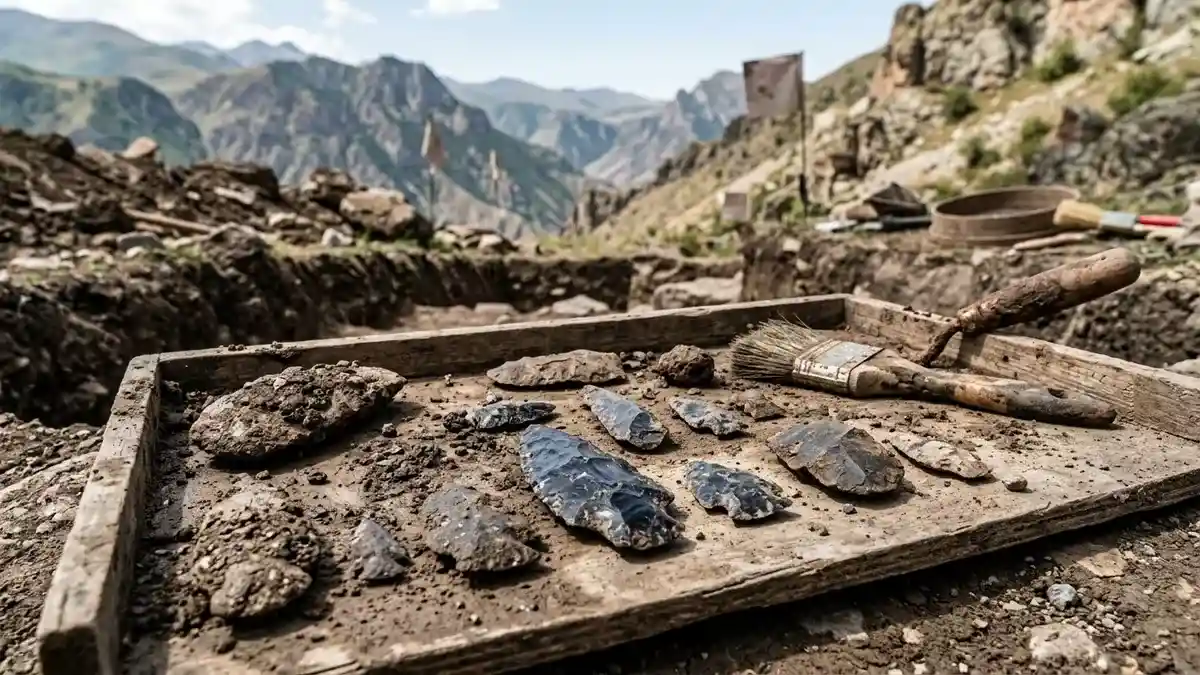
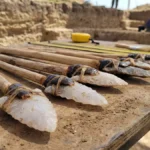
The most compelling proof of this ancient social network was left behind in the stone tools and raw materials recovered from various archaeological sites. Hunter-gatherers in the Armenian Highlands and the broader southern Caucasus were master craftsmen, relying heavily on specialized stone-tool production techniques to manufacture spears, scrapers, and cutting blades.
When researchers analyzed the chemical composition of these artifacts, particularly those made from volcanic glass known as obsidian, they noticed a striking pattern. The raw materials used to make tools at specific base camps frequently originated from geological sources located anywhere from 40 to 200 kilometers (approximately 25 to 125 miles) away.
These substantial distances tell us two important things about prehistoric life:

High Regional Mobility: Hunter-gatherers were not confined to small, localized territories. They regularly traversed rugged mountain ranges and vast valleys to secure premium materials.
Active Inter-Group Contact: Rather than wandering aimlessly through empty terrain, these treks intentionally linked distinct bands of humans, facilitating regular trade and interaction between different communities.
The Uniformity of Prehistoric Knapping
Even more surprising than the physical trade of obsidian was the uniformity of the tool-making techniques themselves. Despite being separated by vast distances and formidable geographic barriers, scattered communities across the southern Caucasus utilized identical methods to shape the working edges of their stone tools.
This technological synchronization could not have happened by chance. It provides definitive proof of a continuous, sophisticated exchange of knowledge. Prehistoric groups were actively teaching, learning, and passing down specific crafting traditions across an extensive regional network.
Challenging the “Rapid Replacement” Narrative
The discoveries in the southern Caucasus fundamentally challenge a long-held milestone in human prehistory. For generations, the transition from the Middle Paleolithic to the Upper Paleolithic was described by textbooks as a rapid, clean-cut cultural shift. The old narrative suggested that a newer, technologically superior population swept through Eurasia, instantly replacing the older cultures and technologies.
The data gathered in this study tells a far slower, more nuanced story:
| Evolutionary Concept | Old Narrative | New Scientific Evidence |
| Transition Speed | Rapid, abrupt cultural shift | Slow, gradual evolution across millennia |
| Population Dynamics | Sudden replacement of older groups | Prolonged co-existence of diverse cultures |
| Inter-Group Relations | Hostile competition or isolation | Continuous interaction and knowledge exchange |
Rather than a sudden displacement event, the archaeological record demonstrates that differing stone-tool traditions and cultural practices existed side by side for thousands of years. Distinct human bands were living in close proximity, interacting frequently, sharing technical innovations, and gradually influencing one another’s cultural trajectories over generational timeframes.
Why Social Networks Mattered More Than Climate
While changing climates and shifting landscapes undoubtedly influenced where hunter-gatherers moved, the study argues that physical mobility alone cannot explain how these populations survived the brutal challenges of the Ice Age. The secret weapon of these ancient communities was their social infrastructure.
Because the total human population across the southern Caucasus was incredibly small and dispersed, individual bands were highly vulnerable to local crises. A severe drought, a localized disease outbreak, or a sudden shift in migratory game patterns could easily push an isolated group to the brink of starvation.
By maintaining active lines of communication across a vast territorial matrix, these small groups built a collective safety net. If a group in modern-day Armenia hit a period of localized hardship, their social ties gave them access to the territories, resources, and ecological knowledge of neighboring groups in modern-day Georgia. Furthermore, sharing successful survival strategies—such as optimized hunting methods or superior tool designs—helped distribute adaptive advantages across the entire network, ensuring that useful innovations were never lost to time.
Reconstructing Daily Life Beyond the Fossil Record
This research highlights a profound shift in modern archaeology. Traditionally, our understanding of prehistoric humans relied almost entirely on discovering rare, fossilized human bones. However, by shifting the focus to how artifacts move across a landscape and how technologies harmonize regionally, scientists can now map out the social realities of people who left no skeletal remains behind.
The southern Caucasus serves as a powerful reminder that prehistoric survival was a complex equation. It depended on an intricate balance of climate conditions, physical landscape navigation, group sizes, and social contact working in unison. The true hallmark of early human resilience was not just our ability to adapt physically to cold climates, but our unique capacity to build invisible, enduring networks of cooperation that spanned across thousands of miles and tens of thousands of years.
Frequently Asked Questions
How long did ancient hunter-gatherers survive in the southern Caucasus region?
Based on the archaeological and environmental evidence analyzed in the study, prehistoric hunter-gatherer communities successfully occupied and navigated the southern Caucasus region for at least 30,000 years, specifically between 57,000 and 27,000 years ago.
How do scientists know these ancient groups were connected over long distances?
Scientists traced these ancient connections by studying stone tools and volcanic obsidian artifacts. They discovered that raw materials were regularly transported across distances ranging from 40 to 200 kilometers. Additionally, different groups across the region used the exact same complex tool-making techniques, proving they actively shared skills and information.
What countries make up the region focused on in this study?
The research focused primarily on the southern Caucasus and the adjacent Armenian Highlands, a highly diverse geographic territory that covers present-day Armenia, Georgia, and their surrounding border zones.
Does this study change what we know about early human cultural transitions?
Yes. It completely challenges the traditional view that the transition from the Middle Paleolithic to the Upper Paleolithic was a fast, aggressive replacement of one culture by another. Instead, the evidence shows a slower, gentler process where different human groups and tool-making traditions coexisted, mingled, and shared ideas for thousands of years.
Why was a large social network crucial for a small population’s survival?
Because early human populations were small and scattered, individual groups were highly vulnerable to localized environmental disasters or food shortages. Having a large, interconnected social network allowed them to share crucial survival strategies, trade better tool materials, and seek refuge or resources from neighboring groups during times of crisis.