
Table of Contents
- 1. Beyond Raiders: The Industrial Scale of Viking Manufacturing
- 2. Inside the Søften Complex: The Architecture of Medieval Industry
- 2.1. Pit Houses: The Subterranean Workshops of Medieval Weavers
- 2.2. The Management Class: Overseeing the Assembly Line
- 3. From Plant to Sailcloth: The Intricate Process of Linen Production
- 4. Feeding the Market: Connecting Søften to the Commercial Empire of Aros
- 4.1. Artifacts of Abundance and International Commerce
- 5. A Growing Puzzle: The Interconnected Communities of Ancient Jutland
- 6. Modern Science Unlocking Ancient Threads
- 7. Frequently Asked Questions
- 7.1. What exactly was discovered near Aarhus, Denmark?
- 7.2. Why is the Søften site different from a normal Viking village?
- 7.3. What are pit houses, and how were they used at this site?
- 7.4. How did this manufacturing hub connect to the wider Viking world?
- 7.5. What kinds of artifacts have been recovered from the excavation?
1,000-Year-Old Viking Textile Center Stuns Archaeologists Today
When most people picture the Viking Age, they imagine fierce warriors, formidable longships, and daring raids across the stormy seas of Europe. However, a groundbreaking archaeological discovery in Denmark is shifting the narrative from seafaring raiders to sophisticated industrial entrepreneurs.
Deep in the soil of eastern Jutland, researchers have uncovered a massive, highly organized manufacturing hub that operated more than a millennium ago. Rather than a traditional agrarian village where families farmed simply to feed themselves, this sprawling settlement was constructed with a singular, highly focused purpose: the mass production of textiles and high-value trade commodities.
This unexpected commercial complex provides an unprecedented look into the economic engine that powered the Viking world, revealing a level of centralized planning and industrial scale that historians are only beginning to fully appreciate.
 Advanced Geochemical Study Reveals Far-Reaching Bronze Age Metallurgy Networks in Sardinia
1,000-Year-Old Viking Textile Center Stuns Archaeologists Today
Beyond Raiders: The Industrial Scale of Viking Manufacturing
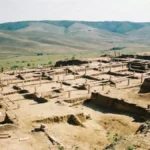
Located near the modern town of Søften, roughly 10 kilometers (about 6 miles) north of Aarhus, the newly exposed settlement covers an astonishing footprint of at least 100,000 square meters. The sheer scale of the site immediately alerted the excavation team from the Moesgaard Museum that they were not looking at a standard domestic hamlet.
During the Viking Age, the vast majority of people lived on self-sustaining farms. Settlements of this magnitude, entirely dedicated to specialized manual crafts, are incredibly rare in the archaeological record of Scandinavia. The evidence gathered so far paints a picture of a vibrant, highly focused industrial zone where weaving, spinning, and raw material processing took place on a near-unprecedented scale.
Inside the Søften Complex: The Architecture of Medieval Industry
The layout of the Søften site indicates that the entire community was planned from the ground up by a centralized authority. Rather than expanding organically over time, the settlement exhibits clear zoning laws of the early medieval world. Different sectors of the expansive site were meticulously assigned to distinct tasks, optimizing efficiency and workflow.
Pit Houses: The Subterranean Workshops of Medieval Weavers
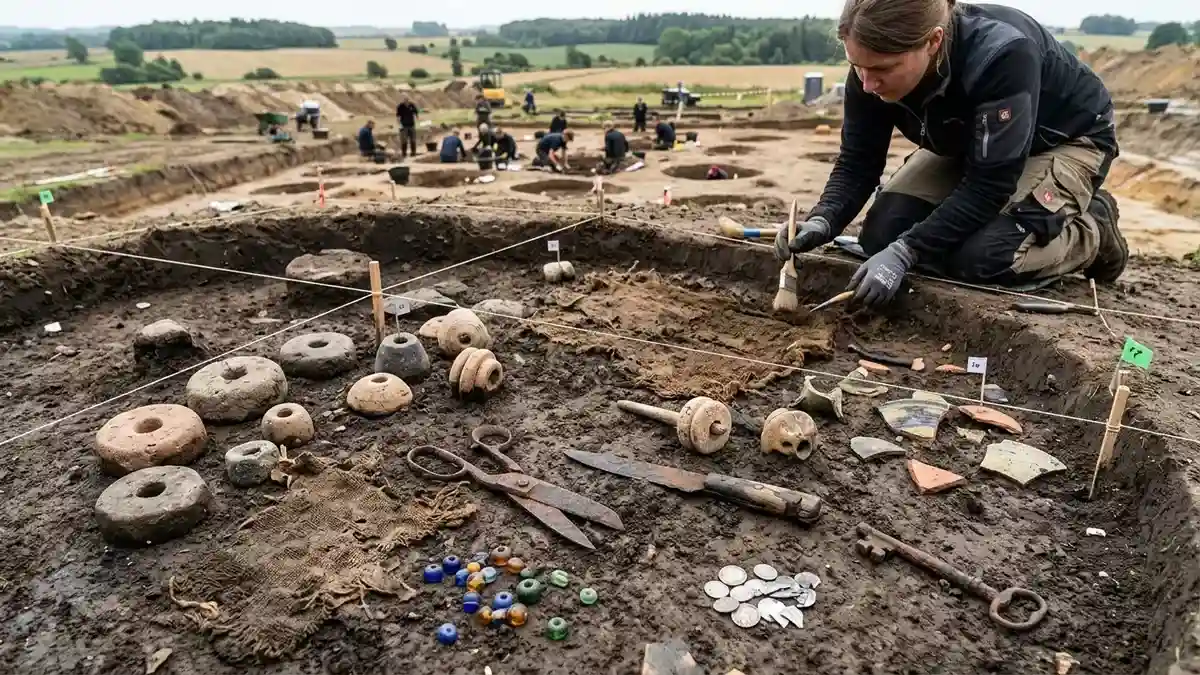
At the heart of this manufacturing hub are 82 excavated pit houses. These small, sunken structures were deliberately built partially underground, a design choice that offered excellent insulation against the biting Scandinavian winters while maintaining the ambient humidity levels required for textile work.
Inside these subterranean workshops, archaeologists discovered a wealth of ancient crafting tools, including:
Spindle Whorls: Heavy discs used to maintain the spin of hand spindles while turning raw fibers into thread.
Loom Weights: Heavy ceramic or stone objects used to keep the vertical threads of a warp-weighted loom taut during the weaving process.
The high concentration of these artifacts within the 82 workshops proves that cloth production was not a casual household chore at Søften; it was an intensive, assembly-line operation.
The Management Class: Overseeing the Assembly Line
Further proof of the site’s highly organized nature lies in a single, structurally distinct residence that stood entirely apart from the cluster of noisy, busy workshops. Archaeologists hypothesize that this prominent building served as the home and office of a site manager or overseer.
This supervisor would have been responsible for managing the steady influx of raw materials, coordinating the daily output of the laborers, and ensuring that finished goods met the strict standards required for regional trade. The presence of a dedicated administrative figure suggests a hierarchy and level of commercial oversight rarely documented in early medieval industrial sites.
From Plant to Sailcloth: The Intricate Process of Linen Production
While wool production was common across the Viking territory, the Søften site stands out for its specialized focus on a much more labor-intensive material: linen. Excavators identified a dedicated sector of the site specifically designed for the preparation and processing of flax, the plant from which linen is derived.
Turning raw flax plants into a soft, wearable, and highly durable textile is a complex multi-step process. It requires pulling the plants, soaking them in water to rot away the woody exterior (a process known as retting), drying them, and then beating and combing the remaining fibers until they can be spun into fine thread.
The presence of a dedicated flax-processing zone means the workers at Søften were managing the entire lifecycle of linen production, converting agricultural crops into valuable, export-ready cloth right on site. In the Viking world, linen was a luxury commodity used for high-end clothing and crucial components of ship sails, making this hub an invaluable asset to the regional economy.
Feeding the Market: Connecting Søften to the Commercial Empire of Aros
The massive volume of cloth produced at Søften far exceeded what the local population could ever consume. Historians argue that this site functioned as a vital cog in a much larger regional economic machine.
The finished textiles were overwhelmingly destined for Aros, the bustling Viking trading port that would eventually evolve into the modern city of Aarhus. During the Viking Age, Aros was rapidly transforming into one of Denmark’s premier commercial gateways, connecting local Nordic craftsmen with lucrative markets stretching across Northern Europe, the Baltic region, and beyond.
+------------------------------------------------------------+
|             THE SØFTEN-AROS SUPPLY CHAIN                   |
+------------------------------------------------------------+
|  1. Søften Production Hub: Mass-produces linen, textiles,  |
|     and handworked goods under strict management.          |
|                             │                              |
|                             ▼                              |
|  2. Regional Transport: Finished products move 10km south  |
|     via overland and river networks.                       |
|                             │                              |
|                             ▼                              |
|  3. Aros (Aarhus) Market: Goods enter international trade  |
|     routes, exchanged for foreign silver, beads, and coins.|
+------------------------------------------------------------+
Artifacts of Abundance and International Commerce
The economic prosperity of the Søften site is thoroughly backed by the physical treasures recovered during the ongoing dig. Workers have unearthed an impressive array of luxury items and currency that demonstrate the craftsmen were well-compensated for their labor. Among the notable discoveries are:
Silver Coins and Hacksilver: Cut-up fragments of silver foreign currency that were weighed out to pay for goods, serving as the standard currency of the Viking economy.
Glass Beads: Brightly colored, imported beads that were highly prized as status symbols and fashion accessories.
Foreign Pottery: Fragments of ceramic vessels that indicate trade connections reaching far beyond the borders of modern-day Denmark.
Iron Tools: Advanced X-ray imaging of the interior of the pit houses has revealed perfectly preserved iron knives, specialized crafting scissors, and keys, illustrating the high level of security and technology available to the inhabitants.
A Growing Puzzle: The Interconnected Communities of Ancient Jutland
The uncovering of the Søften complex is just the latest piece in an expanding archaeological puzzle. The current excavation phase, which kicked off in August 2025 and spans more than 60,000 square meters, expands upon earlier excavations conducted in 2008 and 2013 just to the south. Together, these digs reveal that the industrial landscape of the region was vast and deeply interconnected.
Furthermore, the site sits in close geographic proximity to other major historical power centers. Just four kilometers away lies the elite estate of Lisbjerg, an affluent settlement with undeniable ties to the aristocracy of Aros. Additionally, the discovery of the famous Elsted silver hoard in 2024 reinforces the reality that this specific corridor of eastern Jutland was overflowing with wealth, political power, and manufacturing prowess.
Modern Science Unlocking Ancient Threads
As the field season progresses, researchers are utilizing cutting-edge laboratory techniques to extract every drop of historical data from the site. Scientists are currently employing radiocarbon dating to narrow down the exact decades the complex was operational.
Simultaneously, advanced pollen studies are being conducted on the soil samples taken from the flax-processing zones. These botanical investigations will help identify the exact strains of plants cultivated by the Viking workers, mapping out the precise agricultural methods used to feed this massive medieval assembly line.
The emerging data from Søften completely reshapes our understanding of early medieval society. The Vikings were undeniably fierce warriors, but this groundbreaking discovery proves they were also master logisticians, capable of designing and operating highly sophisticated industrial centers that fueled international commerce long before the dawn of the modern factory.
Frequently Asked Questions
What exactly was discovered near Aarhus, Denmark?
Archaeologists from the Moesgaard Museum discovered a massive, 1,000-year-old Viking Age industrial production center near the town of Søften. Spanning at least 100,000 square meters, the site was uniquely dedicated to the large-scale manufacturing of textiles and other handworked goods, rather than standard farming.
Why is the Søften site different from a normal Viking village?
Most Viking settlements were small, self-sustaining agricultural communities. Søften stands out because it was a highly organized, master-planned industrial hub. It featured clear zoning for different crafts, a specialized area for processing flax into linen, 82 dedicated workshop buildings, and an isolated manager’s house to oversee production.
What are pit houses, and how were they used at this site?
Pit houses are small, traditional buildings constructed partially below ground level. The sunken design provided natural insulation and regulated humidity. At the Søften site, 82 of these structures were used exclusively as workshops, as evidenced by the large amounts of loom weights and spindle whorls found inside them.
How did this manufacturing hub connect to the wider Viking world?
The site was located just 10 kilometers north of Aros (modern-day Aarhus), which was one of the most prominent international trading hubs of the Viking Age. The massive quantities of linen and textiles produced at Søften were transported to Aros to be sold and distributed across major trade networks spanning Northern Europe.
What kinds of artifacts have been recovered from the excavation?
In addition to textile tools like spindle whorls and loom weights, archaeologists have found silver coins, pieces of cut silver (hacksilver), foreign pottery, and luxury glass beads. X-ray technology has also revealed iron keys, knives, and crafting scissors preserved within the subterranean workshops.