
Table of Contents
- 1. The Rising Sun and Srivatsa: Decoding the Ancient Motif
- 2. Fingerprinting the Mint: The Power of Die Studies
- 3. Mapping the Maritime Silk Road: Verified by Coins and Chronicles
- 4. A High-Tech Weapon Against Antiquities Trafficking
- 5. Conclusion: Elevating Southeast Asian Numismatics
- 6. Frequently Asked Questions
- 6.1. What are the “Rising Sun” coins?
- 6.2. What is a “die study” in archaeology?
- 6.3. How far did these ancient coins travel?
- 6.4. Why is this discovery important for Southeast Asian history?
- 6.5. How do die studies help stop the illegal antiquities trade?
Ancient Coins Rewrite the Scale of Early Southeast Asian Trade
Centuries before European merchants drafted early maritime charts of the Orient, a sophisticated, highly integrated economic network was already humming across Southeast Asia. For generations, traditional historical narratives portrayed the first-millennium kingdoms of the region as isolated, fractured tribal states that primarily functioned as passive transit stops for merchant ships traveling between the economic powerhouses of India and China.
However, a revolutionary archaeological study has completely dismantled this insular view. By conducting an unprecedented analysis of ancient silver currency dating as far back as the 4th century CE, researchers have exposed a vast, highly synchronized trade infrastructure stretching thousands of miles across national borders. Known as the “Rising Sun” coins, these tiny silver discs have emerged as undeniable proof that the early polities of Southeast Asia shared an advanced monetary and cultural system that operated on a scale rivalling the famous currency networks of the Roman Empire.
Ancient Coins Rewrite the Scale of Early Southeast Asian Trade

The Rising Sun and Srivatsa: Decoding the Ancient Motif
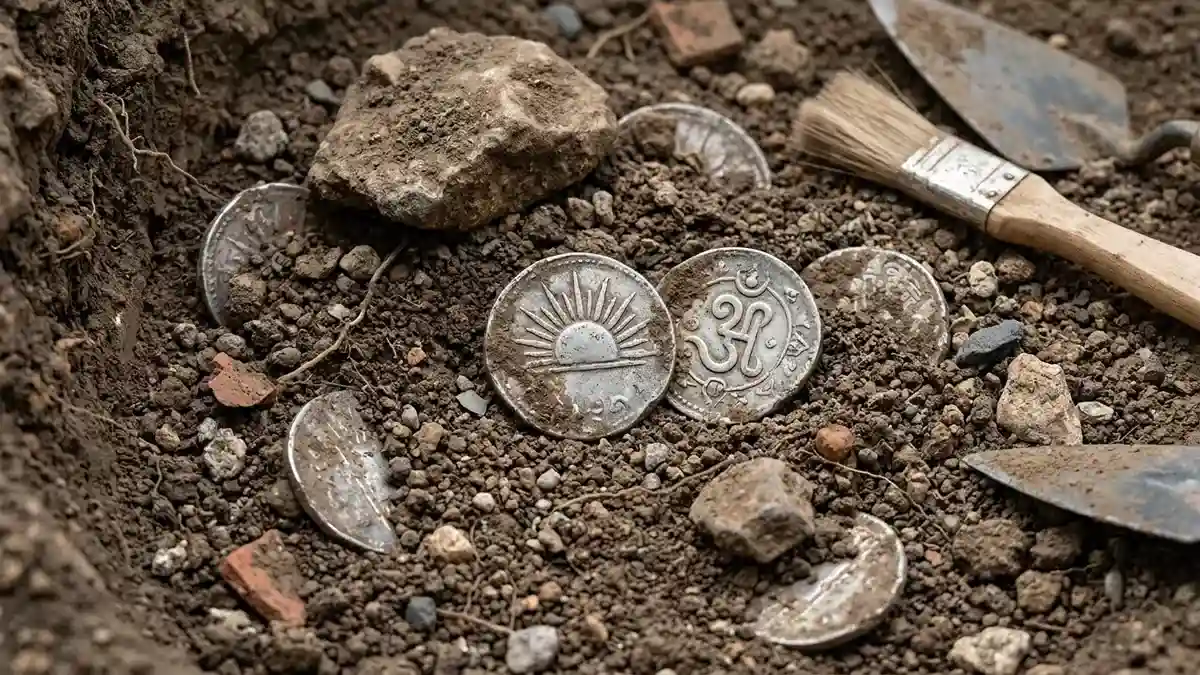
The artifacts at the center of this breakthrough are highly standardized silver coins originally manufactured by the Pyu-Mon polities of north-central Myanmar. These ancient kingdoms were master metalsmiths, utilizing highly precise, hand-carved metallic stamps—known as dies—to permanently strike complex iconographic designs onto both faces of raw, blank silver discs.
Despite moving across vastly different cultures and modern borders, the coins maintain a striking, uniform design language:
The Obverse (Front) Design: Features the vivid image of a rising sun, an emblem universally linked across the region to divine kingship, renewal, and the dawn of cosmic order.
The Reverse (Back) Design: Depicts the Srivatsa, a highly revered ancient South and Southeast Asian motif symbolizing prosperity, structural harmony, and the presence of the water and fertility deities.

While independent regional markets introduced minor, localized variations in the exact coin diameter and weight, the overall uniformity of the striking process is a massive historical revelation. This structural consistency proves that early Southeast Asian states were not trading blindly; instead, they operated under a strictly enforced, standardized economic framework that transcended regional political rivalries.
Fingerprinting the Mint: The Power of Die Studies
The true scientific catalyst for this historical rewrite comes from a pioneering numismatic methodology executed by Dr. Andrew Harris of the National University of Singapore, alongside an international team of researchers. The team traveled across Asia to conduct an exhaustive “die study” of 245 pristine coins housed in major museum collections throughout Myanmar, Thailand, Cambodia, and Vietnam.

A die study acts as a forensic fingerprinting system for ancient currency. Because each coin-striking die was hand-carved by a master artisan, every single die possessed microscopic flaws, unique line angles, and tiny imperfections. When a coin was struck, these unique flaws were permanently transferred to the silver. By meticulously cataloging these microscopic anomalies, scientists can determine exactly which coins were struck by the exact same physical piece of iron or bronze.
The results of the study were nothing short of spectacular. The team discovered multiple exact die matches on coins recovered from archaeological sites separated by thousands of kilometers of treacherous mountain ranges and open seas.
The most jaw-dropping match occurred when researchers examined the obverse profiles of two independent coins: one excavated in modern-day Bangladesh and the other recovered from a coastal site in Vietnam. The microscopic analysis proved that both coins were struck using the exact same physical die. This means that despite their eventual resting places being separated by thousands of miles of ancient jungle and ocean, these two coins were manufactured in the exact same workshop, by the exact same state authority, and possibly by the very same ancient artisan.
Mapping the Maritime Silk Road: Verified by Coins and Chronicles
This expansive geographic distribution perfectly mirrors the early accounts left behind in ancient Chinese imperial chronicles. Scribes writing as early as the late Han Dynasty (2nd century CE) regularly recorded Southeast Asia’s vital role as a thriving corridor for massive sea and land-based trade routes. These ancient pipelines safely connected the Near East and the Indian Ocean directly to the markets of imperial China via the Persian Gulf and the South China Sea.
While earlier excavations along this maritime corridor regularly yielded imported luxury items—such as delicate Roman glassware, Persian glazed ceramics, Indian jewelry, and Chinese porcelain—these items were often viewed as elite, passive gifts rather than indicators of a fluid cash economy. The sweeping distribution of the Rising Sun/Srivatsa coins completely changes this interpretation, tracking a highly fluid currency flowing through the region’s primary economic hubs:
The Irrawaddy River Basin (Myanmar): The industrial cradle where the currency was initially struck and regulated.
Dvaravati Culture Centers (Thailand): Inland trading hubs that utilized the silver coins to facilitate overland commerce.
Funanese Centers (Mekong Delta): Bustling international mega-ports that managed shipping lanes between the Indian Ocean and the Pacific.
The Malay Peninsula: Coastal and riverine settlements that functioned as the vital transshipment checkpoints for maritime long-distance trade.
A High-Tech Weapon Against Antiquities Trafficking
Beyond rewriting history textbooks, the published research provides a powerful, modern practical application. Southeast Asia’s rich cultural heritage is currently facing a catastrophic crisis. Due to ongoing regional conflicts and economic instability, ancient sites across Myanmar and neighboring territories are being systematically plundered by black-market looters. Thousands of invaluable ancient coins are regularly smuggled across borders, sold into anonymous private collections, or melted down entirely into raw silver bullion, erasing their historical data forever.
By establishing a rigid, global database of known die fingerprints, this study gives customs officials, museum curators, and international law enforcement a powerful weapon to combat illicit antiquities trafficking. If a private collector or auction house attempts to sell an un-documented Rising Sun coin, a quick comparison against the die database can immediately determine if the object was recently looted from a known archaeological zone, successfully protecting the region’s cultural heritage from erasure.
Conclusion: Elevating Southeast Asian Numismatics
Ultimately, this pioneering study marks a monumental leap forward for global numismatic history. By utilizing modern statistical modeling and forensic die analysis, researchers have successfully elevated the study of early Southeast Asian currency to the exact same academic tier as the heavily documented monetary systems of ancient Rome, classical India, and Central Asia. The silent silver discs of the first millennium have finally been allowed to speak, revealing an ancient Southeast Asia that was vibrant, profoundly sophisticated, and deeply connected to the global economy.
Frequently Asked Questions
What are the “Rising Sun” coins?
The “Rising Sun” coins are ancient silver currencies dating back to the 4th century CE. Originally minted by the Pyu-Mon polities of north-central Myanmar, they featured a distinctive rising sun on the front (obverse) and a sacred prosperity symbol called a Srivatsa on the back (reverse).
What is a “die study” in archaeology?
A die study is a forensic method used to analyze ancient coins. Because the metallic molds (dies) used to stamp coins were hand-carved, each possessed unique microscopic flaws. By matching these exact imperfections across different coins, archaeologists can prove which coins were minted in the exact same workshop by the same authority, even if they were found thousands of miles apart.
How far did these ancient coins travel?
The study revealed an astonishing geographic spread. Coins struck from the exact same physical mold have been recovered from archaeological sites stretching all the way from Bangladesh across to the Mekong Delta in Vietnam, demonstrating an incredibly vast, integrated trade network.
Why is this discovery important for Southeast Asian history?
For years, historians assumed early Southeast Asian kingdoms were small, isolated, and economically primitive compared to India or China. Finding a highly standardized, long-distance silver currency system proves these cultures possessed highly advanced economic integration, complex laws, and sophisticated trade infrastructure.
How do die studies help stop the illegal antiquities trade?
When ancient sites are looted, the historical context of the artifacts is lost. By mapping the unique metallic fingerprints of authentic coins, die studies allow museums and border forces to identify fake coins, trace the original geographic source of smuggled items, and stop looters from selling stolen heritage on the black market.