
Table of Contents
- 1. Breaking the Sacred Code of Iberian Cremation
- 2. Forensic Reconstruction of a Double Murder
- 2.1. Individual A: The Fatal Femur Strike
- 2.2. Individual B: The Decapitation
- 3. The Antler Enigma: Ritualistic Layering of the Dead
- 4. Isotope Analysis: Tracking the Lives of the Executed
- 5. The Cultural Legacy of a “Bad Death”
- 6. Frequently Asked Questions
- 6.1. What makes the burial discovery at Cerro de las Cabezas unique?
- 6.2. How did the two men die?
- 6.3. Why were deer antlers included in the burial?
- 6.4. Were the executed men foreign invaders?
- 6.5. What is a “bad death” in ancient archaeology?
Ancient Iberian Ritual Execution Site Discovered in Central Spain
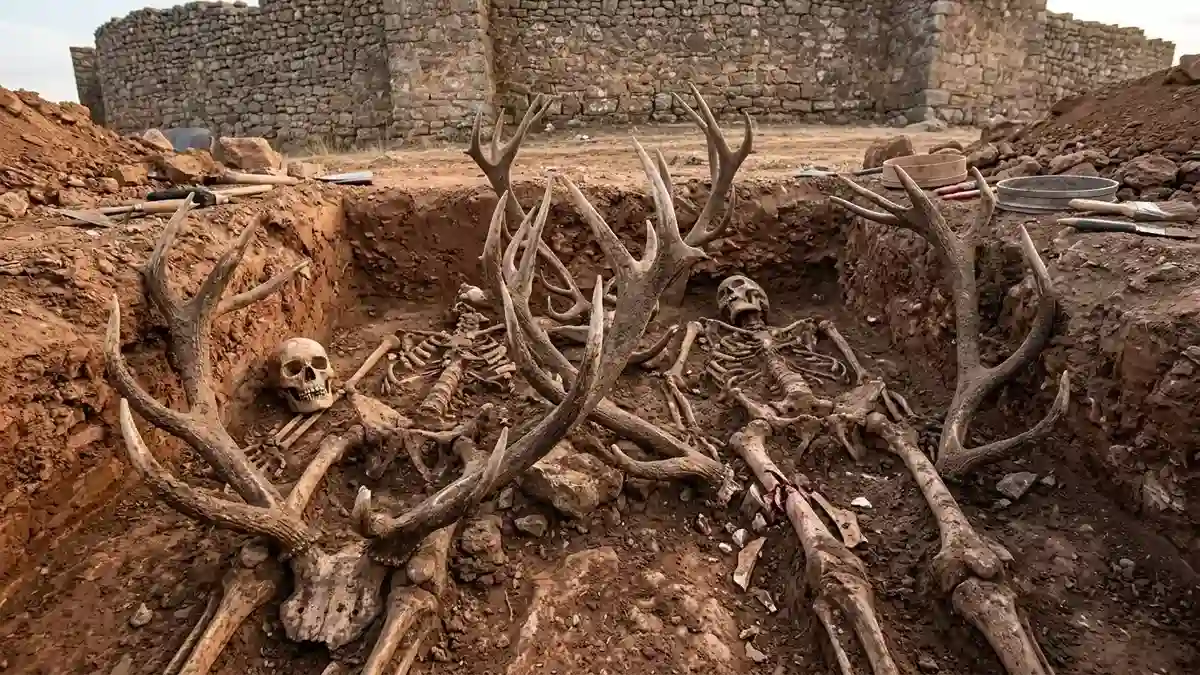
The violent deaths of two men buried outside the defensive walls of an ancient settlement more than 2,200 years ago are offering scientists a rare, dark perspective on social control, execution, and spiritual rituals in pre-Roman Spain. Discovered at the historical site of Cerro de las Cabezas, this highly unorthodox burial combines evidence of extreme bodily trauma with six massive red deer antlers placed deliberately around the corpses. Investigators note that the bizarre archaeological configuration has absolutely no known parallel in the entire history of Iberian field research.
The discovery gives researchers an explicit look at how early Iberian communities handled individuals who violated cultural boundaries, acted as enemies, or fell victim to societal punishments. By isolating the deceased from standard communal spaces, the ancient inhabitants left behind a powerful message frozen in stone and bone.
Ancient Iberian Ritual Execution Site Discovered in Central Spain

Breaking the Sacred Code of Iberian Cremation
To understand why this burial shocked the research team, one must look at the strict funerary laws that governed Iron Age Iberia between the 6th and 1st centuries BCE. Under normal circumstances, the dead were treated with uniform spiritual respect.
The standard cultural protocol was highly specific:
Cremation as the Norm: Bodies were systematically cremated on sacred pyres.
Cemetery Placement: The remaining ashes were gathered and placed inside ceramic urns.
Community Integration: These urns were buried within organized, communal cemeteries located away from the living quarters, often surrounded by personal belongings and funeral offerings.
The two men found at Cerro de las Cabezas were denied every single step of this sacred process. Instead of being cremated, their intact bodies were cast into the dirt right up against the settlement’s southern defensive fortification wall. They were buried without a formal grave pit, structural markers, or a single piece of funerary pottery, indicating that they were intentionally excluded from the community’s spiritual afterlife.

Forensic Reconstruction of a Double Murder
Skeletal analysis reveals that both men, dubbed Individual A and Individual B, suffered brutal, localized trauma immediately preceding their deaths. Because the bones were discovered in perfect anatomical alignment, forensic scientists know the bodies were covered with dirt almost immediately after the executions occurred, before scavengers could disrupt the remains.
Individual A: The Fatal Femur Strike
Estimated to be between 35 and 45 years old, Individual A was no stranger to violence. Forensic mapping of his skull revealed a severe forehead fracture that had occurred several weeks prior to his death, with the bone tissue showing healthy signs of early healing.
His luck ran out when a heavy, sharp weapon—likely an iron sword—struck his right thigh bone with tremendous mechanical velocity. The blow was so powerful that it sliced clean into the thick femur, severing the femoral artery and causing massive, fatal blood loss within minutes. Microscopic chips on the bone surface reveal that the weapon became physically stuck in his thigh before the attacker violently yanked it free.
Individual B: The Decapitation
Individual B, who was older, aged between 40 and 59 years, suffered an even more dramatic fate. He was completely decapitated either right at the moment of death or seconds after.
When the burial occurred, his skull, jawbone, and upper neck vertebrae were still bound firmly together by soft muscle tissue. The executioners deliberately detached the head and placed it roughly 40 centimeters away from the torso, resting it carefully on top of the corpse’s left arm at the apex of the burial mound. Scientists state that this specific positioning could never have happened naturally through soil shifting, proving it was a conscious, symbolic human act.
The Antler Enigma: Ritualistic Layering of the Dead
The inclusion of six massive red deer antlers—some measuring well over three feet long—adds a deeply complex layer of ancient mythology to the crime scene.
In Celtic and Celtiberian cultures, deer antlers carried immense symbolic weight, often associated with protection, virility, and the wild forces of nature. While archaeologists have occasionally discovered antlers buried beneath household floors or fortress gates to act as good-luck charms or “foundation offerings,” this is the first time in European history that antlers have been explicitly tied to the shamed bodies of executed humans. The antlers may have been used to ritually “pin” the bad luck of these men to the earth, protecting the town from their spirits.
The architectural staging of this deposit was strictly timed. Antlers were placed down first, the bodies were layered on top, more antlers were stacked above the flesh, and the severed head was positioned last.
Isotope Analysis: Tracking the Lives of the Executed
To find out if these men were foreign invaders or local citizens, the research team conducted stable isotope testing on the carbon, nitrogen, and oxygen levels trapped within the skeletal tooth enamel.
The biological data revealed surprising insights into their backgrounds:
High-Protein Diets: The carbon and nitrogen profiles of Individual A indicated a wealthy, stable diet packed with animal proteins that remained completely unchanged from his teenage years into his adult life.
Distinct Water Sources: The oxygen signatures proved that the two men drank water from completely different geographic water tables during their development, meaning they lived very different early lives.
Local Identification: Despite their different personal histories, both isotope values match the native environmental signatures of central Spain. Neither man was a foreign invader; both were local to the broader region.
Furthermore, unique structural wear on the leg bones of Individual A showed extensive, repeated long-distance walking. Combined with his high-protein signature, researchers hypothesize that he may have worked as a professional livestock herder, moving herds across the Spanish plains before meeting his violent end.
The Cultural Legacy of a “Bad Death”
When all the archaeological data is synthesized, it points directly to a single, highly orchestrated public event rather than a standard criminal concealment. In anthropological terms, these men were subjected to a “bad death”—a punitive ritual reserved for those who died carrying heavy social shame, committed treason, or broken core tribal laws.
By executing these men brutally, denying them the purification of cremation, and burying them directly under the defensive shadow of the city walls mixed with animal bone, the leaders of Cerro de las Cabezas created a highly visible public warning. This unique find provides modern historians with an invaluable, unfiltered look into how prehistoric European societies utilized religious symbolism, violent execution, and public shaming to maintain absolute law and order in the volatile centuries before the Roman Empire conquered the peninsula.
Frequently Asked Questions
What makes the burial discovery at Cerro de las Cabezas unique?
It is the only known Iron Age burial in Spain that rejects the universal tradition of cremation, opting instead to bury intact, mutilated bodies directly against a city wall alongside massive red deer antlers.
How did the two men die?
Individual A died from a catastrophic sword blow to his right femur that severed his major blood vessels. Individual B was completely decapitated, with his severed head intentionally placed on his own left arm during the burial.
Why were deer antlers included in the burial?
While antlers were traditionally used as protective or structural offerings in Celtic houses, their placement here suggests a complex ritual. They may have been used to spiritually neutralize the “bad death” of the criminals, preventing their spirits from harming the town.
Were the executed men foreign invaders?
No. Advanced stable isotope testing on their teeth confirms that both men grew up drinking local water and eating local food from the central Spanish region, meaning they were native to the area rather than outside attackers.
What is a “bad death” in ancient archaeology?
A “bad death” refers to a punitive burial practice where individuals who violated societal laws or died under shameful circumstances were denied normal funeral rites—such as cremation or cemetery burial—to intentionally exclude them from the community’s spiritual afterlife.