
Table of Contents
- 1. The Discovery: A Text Book Example of Field Preservation
- 2. Decoding the Anatomy of a Tang-Hilted Blade
- 2.1. The Missing Grip
- 2.2. Artistry Trapped in Patina
- 3. A Fortune Left in the Dirt: The Value of Prehistoric Bronze
- 4. Echoes of History: The Phantom Swords of the 1920s
- 5. Preserving the Blade for the Future
- 6. Frequently Asked Questions
- 6.1. How old is the bronze sword found in Poland?
- 6.2. Why was the sword standing upright in the ground?
- 6.3. What is a tang-hilted sword?
- 6.4. How valuable was a bronze sword during the Bronze Age?
- 6.5. What happened to the other swords found in this forest?
2,700-Year-Old Bronze Age Sword Found Upright in Polish Forest
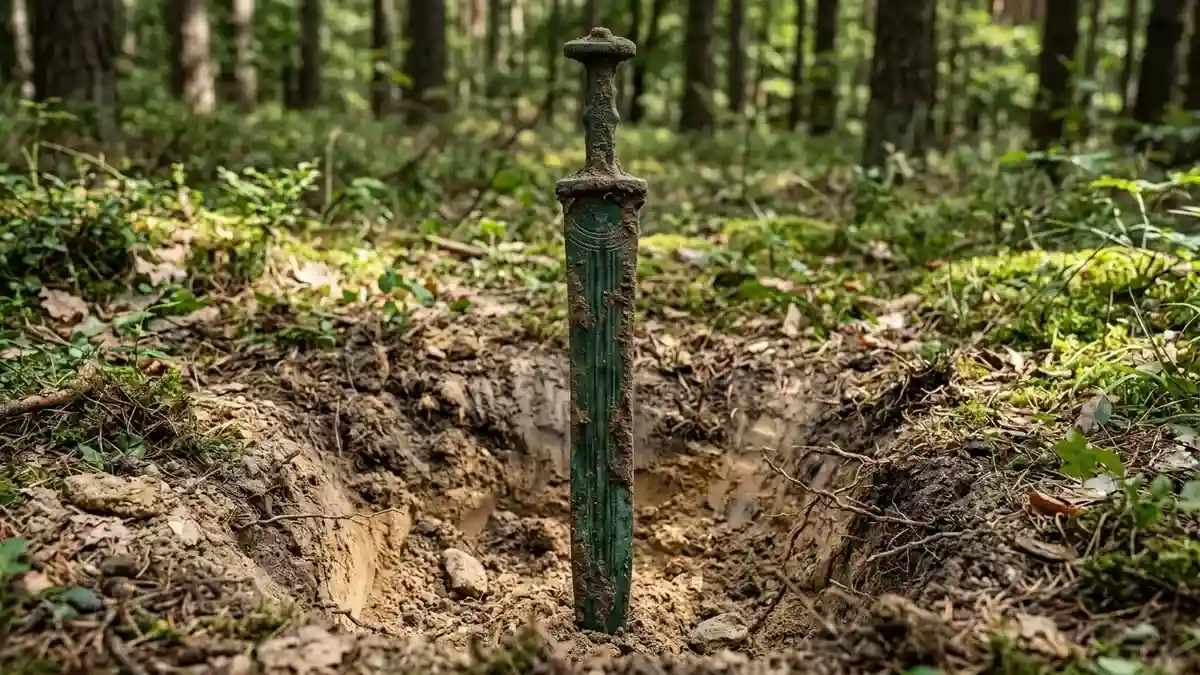
A breathtaking archaeological discovery has come to light in the dense woodlands of northern Poland, where an ancient bronze sword was found standing completely upright in the ground. Dating back approximately 2,700 years, this remarkably well-preserved weapon offers researchers a rare, unfiltered look into the spiritual and ritualistic landscapes of European prehistory.
The extraordinary artifact, which dates to the final centuries of the Bronze Age, was uncovered within the Gdańsk Forest District. Because the item was left in its exact historical position, it provides critical contextual clues about how prehistoric populations interacted with nature, marked territories, and made highly valuable offerings to their deities.
2,700-Year-Old Bronze Age Sword Found Upright in Polish Forest

The Discovery: A Text Book Example of Field Preservation
The recovery of the ancient weapon is a testament to the vital role responsible citizen scientists play in preserving global heritage. The blade was initially located by Marcin Wiśniewski, an experienced historical detectorist conducting an authorized, fully legal metal-detecting survey in the regional forest.
While scanning a patch of sandy soil, Wiśniewski’s equipment flagged a massive metallic signature. Upon investigating, he spotted the tip of a bronze blade emerging vertically from the earth. Recognizing the immense historical value of the intact find and realizing that digging it up could permanently destroy delicate soil layers, Wiśniewski halted his search. He carefully marked the coordinates, protected the immediate perimeter from elements, and immediately alerted local forestry personnel alongside regional heritage authorities.
Professional archaeologists quickly mobilized to the coordinates to conduct a systematic scientific excavation. Utilizing careful stratigraphic techniques, the team meticulously documented the sword’s exact spatial alignment before lifting it from its sandy resting place. While a thorough sweep of the surrounding soil revealed no accompanying artifacts or skeletal remains, the absolute isolation of the weapon—combined with its vertical posture—tells a profound story.
 Ancient Protein Analysis Reveals All Homo naledi Skeletons From Rising Star Cave May Be Female
Decoding the Anatomy of a Tang-Hilted Blade
Measuring roughly 60 centimeters (approximately 24 inches) in length, the ancient weapon has been typologically classified by specialists as a tang-hilted sword. This specific design choice reveals a great deal about the technological transitions of the era.
The Missing Grip
The sword features a narrow metallic extension at the base of the blade known as a tang. During the Bronze Age, this metal strip was sandwiched between two matching plates of organic material—such as carved hardwood, polished animal bone, or dense deer antler—and secured tightly with rivets to form a comfortable handle. Because these natural materials are highly susceptible to acidic soil conditions, they have completely decayed over the past 27 centuries, leaving only the bare bronze skeleton behind.
Artistry Trapped in Patina
Despite the loss of its organic hilt, the metal blade itself remains in an exceptional state of preservation. Over millennia, a vibrant green layer of oxidation, known as a patina, formed over the bronze surface. Far from damaging the weapon, this natural chemical crust acted as a protective shield, sealing the underlying metal away from air and water.

This protective layer successfully preserved intricate, hand-engraved artistic features, including:
Decorative Grooves: Clean, parallel channels running down the length of the blade to reduce weight without sacrificing structural strength.
Engraved Arcs: Microscopic, sweeping circular motifs etched near the hilt.
Crosswise Geometric Lines: Short, rhythmic horizontal engravings that showcase the steady hand of a master metalsmith.
These distinct decorative configurations perfectly match the artistic styles popularized during the fourth and fifth regional periods of the European Bronze Age. However, specialists note that extensive laboratory conservation and chemical testing will be required to confirm the precise manufacturing origin.
A Fortune Left in the Dirt: The Value of Prehistoric Bronze
To comprehend the sheer magnitude of intentionally abandoning a weapon of this caliber in a remote forest, one must evaluate its economic worth through a prehistoric lens. During the late Bronze Age, metal weapons were not mass-produced commodities; they were highly luxurious, handmade assets.
According to data shared by regional forestry and historical organizations, a beautifully crafted bronze sword was one of the most elite possessions an individual could own. In terms of ancient purchasing power, a single bronze blade of this quality was roughly equivalent to the value of an entire herd of cattle.
In a society where livestock represented primary wealth, security, and food, owning a sword was an explicit declaration of immense personal riches, martial prowess, and high aristocratic status. Intentionally driving a weapon of such monumental value into the forest floor is the ancient equivalent of burying a modern sports car or a massive fortune in gold coins.
“Leaving an asset of this value standing upright in the landscape represents a profound economic sacrifice. This was an undeniable act of devotion or a serious political statement.” — Regional Heritage Report
Echoes of History: The Phantom Swords of the 1920s
This is not the first time the Gdańsk Forest District has yielded legendary bronze weaponry. The area holds a deep, mysterious connection to ancient metal deposits that stretches back through modern archival history.
During the 1920s, local workers uncovered two rare bronze antenna-hilted swords buried deep within a peat bog located in the exact same forested region. Those weapons were safely recovered and transferred to the prestigious Provincial Museum in Gdańsk for long-term display. Tragically, during the chaotic final months of World War II, the museum was looted and heavily damaged, and those irreplaceable artifacts vanished entirely.
The discovery of this new, third sword helps bridge a painful historical gap. It confirms that this specific Polish forest was not just a random patch of wilderness, but a highly significant, sacred geography utilized by ancient elites across multiple generations for ritualistic purposes.
Preserving the Blade for the Future
The newly discovered sword has been safely transferred to a secure laboratory facility operated by the regional archaeological heritage office. Over the coming months, specialized conservators will use gentle chemical washes and stabilizing treatments to halt any potential bronze disease while highlighting the hidden details of the engravings.
Once the conservation work is finalized and the weapon is fully stabilized, the Provincial Heritage Conservator will determine which public museum will receive permanent custody of the artifact. For now, the upright blade stands as a staggering reminder that the history of ancient European ritualism is far deeper, wealthier, and more mysterious than previously imagined.
Frequently Asked Questions
How old is the bronze sword found in Poland?
The sword is approximately 2,700 years old, with archaeologists dating its creation and deposition to a window between 900 and 700 BCE during the late Bronze Age.
Why was the sword standing upright in the ground?
Because the sword was found positioned vertically in sandy soil with no other artifacts nearby, archaeologists believe it was deliberately placed there as part of a sacred ritual offering, rather than being accidentally lost or dropped.
What is a tang-hilted sword?
A tang-hilted sword features a narrow metal extension (the tang) at the base of the blade where a handle would be attached. The missing grip was originally made of perishable organic materials like wood, bone, or antler, which rotted away over centuries.
How valuable was a bronze sword during the Bronze Age?
Weapons of this caliber were incredibly elite luxury items. Historical estimates suggest a single bronze sword was worth as much as an entire herd of cattle, making it a definitive symbol of immense wealth and high social standing.
What happened to the other swords found in this forest?
In the 1920s, two other bronze swords were discovered in a nearby peat bog within the same forest. They were placed in a Gdańsk museum but unfortunately disappeared during the destruction of World War II.