
Table of Contents
- 1. The Silent Witness: A 1,500-Year Pollution Record
- 2. Islands of Resilience: The Post-Roman Reality
- 3. The Mid-Sixth Century Crisis: Pathogens, Not Politics
- 4. The Viking Age Industrial Boom
- 5. Tracing Later Historical Economic Cycles
- 6. Frequently Asked Questions
- 6.1. What did the new study prove about post-Roman Britain?
- 6.2. How did scientists track 1,500 years of industrial history?
- 6.3. What actually caused the industrial decline in the 6th century?
- 6.4. When did Britain’s post-Roman economy reach its highest peak?
- 6.5. Why did Henry VIII’s actions shut down metal production in the 1500s?
New Archeological Discovery Explodes the Myth of Britain’s Dark Ages
For centuries, mainstream history books have advanced a bleak, apocalyptic narrative about what happened to Great Britain after the Roman Empire packed up and left around 400 CE. According to the traditional “Dark Ages” theory, the sudden withdrawal of imperial administration triggered an immediate, catastrophic collapse of civilized society. Cities were supposedly abandoned overnight, sophisticated industries instantly vanished, and the entire island plunged into a prolonged era of economic stagnation and cultural regression.
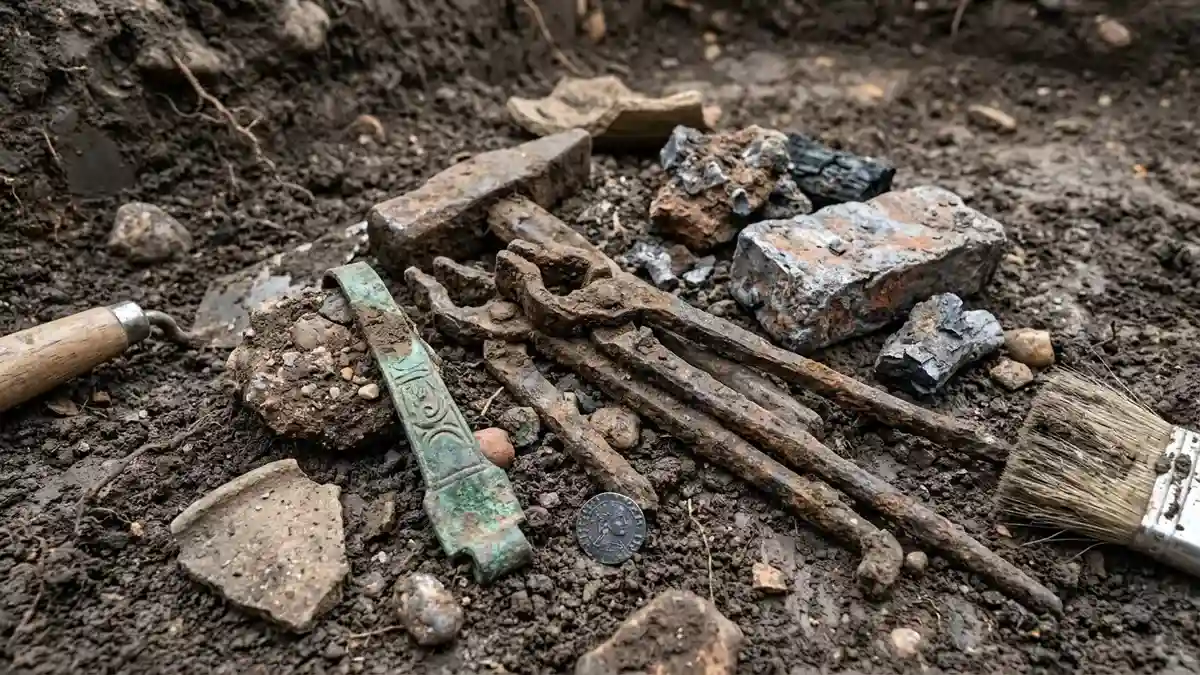
However, a revolutionary geoarchaeological study has completely turned this grim historical timeline on its head. By pulling physical data directly from an ancient industrial hub, an international team of scientists has proven that Britain’s industrial economy did not collapse with the departure of the Roman legions.
Instead, local communities adapted, maintained complex manufacturing practices for generations, and laid the precise economic groundwork that fueled a spectacular industrial renaissance during the Viking Age. The myth of a dark, economically dead post-Roman Britain has officially evaporated.
New Archeological Discovery Explodes the Myth of Britain’s Dark Ages

The Silent Witness: A 1,500-Year Pollution Record
To rewrite the early economic history of northern Europe, a collaborative research team led by scientists from the University of Cambridge and the University of Nottingham bypassed traditional palace excavations. Instead, they focused their attention on a far more reliable historical witness: subterranean dirt.
The team targeted the historic Roman town of Aldborough, located in North Yorkshire. Originally known as Isurium Brigantum, this critical settlement served as a major tribal capital for the indigenous Brigantes people and acted as an industrial powerhouse for heavy metal smelting under Roman imperial command.
[Extract 5-Meter Core from Ancient River Bed]
                     │
                     ▼
  [Analyze Hidden Metallic Micro-Layers]
                     │
                     ▼
[1,500-Year Continuous Timeline of Heavy Industry]
Rather than hunting for scattered pottery fragments, the scientists drilled deep into an ancient, silted-up river channel running adjacent to Aldborough’s primary manufacturing zone, extracting a continuous five-meter-long core of compressed river sediment.

Unlike peat bogs or polar ice cores located thousands of miles away from human activity, this specific core was pulled directly from the geographical epicenter of Britain’s ancient mining industry. Every microscopic layer of the mud trapped a precise slice of time, sealing in the airborne metallic pollutants—specifically lead and iron byproducts—released by local furnaces over 1,500 years of continuous human operation.
Islands of Resilience: The Post-Roman Reality
When the researchers analyzed the chemical signatures locked inside the sediment core, they discovered that the year 400 CE did not bring an end to British manufacturing. The lead and iron pollution levels remained remarkably steady through the fifth and sixth centuries.
In fact, the data exposed an unexpected twist: the production of iron smelting actually increased in the decades following the collapse of Roman administrative authority. The local craftsmen did not forget their trade; they continued to utilize the exact same raw material deposits, mining infrastructure, and coal-burning smelting methodologies pioneered under Roman rule.
Rather than a sweeping, nationwide industrial extinction event, post-Roman Britain was defined by highly organized, regional “islands of industrial resilience.” These active manufacturing pockets mirrored similar networks operating across northern Gaul (modern-day France), proving that the deep economic ties binding Western Europe did not break simply because the Roman army stopped marching.
The Mid-Sixth Century Crisis: Pathogens, Not Politics
If the withdrawal of the Roman Empire didn’t crush northern England’s industrial engine, what did? The core reveals that a sudden, dramatic plunge in metal production finally occurred around 550 to 600 CE.
Archaeologists and historians believe this massive industrial downturn wasn’t caused by a failure of political systems or invading armies, but rather by an invisible biological enemy. The mid-sixth century marked the arrival of the Justinian Plague—a global pandemic of bubonic plague, likely accompanied by waves of smallpox, that decimated human populations across Europe.
This theory matches up beautifully with independent biological data. DNA extracted from skeletons buried in eastern English cemeteries confirms that the bubonic plague had successfully breached the British coast by the 540s. The resulting labor shortages and societal disruption caused by the massive loss of human life struck a temporary blow to the heavy labor operations at Aldborough, forcing foundries to go cold for decades.
The Viking Age Industrial Boom
The cold spell did not last forever. The Aldborough sediment record documents a steady industrial recovery building by the late eighth century, paving the way for a spectacular manufacturing peak during the Viking Age.
From the late 700s through the 900s CE, lead and iron production exploded across North Yorkshire, reaching output levels that rivaled the height of the Roman occupation. This massive surge was directly tied to the arrival of the Norsemen and the shifting geopolitical realities of northern England.
               [Justinian Plague Downturn (540s CE)]
                                 │
                                 ▼
               [Foundries Restabilize (Late 700s)]
                                 │
                                 ▼
             [Viking Trade Networks Interlock (800s)]
                                 │
                                 ▼
      [Massive Industrial Boom: Lead & Iron Production Peak]
Under Viking governance, Aldborough transformed into a highly organized, royal industrial center. The Norse rulers established vast regional trade networks, connecting northern English metal foundries directly to commercial markets across the Baltic and North Seas. The massive quantities of iron and lead pulled from the Yorkshire hills weren’t just used for weapons; they stabilized local currencies, constructed grand buildings, and cemented the power centers of early medieval kings.
Tracing Later Historical Economic Cycles
Because the sediment core provides an unbroken, site-specific timeline running from the fourth century to the modern era, it also captured later historical events with startling accuracy, acting as a chemical validation of Britain’s written archives:
The Medieval Boom: A massive spike in iron and lead contamination between the 12th and 13th centuries aligns perfectly with historical tax records showing booming mining output under the Norman and Plantagenet kings. This English industrial surge was so vast that its chemical signature has been detected in Swedish lakes and Alpine glaciers.
The Tudor Disruption: Production cratered in the 16th century during King Henry VIII’s infamous Dissolution of the Monasteries. When the Crown seized religious properties, workers stripped the massive lead roofs and iron fittings from empty monasteries, flooding the market with cheap, recycled scrap metal and making new smelting operations financially unviable for decades.
The Elizabethan Rebound: Foundries roared back to life under Queen Elizabeth I, who heavily subsidized domestic metal manufacturing to produce weapons, armor, and naval cannons for England’s multi-decade military conflicts with Spain and France.
By fusing geoarchaeological pollution tracking with traditional historical documentation, this study delivers a far more complex, resilient, and human picture of our past. It proves that humanity’s progress is rarely a story of sudden downfalls and simple dark ages. Instead, history is an enduring cycle of continuity, brilliant adaptation, and continuous recovery.
Frequently Asked Questions
What did the new study prove about post-Roman Britain?
The study proved that Britain’s industrial economy did not collapse into a primitive “Dark Age” after the Romans left in 400 CE. Instead, heavy metal production continued successfully for centuries, utilizing Roman mining techniques and infrastructure.
How did scientists track 1,500 years of industrial history?
Researchers extracted a five-meter-long sediment core from an ancient riverbed in the industrial town of Aldborough. By analyzing the layers of lead and iron pollution trapped in the mud over centuries, they created an unbroken timeline of local factory output.
What actually caused the industrial decline in the 6th century?
The decline was caused by global pandemics, specifically the Justinian Plague (bubonic plague) and smallpox, which hit eastern England in the 540s CE. The massive loss of human life created severe labor shortages, forcing foundries to shut down.
When did Britain’s post-Roman economy reach its highest peak?
The economy experienced a massive revival and peak during the Viking Age, between the 8th and 10th centuries. Under Norse influence, Aldborough became a centralized royal manufacturing hub that traded metals across extensive international markets.
Why did Henry VIII’s actions shut down metal production in the 1500s?
When Henry VIII closed England’s monasteries, workers stripped the massive lead roofs and iron structures from the abandoned buildings. This flooded the market with cheap, recycled metal, making it unprofitable to mine or smelt new ore for decades.