
Table of Contents
- 1. Unlocking a Cold Case with 3D Virtual Technology
- 1.1. Reversing a Million Years of Crushing
- 2. Rewriting the Human Family Tree: The Homo longi Connection
- 2.1. The Missing Link to the Denisovans
- 3. Shifting the Deep Timeline of Human Divergence
- 3.1. The New Evolutionary Chronology
- 4. Middle Pleistocene Asia: A Diverse Hominid Sandbox
- 5. Frequently Asked Questions
- 5.1. What is the Yunxian 2 skull and where was it found?
- 5.2. Why did it take 35 years to accurately identify the skull?
- 5.3. Who was Homo longi or “Dragon Man”?
- 5.4. How does this discovery change the timeline of human evolution?
- 5.5. What are “mosaic traits” in fossils?
Million-Year-Old Skull Reshapes Human Evolution and Denisovan Origins
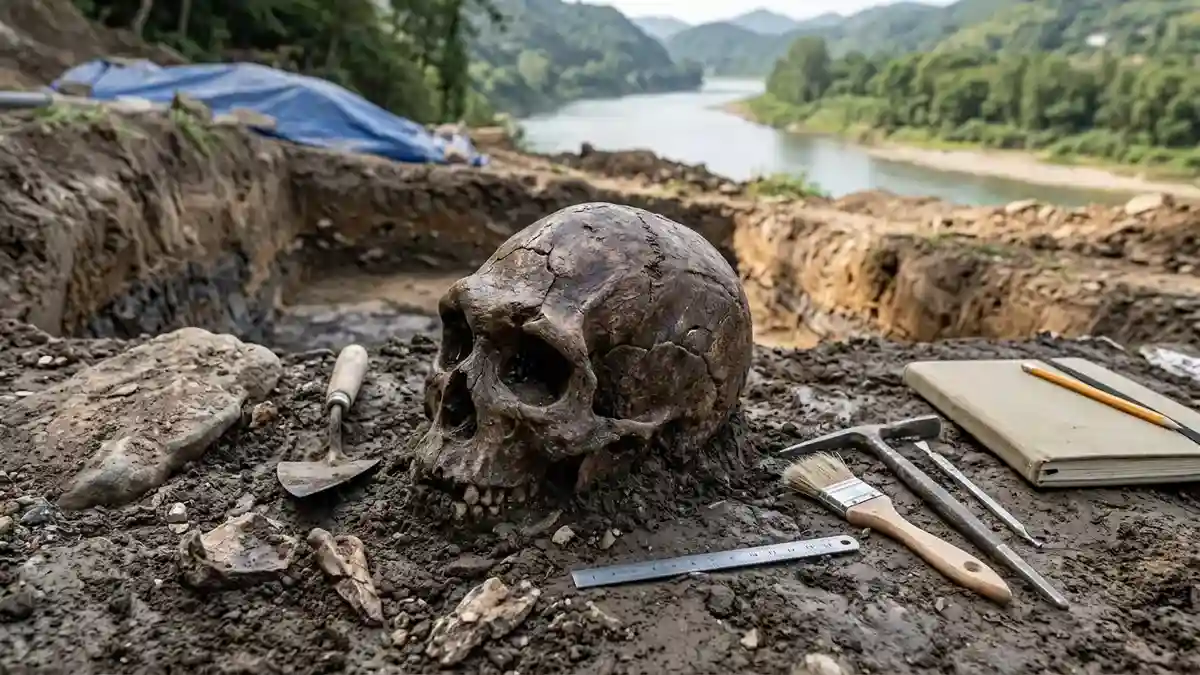
A crushed and heavily distorted fossil skull discovered in central China more than three decades ago has suddenly become the centerpiece of a major scientific revolution. Advanced digital reconstruction of the 1-million-year-old Yunxian 2 cranium has revealed that this ancient individual was not who scientists originally thought.
Instead of belonging to a standard branch of Homo erectus, cutting-edge evolutionary mapping places the skull within the enigmatic Homo longi lineage. This discovery provides the most definitive physical link yet to the mysterious Denisovans, proving that this sister group to modern humans was thriving in Asia much earlier than anyone ever dreamed.
Million-Year-Old Skull Reshapes Human Evolution and Denisovan Origins
Unlocking a Cold Case with 3D Virtual Technology
The Yunxian 2 skull was originally excavated in 1990 from a scenic terrace along the Hanjiang River in China’s Hubei province. When it was pulled from the earth, the fossil was in poor condition—badly crushed and severely warped by the immense weight of river sediment over a million years of burial.

For decades, its distorted shape made it nearly impossible for paleoanthropologists to accurately classify, leading most to broadly categorize it as a local variant of Homo erectus.
Reversing a Million Years of Crushing
To unlock the skull’s secrets, an international research team utilized high-resolution computed tomography (CT) scanning coupled with advanced 3D virtual reconstruction software. By digitally separating the fragmented pieces of bone, scientists reversed the warping caused by fossilization, restoring the cranium to its original anatomical proportions.
The newly reconstructed Yunxian 2 skull revealed a surprising “mosaic” of primitive and highly advanced physical characteristics:
Primitive Features: A long, low braincase, remarkably thick brow ridges, and a broad, robust cranial base that mirrors much earlier human ancestors.
Advanced Features: A surprisingly large brain capacity paired with a modern, notably flat facial structure that aligns closely with later, more evolved hominids.
This unique combination of physical traits confirmed that Yunxian 2 represents a crucial transitional form, bridging the evolutionary gap between ancient Asian Homo erectus and later, more anatomically advanced human groups.

Rewriting the Human Family Tree: The Homo longi Connection
The most profound revelation from the study, published in the prestigious journal Science, came when researchers subjected the reconstructed skull to comprehensive morphometric and phylogenetic analysis (the statistical study of physical shapes and evolutionary relationships).
The results placed Yunxian 2 squarely inside the Homo longi clade—a specialized group of ancient humans often referred to as the “Dragon Man” lineage.
The Missing Link to the Denisovans
For over a decade, Denisovans have been one of the biggest teases in anthropology. Geneticists found their DNA in modern human populations across Asia and Oceania, and in ancient cave sediments, but the fossil record lacked intact skulls to show what they actually looked like.
The new data confirms that the Homo longi lineage likely represents the long-sought physical identity of the Denisovans. Because Yunxian 2 sits perfectly at the base of this group, it pushes the physical timeline of the Denisovan-Dragon Man lineage back to 1 million years ago, proving they coexisted as a distinct group alongside the direct ancestors of Homo sapiens.
Shifting the Deep Timeline of Human Divergence
By firmly anchoring the Yunxian 2 skull into the Homo longi branch, scientists have completely upended previous calculations regarding when the major lineages of ancient humans split from one another.
Historically, genetic models suggested that the evolutionary split between modern humans (Homo sapiens) and our closest extinct cousins occurred roughly 500,000 to 700,000 years ago. The new physical evidence indicates that these lineages parted ways hundreds of thousands of years earlier.
The New Evolutionary Chronology
| Evolutionary Milestone | Estimated Date of Occurrence | Historical Impact |
| Neanderthal Lineage Split | ~1.38 Million Years Ago | Neanderthals diverge as the earliest distinct branch from the common ancestral stock. |
| Sapiens & Longi Divergence | ~1.32 Million Years Ago | The direct ancestors of modern humans (sapiens) and Denisovans (longi) split into independent paths. |
| Longi Trait Solidification | ~1.20 Million Years Ago | Distinctive anatomical features of the Homo longi / Denisovan clade firmly stabilize in East Asia. |
| Early Sapiens Trait Emergence | ~1.02 Million Years Ago | The first primitive anatomical markers of modern human lineage begin appearing in the fossil record. |
Because Yunxian 2 is dated to 1 million years ago, it rests incredibly close to the theoretical point of origin for both the longi and sapiens branches. This explains why it retains such a fascinating mix of overlapping physical features, offering a snapshot of a highly dynamic period in human prehistory.
Middle Pleistocene Asia: A Diverse Hominid Sandbox
The newfound importance of the Yunxian 2 skull expands our understanding of the Middle Pleistocene epoch. Rather than a straight, simple line of evolution where one species neatly replaced another, Asia was a bustling melting pot of diverse human forms.
Discoveries stretching from China and the Philippines down to South Africa reveal that multiple distinct hominid groups—all possessing wildly different skull shapes, brain sizes, and physical builds—were sharing the planet simultaneously.
The Great Academic Debate: This high level of physical diversity has ignited an intense debate among paleoanthropologists. Some scientists argue that these distinct groups represent entirely separate, unique species competing for regional resources. Others suggest they are merely localized, highly diverse regional variations of a single, highly adaptable human lineage that eventually contributed to the modern human gene pool.
Ultimately, by pairing state-of-the-art digital scanning with classic fieldwork, researchers have effectively moved the story of Asian human evolution back by hundreds of thousands of years. Yunxian 2 provides a crucial piece of the evolutionary puzzle, illustrating that our path to becoming Homo sapiens was not a simple, isolated march, but a complex, deeply intertwined network of long-lost cousin lineages.
Frequently Asked Questions
What is the Yunxian 2 skull and where was it found?
Yunxian 2 is a 1-million-year-old fossil human skull discovered in 1990 on a river terrace along the Hanjiang River in the Hubei province of central China. It is one of the most complete skulls ever recovered from that specific era in Asia.
Why did it take 35 years to accurately identify the skull?
When discovered, the skull was severely crushed and warped by a million years of ground pressure, distorting its natural shape. It wasn’t until recent breakthroughs in high-resolution CT scanning and 3D digital reconstruction that scientists could virtually un-crush the bones and view its true anatomical structure.
Who was Homo longi or “Dragon Man”?
Homo longi is an extinct species of ancient human characterized by a large braincase, robust brow ridges, and a modern flat face. They represent a major evolutionary lineage in East Asia that scientists now believe is the physical face of the mysterious, DNA-defined Denisovans.
How does this discovery change the timeline of human evolution?
The skull proves that the lineages of modern humans (Homo sapiens), Neanderthals, and Denisovans (Homo longi) split far earlier than previously believed. The new timeline shows that Neanderthals branched off around 1.38 million years ago, while the modern human and Denisovan lines split roughly 1.32 million years ago.
What are “mosaic traits” in fossils?
Mosaic traits refer to a mix of both primitive, ancestral features and advanced, derived features within a single organism. The Yunxian 2 skull exhibits a mosaic pattern because it pairs an ancient, low-slung brow and skull base with a surprisingly advanced, flat, modern-looking face.