
Table of Contents
- 1. The Evolving Role of Ivory in Ancient Levantine Society
- 2. Advanced Science Rejects the Narrative of Egyptian Control
- 2.1. Pinpointing the African Source
- 3. Nubian Entrepreneurs: The True Kings of the Ivory Trade
- 4. Rethinking Ancient Global Trade Networks
- 5. Frequently Asked Questions
- 5.1. Where did the ivory found in the ancient southern Levant actually come from?
- 5.2. Did Egypt control the ancient ivory trade?
- 5.3. How did Nubian traders manage to maintain the ivory supply for 1,000 years?
- 5.4. What scientific methods did researchers use to trace the ivory’s origin?
- 5.5. Was all ancient Levantine ivory made from elephants?
New Archaeological Study Reveals Sub-Saharan Africa and Nubian Traders Fueled Ancient Levantine Ivory Market
A groundbreaking scientific study has completely transformed our understanding of ancient luxury trade networks in the Near East. By tracking the biological and geographical origins of southern Levantine ivory artifacts, researchers have discovered that for nearly a millennium, the primary source of this highly prized material was not Egypt, nor was it Asia. Instead, the trade relied heavily on African elephants, with independent Nubian merchants driving a resilient, long-distance supply chain that spanned from 1600 to 600 BCE.
This extensive research provides the very first empirical evidence of where Levantine ivories actually originated. In doing so, it successfully debunks decades-old historical theories that credited the Egyptian Empire with absolute domination over the ancient ivory trade.
New Archaeological Study Reveals Sub-Saharan Africa and Nubian Traders Fueled Ancient Levantine Ivory Market
The Evolving Role of Ivory in Ancient Levantine Society
Throughout the Late Bronze and Iron Ages, ivory stood as one of the most coveted status symbols in the southern Levant (encompassing modern-day Israel, Palestine, Jordan, and Lebanon). It served as a tangible manifestation of extreme wealth, political authority, and elite cultural sophistication.
However, as empires rose and fell over this 1,000-year period, the ways people used ivory shifted dramatically alongside the region’s changing political landscapes:
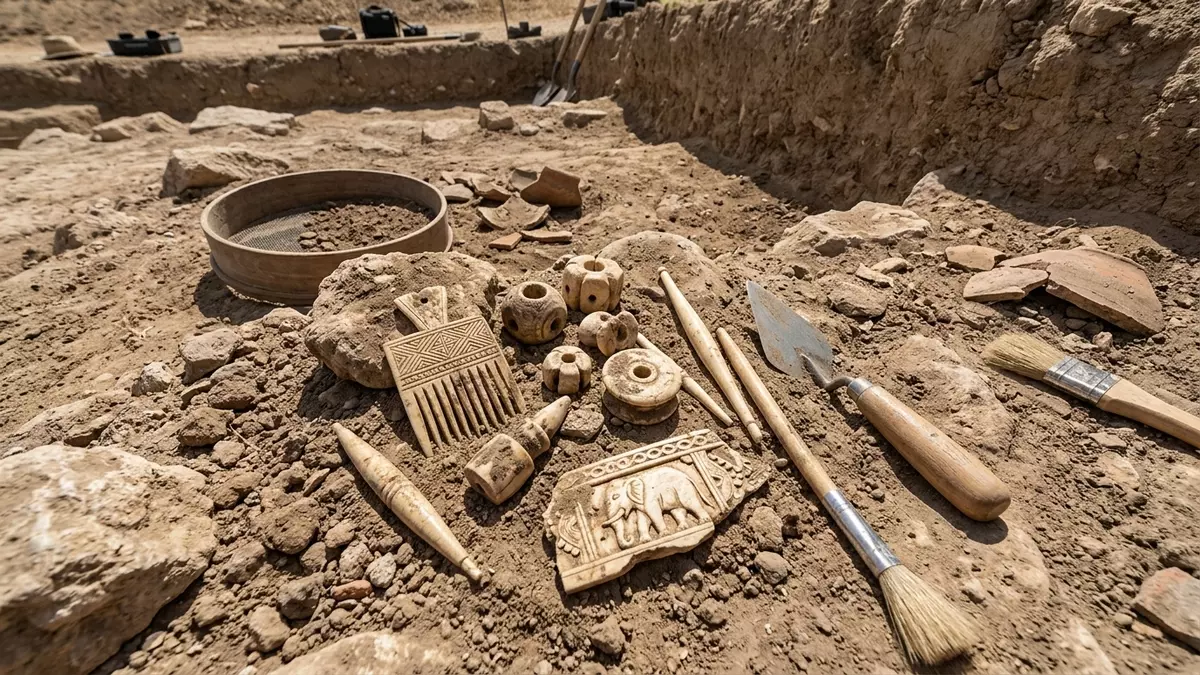
The Late Bronze Age (ca. 1600–1200 BCE): During this era of peak Egyptian New Kingdom dominance, ivory was strictly a luxury commodity. Elite craftsmen transformed it into opulent furniture inlays, intricately carved decorative boxes, and sacred votive objects for temples.
Iron Age I (ca. 1200–1000 BCE): When Egyptian regional influence collapsed and the local Canaanite city-states crumbled, the ivory market experienced a fascinating democratic shift. The material became far more utilitarian, appearing frequently in everyday household items such as grooming combs, spindle whorls, and textile spindles.
Iron Age II (ca. 1000–600 BCE): As new territorial states emerged and eventually fell under the sweeping control of the Assyrian and Babylonian Empires, ivory reverted to its elite status. Once again, it was highly sought after for high-end decorative purposes, specifically as ornate fittings for royal furniture.
Remarkably, despite these severe political disruptions, economic collapses, and cultural reorientations, the flow of ivory into the southern Levant never stopped.
Advanced Science Rejects the Narrative of Egyptian Control
To solve the mystery of the ivory’s origin, an international team of scientists conducted a rigorous, multi-disciplinary analysis of 624 distinct ivory artifacts. They utilized a powerful combination of microscopic examination, proteomics (the study of ancient proteins), and stable-isotope analysis (tracking chemical signatures left by local environments).

The scientific breakdowns yielded definitive, unexpected results:
| Material Type | Percentage of Artifacts | Geographic Source |
| Elephant Tusk | ~85% | Exclusively African Elephants (Loxodonta africana) |
| Hippopotamus Ivory | ~15% | Sourced locally in the Levant and from the Nile River |
| Boar Tusk | Rare / Trace | Sourced from local wild boar populations |
Pinpointing the African Source
The isotopic data allowed scientists to map out the exact environment where the elephants lived. The chemical signatures pointed directly away from Egypt and instead highlighted the woodland mosaic ecosystems surrounding the upper tributaries of the White Nile. This region is located south of Khartoum in modern-day Sudan—deep within sub-Saharan Africa.
This scientific revelation puts to rest a long-standing academic debate. For generations, historians argued whether Levantine ivory came from native Syrian elephant populations or via Asian trade routes. The new data proves that for the southern Levant, the elephant ivory was entirely African.
Nubian Entrepreneurs: The True Kings of the Ivory Trade
The discovery fundamentally redefines the role of Nubia (an ancient region in northeastern Africa, averaging modern-day southern Egypt and northern Sudan). While ancient Egyptian hieroglyphic accounts frequently depicted Nubians as mere passive intermediaries or servant-carriers delivering tribute, the hard physical evidence proves otherwise.
Nubian traders were highly active, independent agents who maintained a functional monopoly on the luxury trade. The supply chain operated through a decentralized, highly flexible network:
Sub-Saharan Sourcing: Nubian merchants ventured deep into sub-Saharan Africa, obtaining raw tusks through localized, small-scale exchanges with indigenous hunting communities.
Northward Transit: The merchants systematically transported the heavy tusks thousands of miles northward through diverse, challenging landscapes.
Levantine Distribution: The tusks bypasses rigid state control to directly feed the hungry commercial markets of the Levant.
A Resilient Supply Chain: This independent merchant network was so resilient that it did not collapse even when Egyptian imperial power shattered, or when the trade of vital metal commodities like copper and silver was severely disrupted. Nubian entrepreneurship kept the ivory trickling into the Levant regardless of what was happening to centralized state economies.
Rethinking Ancient Global Trade Networks
This study serves as a powerful reminder of how complex, flexible, and decentralized ancient global trade truly was. Rather than being entirely dictated by the rigid, closed economies of massive superpowers like Egypt, international commerce was heavily driven by the raw initiative of independent, entrepreneurial groups operating across massive geographic borders.
However, the researchers note that these findings are specific to the southern Levant. Ivory artifacts uncovered in the northern Levant (such as ancient Syria) or on the island of Cyprus may have relied on entirely different trade routes, potentially tapping into alternative Asian or local elephant pools.
Moving forward, expanding these precise proteomic and isotopic testing methods to a broader global dataset promises to uncover even more hidden connections tying the ancient worlds of Africa and Asia together.
Frequently Asked Questions
Where did the ivory found in the ancient southern Levant actually come from?
The vast majority (approximately 85 percent) of the elephant ivory recovered from southern Levantine archaeological sites came from African elephants living in sub-Saharan Africa. Specifically, isotopic data traces the animals back to the woodland environments near the upper tributaries of the White Nile, south of modern-day Khartoum, Sudan.
Did Egypt control the ancient ivory trade?
No. While traditional historical narratives and ancient Egyptian records often claimed total dominance over regional trade, this new empirical study proves that Egypt was not the primary gatekeeper. The trade network was sustained independently by Nubian merchants.
How did Nubian traders manage to maintain the ivory supply for 1,000 years?
Nubian traders operated a highly flexible, decentralized merchant network. They secured elephant tusks through small-scale trade with local hunters deep in Africa and transported them north to Levantine markets. Because their network was driven by independent entrepreneurship rather than a rigid state-controlled economy, the supply chain survived the collapse of major empires and disruptions to other commodities like metals.
What scientific methods did researchers use to trace the ivory’s origin?
The research team analyzed 624 ancient ivory artifacts using three advanced scientific methods: microscopy to examine physical structure, proteomics to determine the specific animal species via ancient protein structures, and stable-isotope analysis to identify the distinct geographic and environmental signature embedded within the ivory.
Was all ancient Levantine ivory made from elephants?
Not all of it. While elephant tusks made up roughly 85 percent of the analyzed artifacts, about 15 percent of the items were crafted from hippopotamus ivory sourced from the Nile and local Levantine river valleys. A very small number of minor items were made using wild boar tusks.