
Table of Contents
- 1. Unlocking the Secret History of Eilean Donan
- 1.1. Peering Beyond the Tourist Image
- 2. The Gravoir: European High Fashion Meets Scottish Craft
- 2.1. Intricate Medieval Artistry
- 3. A Treasure Trove of Daily Life Inside the Fortress
- 3.1. Master Metalworking and Defense
- 3.2. Leisure, Games, and Childhood Play
- 4. The Dramatic Rise, Fall, and Rebirth of an Island Stronghold
- 4.1. Ruin by Rebellion
- 5. Conclusion: From Romantic Icon to Living History
- 6. Frequently Asked Questions
- 6.1. What is a gravoir and how was it used?
- 6.2. Why is the Eilean Donan gravoir discovery so significant?
- 6.3. Where can the public see the artifacts found at the castle?
- 6.4. What happened to Eilean Donan Castle after the medieval period?
- 6.5. What other types of objects were found during the excavation?
Rare Medieval Styling Tool Discovered at Iconic Scottish Castle
An extraordinary archaeological breakthrough at Eilean Donan Castle has dramatically reshaped our understanding of high-status life in the medieval Scottish Highlands. During recent excavation efforts at the famous fortress, researchers unearthed a highly rare, 13th-century hair-grooming implement that offers an unprecedented glimpse into early Scottish fashion and personal care.
The artifact, professionally identified as a gravoir, represents the first object of its kind ever recovered in Scotland. It is one of only three known examples in the entire United Kingdom. Now safely housed within the National Museums Scotland collection, this delicate beauty tool proves that the medieval residents of this remote stronghold were not just rugged warriors focused on defense, but elite individuals deeply connected to the sophisticated high-fashion trends of continental Europe.
Rare Medieval Styling Tool Discovered at Iconic Scottish Castle
Unlocking the Secret History of Eilean Donan
Eilean Donan Castle is globally recognized as an enduring symbol of Scotland. Situated on a small tidal island where three majestic sea lochs meet, the fortress serves as the dramatic gateway to the Isle of Skye. Its striking architecture has captured the public imagination for decades, famously serving as the backdrops for major Hollywood films like Highlander and the James Bond classic The World Is Not Enough.
Peering Beyond the Tourist Image
Despite its immense modern fame and popularity among travelers, the actual day-to-day realities of the castle during its 13th and 14th-century heyday remained shrouded in historical mystery. To peel back these layers, archaeological experts at FAS Heritage launched targeted excavations at the site.
The team aimed to gather physical evidence of how life was lived inside the stone walls during the castle’s early operational peak. The discovery of the gravoir was the crown jewel of these investigations, shedding unexpected light on the personal grooming habits of the Highland aristocracy.
The Gravoir: European High Fashion Meets Scottish Craft
A gravoir was a specialized, pointed instrument utilized by upper-class men and women during the Middle Ages to parting, section, and arrange hair into the highly complex, braided hairstyles favored by European royalty and nobility.

While typical continental gravoirs discovered throughout France, Germany, and England were carved from luxury imported elephant ivory, the Eilean Donan artifact features a distinctly local twist. The Scottish tool was skillfully crafted from the antler of a local red deer, demonstrating a brilliant blend of European style and regional resourcefulness.
Intricate Medieval Artistry
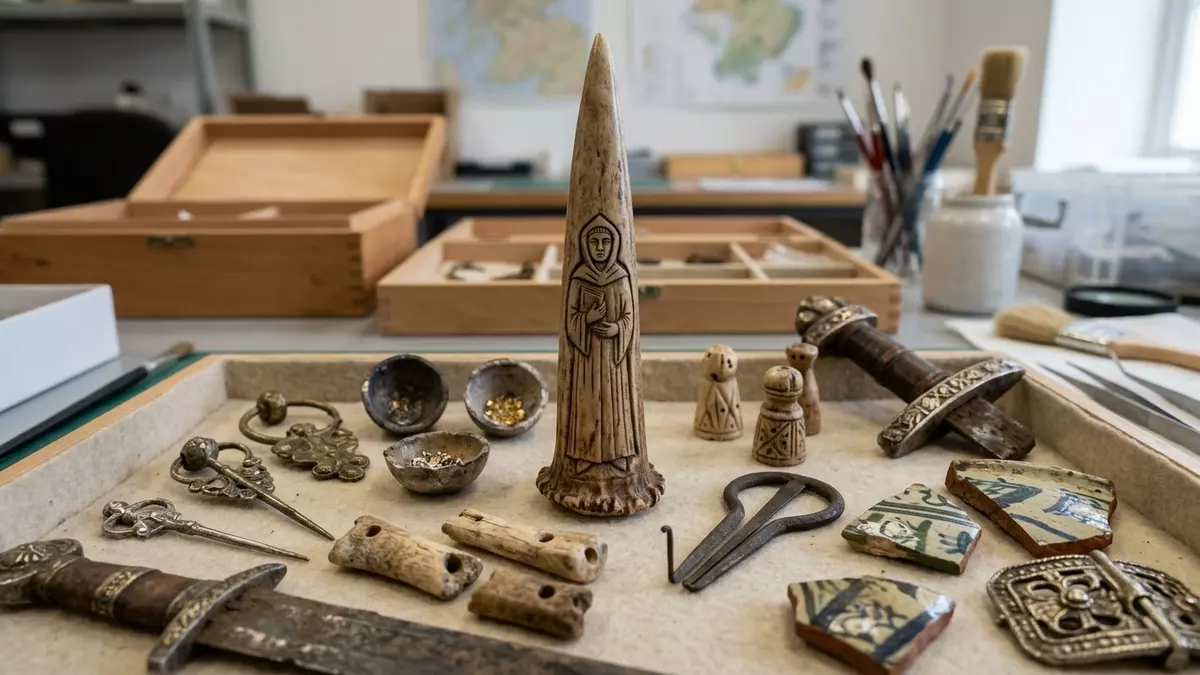
Despite being made from antler rather than ivory, the level of craftsmanship remains incredibly high. The tool is adorned with an incised, hand-carved depiction of a human figure wearing a traditional hood and holding a book.
This specific imagery and the presence of the tool itself indicate that the inhabitants of Eilean Donan were highly literate, cultured, and actively participating in the broader courtly cultures of the era. The finding fundamentally challenges the old historical stereotype of the medieval Highlands as an isolated wilderness cut off from mainstream European society.

A Treasure Trove of Daily Life Inside the Fortress
The remarkable hair tool is just one component of a massive archaeological collection retrieved from the site. Hundreds of newly discovered artifacts have been carefully transported to the National Museums Collection Centre in Edinburgh, where they occupy roughly 80 storage boxes.
Together, these items paint a vivid, multi-dimensional picture of a bustling, self-sustaining medieval community.
Master Metalworking and Defense
The excavation yielded an astonishing array of metal artifacts, including decorative dress pins, brooches, and specialized crucibles still bearing microscopic traces of silver and gold. These industrial finds reveal that the castle housed its own highly skilled metalsmiths.
Rather than relying purely on external trade, the fortress was fully capable of manufacturing its own luxury jewelry, utilitarian belt buckles, and heavy weaponry like swords directly on-site. Historians now consider this collection to be one of the most important medieval metalworking assemblages ever discovered in Great Britain.
Leisure, Games, and Childhood Play
Beyond items of war and vanity, the collection provides an intimate look into how the castle’s residents spent their free time. The excavations brought up a diverse variety of recreational items that crossed all social classes, from elite lords to working-class families:
Carved Gaming Pieces: Intricately shaped from animal bone, these items indicate that board games were a popular pastime in the great hall.
Musical Instruments: The discovery of an iron jaw harp proves that live music echoed through the stone corridors.
Ancient Toys: Researchers found “buzz bones”—animal bones carefully drilled with central holes and threaded with cord, which children spun rapidly through the air to create a whizzing or buzzing musical sound.
Imported Pottery: Fragments of high-quality ceramic vessels show that the castle frequently entertained guests with fine dining and imported goods.
The Dramatic Rise, Fall, and Rebirth of an Island Stronghold
The newly discovered artifacts provide crucial context to the turbulent timeline of Eilean Donan. Originally built in the early 13th century as a defensive bastion against Norse raiders, the castle rapidly evolved into an influential stronghold of Highland Gaelic lordship.
However, by the close of the 15th century, regional power dynamics shifted, and the fortress began to lose its strategic geopolitical importance. By the dawn of the 18th century, the structure sat largely abandoned and neglected.
Ruin by Rebellion
The castle’s ultimate military catastrophe occurred during the Jacobite uprisings of 1719. Spanish troops backing the Jacobite cause occupied the fortress, prompting the British government to dispatch three heavily armed warships to the loch. The naval vessels bombarded the castle walls, and government forces subsequently detonated the fortress’s own gunpowder magazine, reducing the grand medieval structure to a shattered, hollow ruin.
For nearly two centuries, Eilean Donan remained a derelict, roofless shell. It wasn’t until the early 20th century that Lieutenant Colonel John MacRae-Gilstrap meticulously reconstructed the castle based on surviving ground plans, transforming the ruins into the stunning historic monument seen today.
Conclusion: From Romantic Icon to Living History
The discovery of the 13th-century gravoir and its accompanying artifacts marks a major turning point for Scottish heritage. This research ensures that Eilean Donan will no longer be viewed merely as a photogenic tourist stop or a romantic backdrop for movies.
Instead, the material evidence firmly establishes the castle as having been a vibrant, cosmopolitan medieval community. By adapting elite continental fashions using local Scottish red deer antlers, the historic residents of the castle left behind a permanent testament to the ingenuity, taste, and interconnectedness of medieval Highland society.
Frequently Asked Questions
What is a gravoir and how was it used?
A gravoir is a rare, slender medieval styling tool featuring a pointed end. It was used by elite men and women during the Middle Ages to precisely part, section, and style their hair into the intricate, elaborate arrangements that were popular in royal courts at the time.
Why is the Eilean Donan gravoir discovery so significant?
This particular find is highly significant because it is the first gravoir ever discovered anywhere in Scotland, and it is one of only three known to exist in the entire United Kingdom. Additionally, while continental European versions were typically carved from expensive imported ivory, this Scottish version was uniquely crafted from local red deer antler.
Where can the public see the artifacts found at the castle?
The newly discovered medieval artifacts, including the rare gravoir, are currently preserved and curated within the National Museums Scotland collection, with major research operations centered in Edinburgh. Portions of the wider collection are slated for future public historical displays.
What happened to Eilean Donan Castle after the medieval period?
After losing its strategic importance in the late 15th century, the castle fell into relative disuse. During the Jacobite uprising of 1719, it was occupied by Spanish forces and subsequently blown up by the British military. It sat completely ruined for nearly 200 years until it was fully rebuilt in the early 20th century.
What other types of objects were found during the excavation?
The extensive excavations uncovered a massive collection of daily life objects. These include master-crafted gold and silver smithing crucibles, clothing brooches, iron jaw harps, bone gaming pieces for entertainment, and primitive children’s toys known as “buzz bones” made from drilled animal skeletal remains.