
Table of Contents
- 1. Shifting Paradigms in Human Cognitive Evolution
- 2. Unearthing the Core Middle Paleolithic Sites
- 3. Inside the Lab: Advanced Microscopic and Chemical Analysis
- 4. The Anatomy of a Prehistoric Crayon
- 4.1. The Yellow Ochre Crayon
- 4.2. The Red and Orange Artifacts
- 5. Practical Utility vs. Symbolic Expression
- 6. Implications for Paleolithic Communication
- 7. Conclusion
- 8. Frequently Asked Questions
- 8.1. What did the new study discover about Neanderthals?
- 8.2. How old are these prehistoric ochre crayons?
- 8.3. What does the 4.5-centimeter yellow ochre piece look like?
- 8.4. What are the other non-utilitarian pieces found in the study?
- 8.5. What scientific methods were used to verify the discovery?
16 Prehistoric Ochre Tools Reveal Lost Neanderthal Art
For generations, popular culture and traditional science framed Neanderthals as primitive, muscle-bound hominids who lacked the capacity for abstract thought, language, and artistic expression. According to this old narrative, the spark of creativity and symbolic communication belonged exclusively to our direct ancestors, Homo sapiens. However, a pioneering archaeological study has shattered this long-standing evolutionary bias.
By conducting a rigorous forensic analysis on a series of ancient mineral fragments recovered from Eastern Europe, an international team of scientists has uncovered definitive proof that Neanderthals manufactured and utilized specialized drawing instruments. The discovery of modified ochre pieces—including a meticulously crafted, intentionally pointed crayon—demonstrates that these ancient hominids engaged in deliberate symbolic behavior at least 42,000 years ago, and potentially as far back as 70,000 years into the deep past.
16 Prehistoric Ochre Tools Reveal Lost Neanderthal Art
Shifting Paradigms in Human Cognitive Evolution
The boundaries separating modern humans from Neanderthals have been eroding for years due to a steady stream of archaeological discoveries. Evidence of Neanderthal cave paintings, hand stencils, and personal ornaments made from raptor talons has gradually forced a reassessment of their mental capabilities. Yet, critics often dismissed these early discoveries as isolated anomalies or instances where Neanderthals merely copied behaviors after interacting with migrating Homo sapiens.
This latest study, published in the journal Science Advances, permanently alters that conversation. The discovery of an organized, curated toolkit of pigment marking devices proves that symbolic behavior was deeply embedded within Neanderthal cultural systems long before modern humans came to dominate the European continent. These findings suggest that the cognitive hardware required for abstract representation, identity expression, and visual communication was a shared ancestral trait rather than a unique evolutionary monopoly held by Homo sapiens.
Unearthing the Core Middle Paleolithic Sites
The definitive evidence for this behavioral breakthrough comes from a thorough re-examination of legacy collections gathered from four key Middle Paleolithic archaeological sites located across Crimea and Ukraine:
Zaskalnaya V
Zaskalnaya VI
Prolom II
Mukhovets

    [CRIMEAN & UKRAINIAN NEANDERTHAL OCCUPATION HUBS]
                           │
       ┌───────────────────┼───────────────────┐
       ▼                   ▼                   ▼
  Zaskalnaya V & VI     Prolom II           Mukhovets
  (Micoquian Culture)  (Rock Shelters)     (Open-Air Sites)
These specific rock shelters and open-air encampments were historically occupied by Micoquian Neanderthals, a regional cultural group famous for producing distinctive, finely crafted bifacial stone handaxes and specialized scraping knives. Because these layers are securely sealed and dated between 42,000 and 70,000 years old, they provide an uncontaminated window into a time when Neanderthals were the sole human inhabitants of these sub-arctic European landscapes.
Inside the Lab: Advanced Microscopic and Chemical Analysis
To determine whether the recovered mineral fragments were altered by human hands or simply shaped by natural geological processes, the research team, led by Francesco d’Errico of the University of Bordeaux, subjected 16 distinct ochre fragments to a battery of high-resolution laboratory tests.
Instead of relying on basic visual inspections, the scientists utilized non-destructive portable X-ray fluorescence (pXRF) to map the precise elemental composition and iron oxide purity of the minerals. They paired this with scanning electron microscopy (SEM) to evaluate the microscopic texture, surface abrasions, and hidden wear patterns etched into the stone faces.
+-----------------------------------------------------------------+
|                 THE FORENSIC DIAGNOSTIC PIPELINE                |
|                                                                 |
|   [Ochre Mineral] ──> [pXRF Analysis] ──> Maps Iron Oxide Purity|
|                           │                                     |
|                           └──> [SEM Microscopy] ──> Detects Wear|
+-----------------------------------------------------------------+
The laboratory readouts revealed a highly systematic pattern of intentional modification. The Neanderthals had deliberately altered the raw iron-rich minerals through a series of specific mechanical actions, including grinding, scoring, intentional flaking, and superficial scraping. While many of the fragments bore signs of simple utilitarian processing, a small cluster of items stood out as highly specialized, non-functional tools.
The Anatomy of a Prehistoric Crayon
Out of the 16 analyzed specimens, three specific ochre fragments provided undeniable proof of active marking behavior that extended far beyond everyday survival tasks.
The Yellow Ochre Crayon
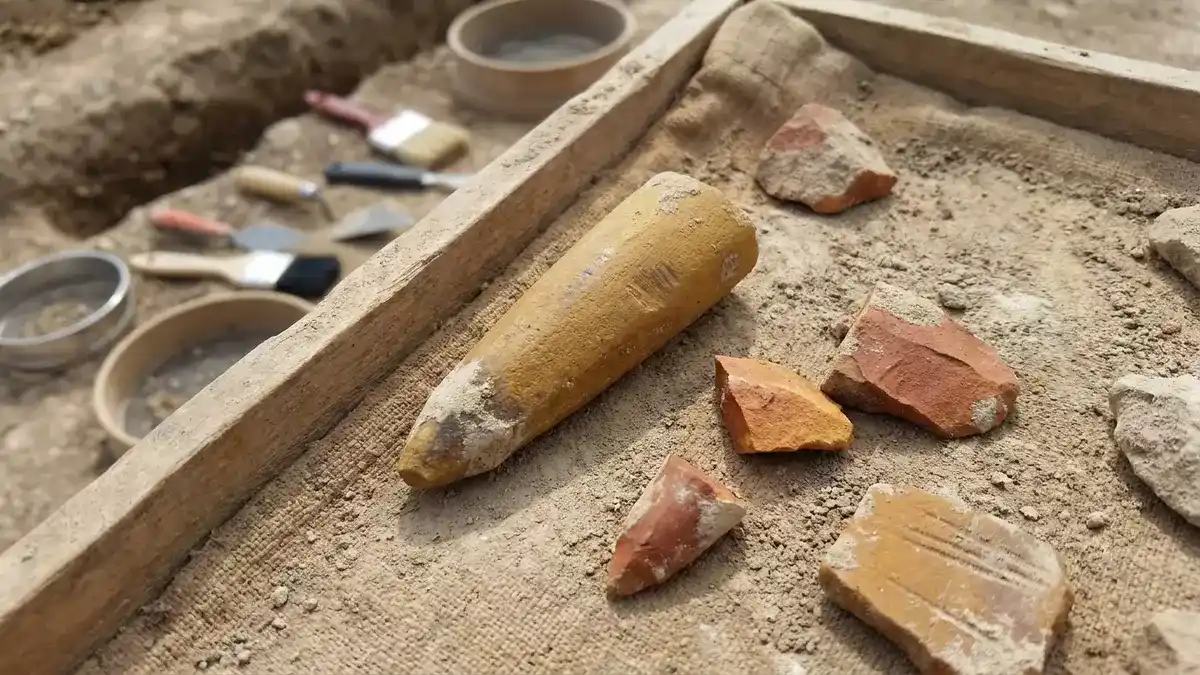
The absolute crown jewel of the collection is an elongated fragment of high-purity yellow ochre measuring approximately 4.5 centimeters in length. The forensic microscopy revealed that this piece had been purposefully ground and whittled down on multiple sides to create a distinct, tapered, pencil-like tool featuring a functional pointed tip.
                    [THE 4.5 CM OCHRE CRAYON PROFILE]

      ═══════════════════════════════════════════════════╦══>
     (   Conical Grip Body Stated by Grinding   )    ║ Pointed Tip
      ═══════════════════════════════════════════════════╩══>
                                                         │
                                                         ▼
                                            *Micro-Resharpening Scars*
Crucially, the scanning electron microscope exposed miniature resharpening scars and localized pressure-wear facets concentrated directly on the conical tip. This pattern only forms when an individual repeatedly uses a soft mineral stick to draw, sign, or apply pigments onto a firm, receptive surface—such as limestone cave walls, animal hides, or human skin.
The Red and Orange Artifacts
The second key artifact is a fragment of rich red ochre that displays identical structural geometries, appearing to be the snapped tip of a second, larger crayon-shaped tool. The third piece consists of a flat, vibrant orange tablet of ochre. Rather than being pulverized into powder, this tablet features highly polished faces framed by deep, deliberately engraved parallel grooves, indicating a systematic design process that served an abstract, non-utilitarian purpose.
Practical Utility vs. Symbolic Expression
Historically, whenever archaeologists discovered ochre at Neanderthal sites, mainstream science defaulted to strictly practical explanations. Iron-rich minerals like ochre are versatile materials that served multiple utilitarian purposes in the Paleolithic world. However, the unique modifications found on the Crimean crayons prove that a clear boundary had been crossed from basic survival utility to high-level cultural expression.
| Utilitarian/Functional Uses of Ochre | Symbolic/Artistic Expressions of Ochre |
| Pulverized as an ingredient in complex hunting glues | Shaped into crayons for drawing symbolic cave motifs |
| Applied to raw animal pelts to assist in tanning hides | Used for personal body ornamentation and skin painting |
| Utilized as a natural insect repellent or sunblock | Engraved with parallel lines to encode abstract data |
| Deployed as a medicinal antiseptic for open wounds | Infused into funeral rituals to mark tribal identity |
The intentional preservation and repetitive maintenance of these crayon tips indicate that they were treated as valued personal possessions. They were curated, protected, and repeatedly resharpened over an extended period, reflecting a level of forward planning and long-term cultural investment that matches our own ancestors.
Implications for Paleolithic Communication
What were Neanderthals drawing with these 42,000-year-old crayons? While the soft surfaces they marked—such as skin, clothing, or wooden posts—have long since decayed, the tools themselves speak volumes about how their society functioned.
The production of visual symbols is a fundamental component of advanced human communication. These markings likely played a critical role in defining group identity, marking territorial boundaries, signaling social rank during tribal gatherings, or preserving sacred knowledge across generations. By proving that Neanderthals were actively manufacturing their own artistic media, this discovery permanently bridges the intellectual chasm that once separated our species, painting a far richer, more empathetic portrait of our ancient European cousins.
Conclusion
The golden age of viewing Neanderthals as cognitive evolutionary failures is officially over. The beautifully preserved ochre crayons recovered from the ancient soil of Crimea and Ukraine demonstrate a clear capacity for abstract thought, long-term planning, and symbolic storytelling. As analytical chemistry and microscopic forensics continue to unlock the secrets of legacy museum collections, we are discovering that the ancient roots of human creativity did not grow on a single isolated branch, but flourished across a deeply interconnected prehistoric family tree.
Frequently Asked Questions
What did the new study discover about Neanderthals?
The study confirmed that Neanderthals deliberately manufactured and maintained pigment crayons out of raw ochre minerals. This proves they engaged in symbolic marking and abstract behavior, challenging the outdated view that artistic expression was unique to modern humans.
How old are these prehistoric ochre crayons?
The ochre fragments were recovered from Middle Paleolithic sites in Crimea and Ukraine that date between 42,000 and 70,000 years old, placing them firmly within the era of absolute Neanderthal dominance in Europe.
What does the 4.5-centimeter yellow ochre piece look like?
The fragment was intentionally ground on its sides to create a distinct, tapered, crayon-like tool with a functional pointed end. Microscopic analysis showed clear signs of pressure wear and tiny scars from being repeatedly resharpened for drawing.
What are the other non-utilitarian pieces found in the study?
Alongside the yellow crayon, researchers identified a red ochre fragment that appears to be the broken tip of a larger drawing stick, as well as a flat orange stone featuring polished surfaces and deliberately engraved parallel grooves.
What scientific methods were used to verify the discovery?
The international research team deployed non-destructive portable X-ray fluorescence (pXRF) to analyze the chemical purity of the iron minerals, combined with scanning electron microscopy (SEM) to identify human-made tool marks and tip-wear patterns.