
Table of Contents
- 1. Reconstructing the Defenses of Nya Lödöse
- 2. A Tale of Two Cities: Urban Splendor Meets Semi-Rural Life
- 3. The Turbulent Cycle of Relocation and Renewal
- 4. Preserving a Sunken Urban Ecosystem
- 5. Frequently Asked Questions
- 5.1. What is Nya Lödöse?
- 5.2. Where was this forgotten city discovered?
- 5.3. What defensive structures did archaeologists uncover?
- 5.4. Why was Nya Lödöse abandoned multiple times?
- 5.5. How did the wooden artifacts survive for 400 years?
Buried Renaissance City Found Under Gothenburg Alters Swedish History
A major urban excavation in Sweden has revealed the remarkably preserved remains of a forgotten 16th-century metropolis buried directly beneath a bustling modern shipping hub. While conducting rescue archaeology ahead of infrastructure developments in Gothenburg’s Gamlestaden district, a team of researchers uncovered the structural footprint of Nya Lödöse—a vital Renaissance-era city that served as a strategic predecessor to modern Gothenburg before vanishing from maps over four centuries ago.
The complex investigation, spearheaded by the specialized archaeological agency Arkeologerna under the supervision of the County Administrative Board, focused extensively on the southern boundaries of the historical settlement near the modern Olskroken sector. Despite centuries of heavy industrial activity and factory construction dating from the 1870s onward, substantial archaeological layers remained locked securely beneath building foundations, providing an extraordinary window into early modern Swedish urbanism.
Buried Renaissance City Found Under Gothenburg Alters Swedish History

Reconstructing the Defenses of Nya Lödöse
Nya Lödöse initially developed from the late 1400s as a crucial economic outpost for Sweden, which desperately required a trading gateway to the North Sea that bypassed the heavy customs duties controlled by Denmark. As geopolitical tensions escalated around 1530, municipal leaders and military engineers constructed a massive earth rampart and protective moat along the city’s southern edge to establish a defensible perimeter.
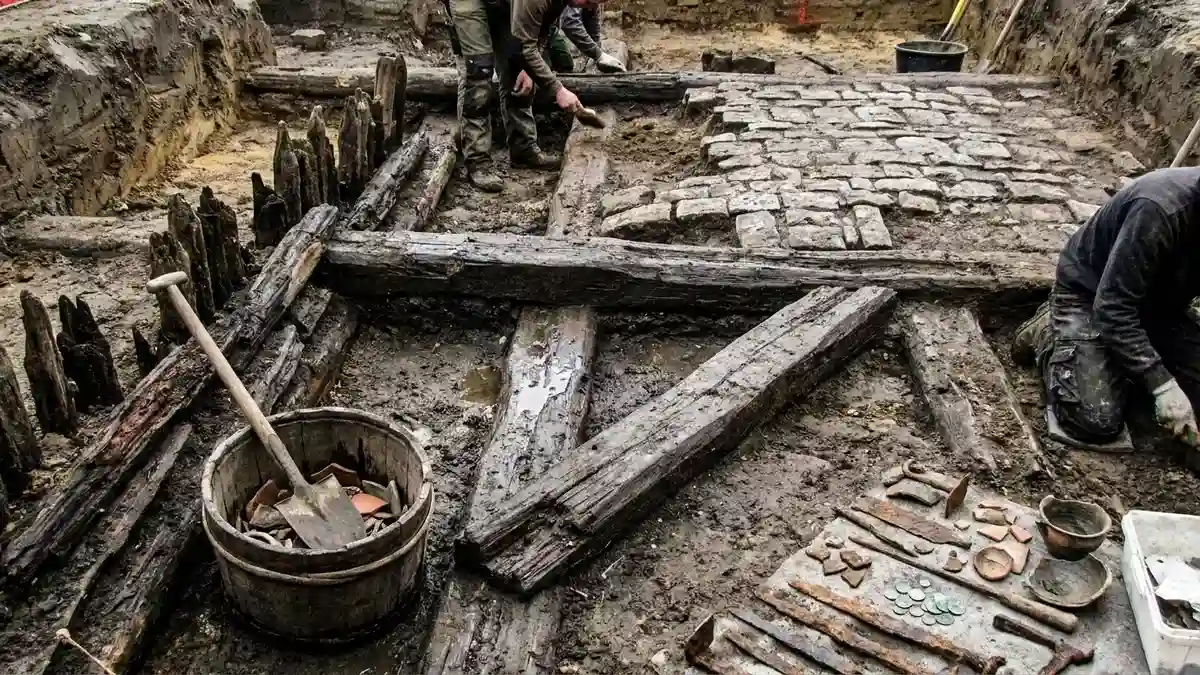
Where the primary urban thoroughfare intersected this fortified boundary, engineers constructed a monumental, stone-paved entry checkpoint known as the southern gate. The recent excavations successfully exposed the massive timber foundations, defensive palisades, and heavy soil reinforcements used to stabilize the gate complex over marshy clay. Directly adjacent to this thoroughfare, archaeologists identified the structural remains of a building interpreted as the municipal tollhouse, where goods arriving from provincial hinterlands were systematically logged, weighed, and taxed.
       [THE SOUTHERN DEFENSIVE PERIMETER — CIRCA 1530]

   [OUTER LANDS] ───> [PROTECTIVE MOAT] ───> [WOODEN PALISADE WALL]
                                                    │
                                                    ▼
   [INNER URBAN SPACE] <─── [TOLLHOUSE] <─── [STONE-PAVED SOUTHERN GATE]
A Tale of Two Cities: Urban Splendor Meets Semi-Rural Life
The data pulled from the southern district has provided a stark contrast to historical descriptions of Nya Lödöse’s densely packed, industrial northern sector. Inside the southern earth ramparts, the city adopted an open, semi-rural layout characterized by modest wooden households interspersed with highly organized, private cultivation plots and kitchen gardens.
This distinct neighborhood organization proves that Nya Lödöse was a hybrid community, seamlessly fusing specialized international commerce with localized agricultural subsistence. Thousands of recovered artifacts have allowed researchers to reconstruct the daily domestic rhythms of the inhabitants, including:
Imported Ceramics: Shards of fine stoneware and earthenware highlighting active trade networks with Germany and the Netherlands.
Currency and Commerce: Well-preserved silver and copper coins marking localized marketplace transactions.
Daily Utilities: Iron tools, leather footwear elements, and glass shards charting household tasks.
Devotional Objects: Small religious tokens, crucifixes, and pilgrim badges providing a personal look into the spiritual beliefs of the community during the transition toward Protestantism.
The Turbulent Cycle of Relocation and Renewal
The historical timeline of Nya Lödöse was defined by constant upheaval, driven entirely by the crown’s shifting military strategies to protect Sweden’s narrow corridor to the western ocean.
+-------------------------------------------------------------------------+
|                  THE CHRONOLOGICAL SHIFTS OF NYA LÖDÖSE                 |
|                                                                         |
|  1400s        1547                  1560s               1624            |
|  [ FOUNDED ] ──> [ FORCED EXODUS ] ──> [ REOCCUPATION ] ──> [ FINAL MOVE ]  |
|  • Port Town     • Moved to Älvsborg   • Walls Repaired    • Moved to new   |
|                  • Houses Abandoned    • Gate Rebuilt      • Gothenburg City|
+-------------------------------------------------------------------------+
In 1547, the crown ordered the absolute abandonment of the town, forcing the entire population to relocate southwest to fortify the newly established settlement of Älvsborg. This engineered exile lasted nearly twenty years before geopolitical shifts allowed residents to reoccupy Nya Lödöse.
Upon returning, the community immediately set to work repairing the compromised earth ramparts, rebuilding houses directly on top of older footprints, and re-establishing the main street. By the early 1600s, as Sweden consolidated military control over the region, the southern gate underwent a massive architectural overhaul using updated timber techniques. This final renaissance was short-lived; in 1624, King Gustavus Adolphus ordered the permanent dissolution of Nya Lödöse, moving its citizens to populate his newly designed, heavily fortified showpiece city: modern Gothenburg.
Preserving a Sunken Urban Ecosystem
Following its final abandonment in 1624, the abandoned city blocks reverted into agricultural pastures, and the once-formidable moats and ramparts were slowly filled with topsoil, sealing the Renaissance architecture underneath.
| Excavation Feature | Structural Materials | Preservation Factor | Archaeological Significance |
| Southern Gate | Heavy timber piles, stone pavers | High-moisture clay occlusion | Maps the official entry point and toll grid of the city |
| Refuse Pits | Preserved wooden barrels | Anaerobic mud encapsulation | Contains 17th-century ceramics and household waste |
| Cultivation Plots | Stratified soil profiles | Undisturbed pasture capping | Reveals agricultural dependencies within town borders |
Among the most remarkable organic discoveries was an intact wooden barrel found resting deep within an ancient disposal pit. Used primarily as a domestic refuse container during the first half of the 17th century, the barrel contained a wealth of consumer waste, capped by a wooden spade still stuck vertically into the natural clay floor by the last person to work the plot before the final 1624 relocation.
All recovered architectural components and artifacts are undergoing intensive lab analysis and conservation to prevent decay from modern air exposure. Scholars emphasize that the extensive Nya Lödöse datasets provide an invaluable baseline for studying early modern Scandinavian urbanization, illustrating how everyday communities lived, worked, and dynamically adapted within a heavily militarized border city on the frontier of an expanding empire.
Frequently Asked Questions
What is Nya Lödöse?
Nya Lödöse was a prominent Swedish city established in the late 15th century. It served as a vital trading port and strategic military outpost for Sweden before being permanently abandoned in 1624 when its population was moved to found modern Gothenburg.
Where was this forgotten city discovered?
The remains of the city were discovered buried directly beneath modern building foundations and industrial zones within the Gamlestaden district of Gothenburg, Sweden, specifically around the Olskroken sector.
What defensive structures did archaeologists uncover?
The excavation exposed a massive earth rampart and moat system built around 1530, alongside the timber foundations and stone-paved roadway of the southern gate, which functioned as a secure entryway and toll collection checkpoint.
Why was Nya Lödöse abandoned multiple times?
The town was subjected to state-mandated relocations. In 1547, the population was moved to fortify the town of Älvsborg. After returning decades later, they were permanently relocated in 1624 to populate the newly built city of Gothenburg.
How did the wooden artifacts survive for 400 years?
The wooden artifacts, including structural palisades, gate foundations, and an intact refuse barrel with a spade, survived because they were buried in thick, wet natural clay. This created an oxygen-deprived (anaerobic) environment that prevented standard dry rot and decomposition.