
Table of Contents
- 1. Unearthing the “Bavarian Princess” and Hidden Generations
- 2. Inside the Severin Horizon: Life on the Edge of an Empire
- 2.1. The Anatomy of a Fatal Bronze Age Ambush
- 3. Bridging the Gap: From Roman Province to Medieval Bavaria
- 4. Frequently Asked Questions
- 4.1. Where is Bad Füssing and why is it historically important?
- 4.2. Who was the “Bavarian princess” found at the site?
- 4.3. What is the “Severin Horizon”?
- 4.4. How did scientists realize the cemetery was older than originally thought?
- 4.5. What did the skeletal remains reveal about violence during this era?
Bavarian Graves Unearth Secrets of Migration, War, and Falling Rome
What began as a routine rescue excavation in 2021 has completely rewritten the early medieval history of southeastern Germany. While conducting a standard archaeological survey in Bad Füssing, a town located in Bavaria’s Passau district along the Inn Valley, researchers stumbled upon a sprawling ancient cemetery.
Instead of a typical communal burial ground, the team uncovered an extraordinary timeline of human movement, brutal violence, and cultural integration playing out precisely as the western Roman Empire collapsed. The overlapping generations buried at the site reveal that the transition into the Middle Ages was not a sudden, clean break, but a complex, messy melting pot of shifting identities.
Bavarian Graves Unearth Secrets of Migration, War, and Falling Rome
Unearthing the “Bavarian Princess” and Hidden Generations
The archaeological team initially uncovered roughly 90 graves in total, initially estimating that the entire burial ground operated during the sixth and seventh centuries CE. This specific era is deeply significant in Central European history, as it directly aligns with the emergence and consolidation of the early Bavarian elite.
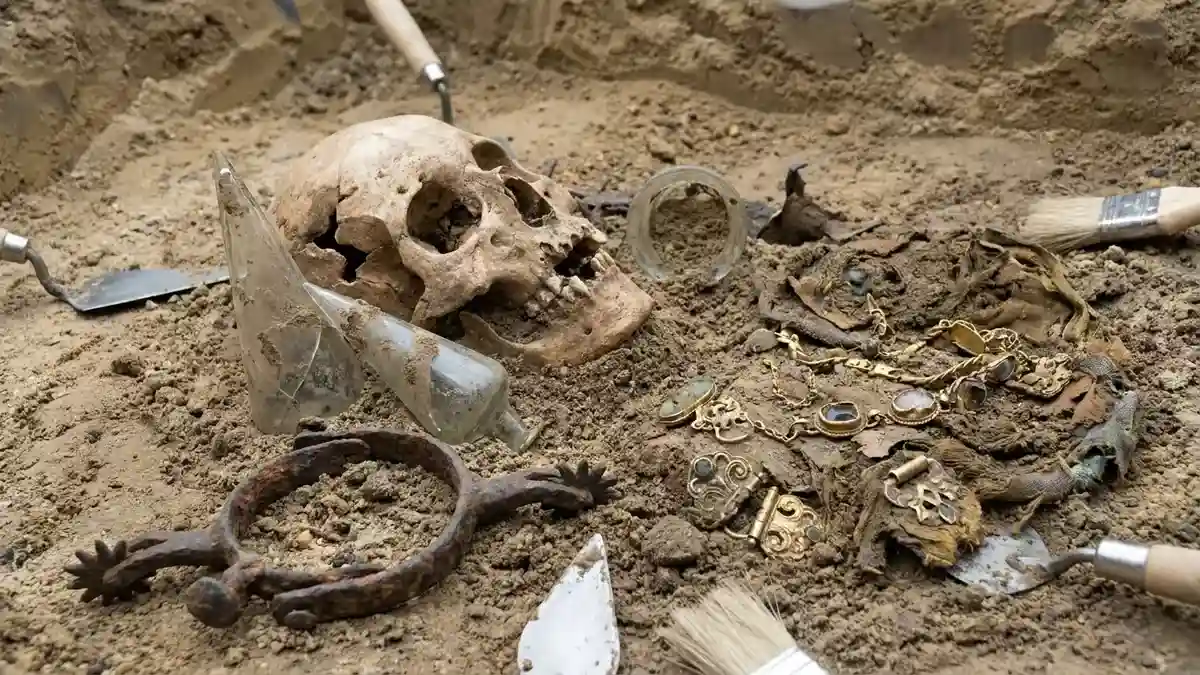
One particular burial immediately captured global attention. Archaeologists discovered the resting place of an aristocratic woman who was buried with an astonishing array of luxury items. Adorned with exceptionally fine metalwork, intricate jewelry, and high-status imported materials, she was quickly nicknamed the “Bavarian princess” by the research team. Her grave goods served as a vivid baseline for the immense wealth and prestige commanded by regional elites during the height of the early medieval period.
+------------------------------------------------------------+
|            BAD FÜSSING CEMETERY TIMELINE                   |
|                                                            |
|  [MID-5TH CENTURY CE]                   [6TH-7TH CENTURY CE] |
|  • "Severin Horizon"                    • "Bavarian Princess"|
|  • Falling Roman Administration         • Rise of Bavarians  |
|  • Pointed Glass Beakers & Spurs        • Fine Gold & Jewelry|
|                                                            |
|  <------------------ 120-YEAR GAP -----------------------> |
+------------------------------------------------------------+
However, as the excavation pushed deeper into the surrounding earth, the historical narrative began to splinter. Several graves located right next to the princess contained artifacts that felt completely out of place for the sixth century. Intrigued by these early ceramic vessels, older styles of garment clasps, and delicate glass beakers featuring distinct pointed bases, scientists ordered precise radiocarbon dating on 16 selected graves.

The lab results completely blindsided the team. The cemetery hadn’t started with the princess; it had actually been established around 450 CE—roughly 120 years before she was ever laid to rest.
Inside the Severin Horizon: Life on the Edge of an Empire
By pushing the cemetery’s origin back to the mid-fifth century, the radiocarbon dating placed the site squarely within a chaotic, dimly understood historical window known to scholars as the Severin Horizon. Named after Saint Severinus of Noricum, this era represents the final, flickering moments of Roman provincial administration along the Danube and Eastern Alps.
During this time, official Roman military legions were retreating or dissolving due to a lack of pay and central support from a collapsing Rome. The Bad Füssing site proves that as official Roman governance dissolved, the Inn Valley did not become an unpopulated wasteland. Instead, non-Roman, migratory communities from across the border immediately moved into the landscape, burying their dead in the exact same spaces and seamlessly interacting with the remaining local populations.
The Anatomy of a Fatal Bronze Age Ambush
While the artifacts tell a story of cultural mixing, the human skeletons reveal the raw, physical dangers of living through an imperial collapse. Anthropological examinations of the fifth-century remains provide a visceral look at the violence of the era, epitomized by the skeleton of one middle-aged male.
Forensic analysis of the man’s thigh bones revealed distinct skeletal wear patterns that only develop after a lifetime spent tightly gripping a saddle, confirming he was a highly experienced, career horseman. This assessment was further supported by the presence of a iron riding spur buried directly with him. However, it was his skull and legs that told the terrifying story of his final moments.
                  [THE FATAL CLOSE-COMBAT ENCOUNTER]
                                  │
                                  ▼
                        1. SWORD BLOW TO LEG
                   (Disables rider, throws him off)
                                  │
                                  ▼
                     2. TWO SWIFT CRANIUM STRIKES
                    (Finishes fallen combatant)
The rider suffered a catastrophic sword blow to his leg, a classic tactical strike designed to disable a mounted combatant or bring down his horse. Once thrown to the dirt, his attacker closed in, delivering two heavy, sharp strikes directly to his skull. Because the bone showed absolutely zero signs of healing or cellular remodeling, anthropologists know these injuries occurred simultaneously and were immediately fatal. He was caught in a fast-paced, unforgiving skirmish, knocked from his mount, and executed on the ground.
Bridging the Gap: From Roman Province to Medieval Bavaria
For centuries, historians have struggled to piece together exactly what happened in the decades separating the departure of Roman officials from the arrival of the first documented medieval duchies. Written records from this dark age are notoriously scarce, fragmented, and heavily biased.
The graves at Bad Füssing effectively bridge this historical chasm. They prove that the transition from a Roman province to a medieval Germanic territory was defined by continuity rather than wholesale destruction. New populations migrated into the valley, bringing their own distinct customs—like burying dead loved ones with pointed glass beakers—while simultaneously adopting and adapting to the existing local culture. It was out of this prolonged, generation-spanning blend of conflict, survival, and cohabitation that the early Bavarian identity was truly forged.
Frequently Asked Questions
Where is Bad Füssing and why is it historically important?
Bad Füssing is a town located in the Passau district of Bavaria, Germany, situated along the strategically vital Inn Valley. It is historically significant because its newly discovered cemetery provides a rare physical record of human life during the collapse of Roman power in the region.
Who was the “Bavarian princess” found at the site?
The “Bavarian princess” is a nickname given by researchers to a high-status woman buried in the cemetery during the sixth or seventh century CE. She was discovered inside a richly adorned grave filled with premium jewelry, fine metalwork, and expensive imported goods that highlighted her elite social standing.
What is the “Severin Horizon”?
The Severin Horizon refers to the turbulent mid-fifth century CE in the Eastern Alps and Danube region. It marks the final phase of fading Roman authority, characterized by political instability, regular migrations, and localized conflicts as regional populations adapted to the absence of Roman military protection.
How did scientists realize the cemetery was older than originally thought?
While the “princess” grave dated to the sixth or seventh century, surrounding graves contained much older styles of garments, ceramics, and pointed glass beakers. Radiocarbon dating on 16 skeletons confirmed that the burial ground was actually established around 450 CE, roughly 120 years earlier than initially assumed.
What did the skeletal remains reveal about violence during this era?
Anthropological study of a fifth-century male skeleton revealed he was a veteran horseman who died in a brutal battle. He suffered a severe sword wound to his leg that likely knocked him off his horse, followed by two fatal strikes to his skull, illustrating the volatile nature of the period.