
Table of Contents
- 1. Resisting the Agricultural Wave
- 2. The “Maternal Bridge” and Male Resilience
- 3. Corded Ware: Culture Without Replacement
- 4. The Bell Beaker Expansion: The Turning Point
- 5. Why This Matters
- 6. Frequently Asked Questions
- 6.1. Why did people in the Low Countries remain hunter-gatherers for so long?
- 6.2. Did the Corded Ware people migrate to the Low Countries?
- 6.3. What was the “Bell Beaker” shift?
- 6.4. How did researchers identify the gender of the ancestry flow?
- 6.5. Why is this study significant for British history?
3,000 Years of Genetic Stability: A New Look at the Low Countries
For generations, European prehistory was taught as a series of sweeping migrations, where one population after another replaced its predecessor in a domino effect of genetic change. However, a landmark ancient DNA study published in Nature has dismantled this “replacement” model for the Low Countries—the region encompassing modern-day Belgium, the Netherlands, and northwestern Germany. By analyzing the genomes of 112 individuals spanning over 6,000 years, researchers have revealed that these ancient communities were remarkably resilient, maintaining their own genetic identity for millennia before finally becoming the catalyst for a continental transformation.
3,000 Years of Genetic Stability A New Look at the Low Countries
Resisting the Agricultural Wave
When farming spread across Europe between 6500 and 4000 BCE, it typically brought a massive genetic turnover. Across much of the continent, descendants of Anatolian farmers arrived and quickly made up 70% to 100% of the local population. The Low Countries, however, defied this trend.
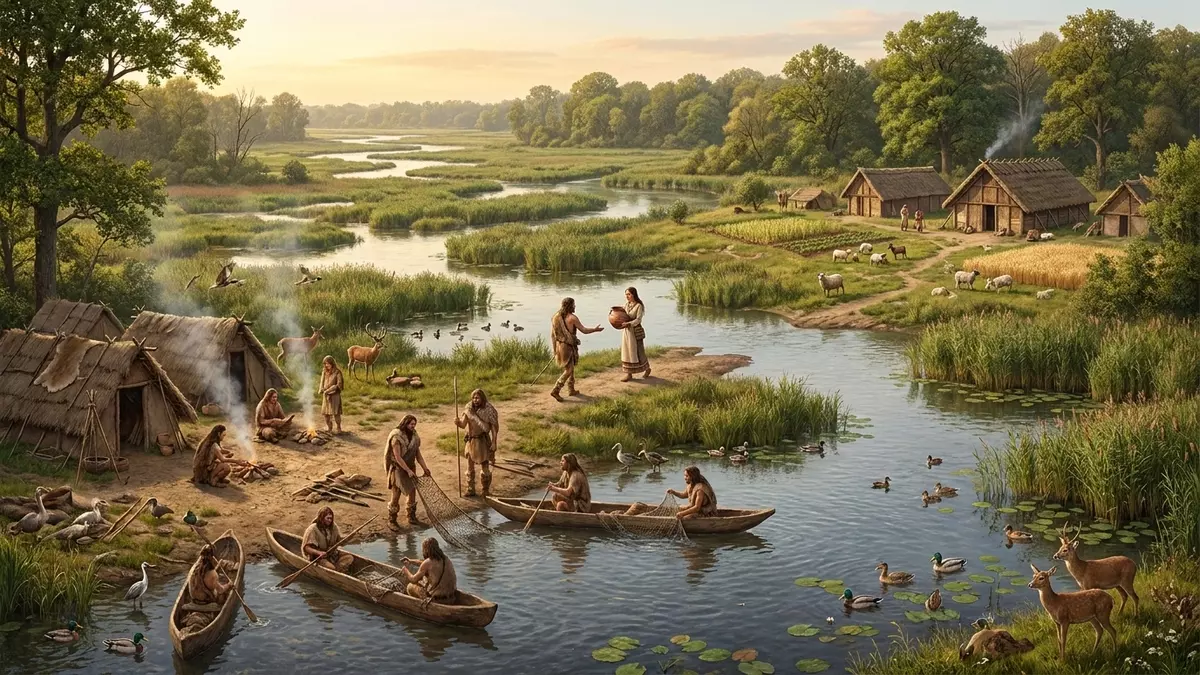
The study found that hunter-gatherer ancestry in the Rhine-Meuse delta remained remarkably high until as late as 3000 BCE. In many cases, individuals living during this period still traced half of their genetic profile back to local foragers.
This genetic continuity was a direct result of the landscape. The resource-rich Rhine-Meuse delta provided an abundance of fish, game, and wild plants, making the transition to full-scale agriculture less urgent than it was in the drier, more predictable landscapes of Central Europe. Even when early farmers from the south settled in areas like Zuid Limburg, they remained somewhat isolated. Rather than displacing the foragers, they largely coexisted, exchanging tools and pottery while maintaining distinct genetic lines.
The “Maternal Bridge” and Male Resilience
One of the most intriguing findings involves the gender dynamics of these ancient social ties. The data suggests that when genetic mixing did occur, it often traveled through the maternal line. Early farmer ancestry frequently entered northern delta communities through women, while male hunter-gatherer lineages remained dominant for centuries. This indicates that social and marital networks were the primary drivers of integration, rather than mass migration or population replacement.
Corded Ware: Culture Without Replacement
Around 3000 BCE, the “Corded Ware” complex swept across Europe, a phenomenon usually associated with massive waves of migration from the Eurasian steppe. In many regions, this event triggered a sharp rise in steppe ancestry.
The Rhine-Meuse delta, however, provides a fascinating exception. While the local populations eagerly adopted Corded Ware pottery styles and single-burial customs, their genomes told a different story. They showed very little steppe ancestry. This proves that culture and biology are not always linked; the people of the Low Countries adopted the “fashion” of the time without becoming the people who invented it. They were innovators and cultural adapters, not merely victims of demographic shifts.
The Bell Beaker Expansion: The Turning Point
The period of stability finally began to change around 2500 BCE with the rise of the Bell Beaker culture. Here, the evidence shows a genuine demographic shift. A new, blended population emerged in the Rhine-Meuse region, formed by the mixing of local groups and migrants connected to the wider Bell Beaker network.
This blended population didn’t just stay in the Low Countries; they became a dominant force. When these groups crossed the channel to Great Britain, they acted as a genetic catalyst, contributing to a 90% to 100% replacement of the earlier Neolithic ancestry. It is a profound historical irony: a region that had spent 3,000 years stubbornly maintaining its local heritage eventually became the primary engine for the total transformation of the British genetic landscape.

Why This Matters
This study is a milestone for our understanding of human history. It reminds us that European prehistory was not just a story of “incoming vs. outgoing” groups, but a complex tapestry of choice, adaptation, and environmental influence. The people of the Low Countries were not “left behind” by the rest of Europe; they were pioneers who thrived on their own terms, leveraging the bounty of their wetlands to maintain their identity long after other regions had merged into a single genetic mainstream.
Frequently Asked Questions
Why did people in the Low Countries remain hunter-gatherers for so long?
The region was incredibly rich in resources. Between the rivers, the sea, and the forests, there was simply no immediate need to switch to the difficult, labor-intensive lifestyle of farming that was being adopted elsewhere in Europe.
Did the Corded Ware people migrate to the Low Countries?
Only in very small numbers. While the people of the Rhine-Meuse delta adopted the Corded Ware pottery and burial style, the genetic data shows that this was a “cultural diffusion.” They learned the customs from their neighbors but did not experience a significant influx of new genetic material.
What was the “Bell Beaker” shift?
The Bell Beaker period (around 2500 BCE) was a true demographic shift. Unlike the earlier Corded Ware period, this era involved significant movement and the creation of a new, blended population that combined local ancestry with incoming migrant groups.
How did researchers identify the gender of the ancestry flow?
By comparing the Y-chromosome (passed through fathers) with the mitochondrial DNA (passed through mothers) and the overall genome, the team could identify whether ancestral markers were entering the community via men or women. They found that women from farming communities were often marrying into forager groups.
Why is this study significant for British history?
It explains where the people who “replaced” the original Neolithic farmers of Great Britain came from. It shows that the Bell Beaker groups who arrived in Britain weren’t just random travelers; they were the product of a specific, blended culture formed in the Rhine-Meuse delta.