
Table of Contents
- 1. The Recovery of the Foundation Cylinders
- 2. Anatomy of a Cuneiform Inscription
- 2.1. 1. Divine Legitimacy
- 2.2. 2. The Ruined Ziggurat
- 2.3. 3. The Restoration and Prayer
- 3. Confirming a Century of Archaeological Suspicion
- 4. Architecture as Imperial Propaganda
- 5. Frequently Asked Questions
- 5.1. What are the clay cylinders discovered at Kish?
- 5.2. Where is the city of Kish located?
- 5.3. Who were the gods worshipped at the Kish Ziggurat?
- 5.4. Why did ancient kings bury these cylinders?
- 5.5. How does this find change our understanding of Nebuchadnezzar II?
Inscribed Clay Cylinders Reveal Nebuchadnezzar II’s Restoration of the Kish Ziggurat
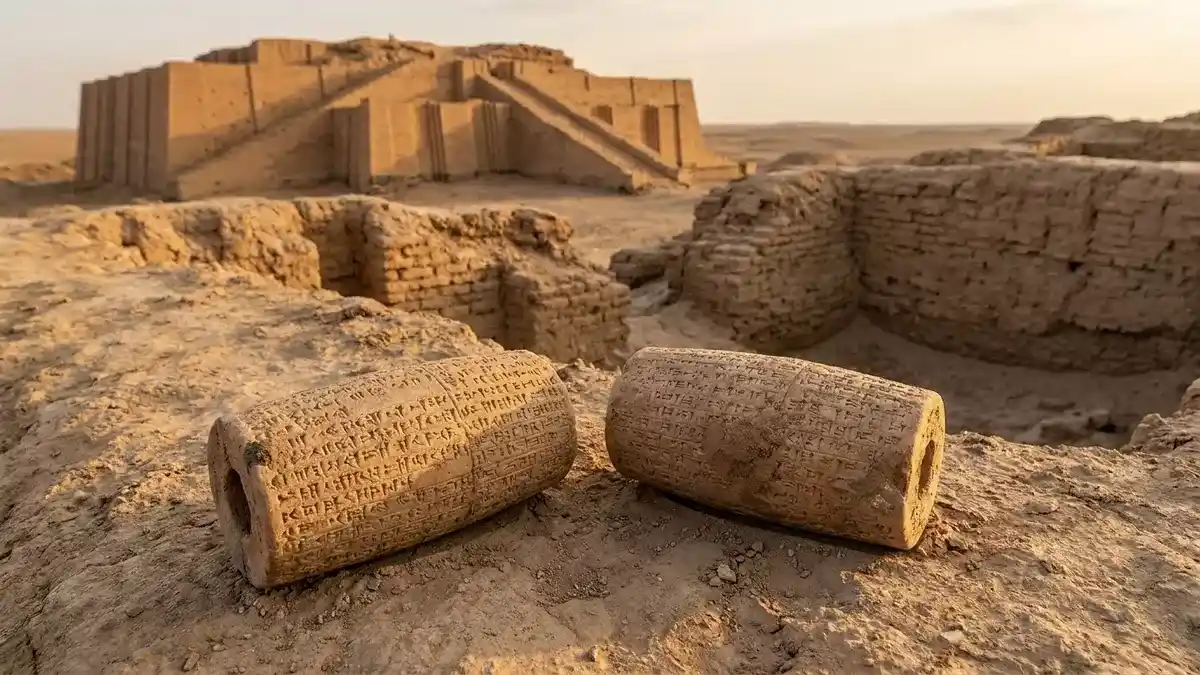
A major discovery published in the journal Iraq has provided direct textual proof of King Nebuchadnezzar II’s extensive restoration work on the legendary ziggurat of Kish. Two small, barrel-shaped clay cylinders, recovered from the surface ruins of Tell al-Uhaimir in central Iraq, have finally linked Babylon’s most famous ruler to the preservation of one of ancient Mesopotamia’s most sacred monuments.
For centuries, Nebuchadnezzar II (who ruled from 604 to 562 BCE) was celebrated for constructing the Hanging Gardens and the Ishtar Gate of Babylon. However, this new discovery highlights a different side of his legacy: his role as a pious restorer of ancient religious architecture, a political strategy used to legitimize his imperial authority by aligning himself with the gods and the prestigious rulers of the past.
Inscribed Clay Cylinders Reveal Nebuchadnezzar II’s Restoration of the Kish Ziggurat
The Recovery of the Foundation Cylinders
The journey to identifying these artifacts began in December 2013, when local residents discovered the clay cylinders on the surface of Tell al-Uhaimir—the archaeological site that preserves the ancient Sumerian city of Kish. Recognizing their potential value, the residents handed them over to Iraq’s State Board of Antiquities and Heritage.
Following detailed photographic documentation, architectural analysis, and cuneiform translation, researchers confirmed that both objects are exceptionally well-preserved examples of Neo-Babylonian royal foundation inscriptions. In ancient Mesopotamia, kings traditionally buried these small clay barrels within or near the foundations of monumental buildings to commemorate their construction and secure divine favor.
Anatomy of a Cuneiform Inscription
Made of durable baked clay, the two cylinders are almost identical in their cuneiform wording. The texts follow a strict, highly conventionalized royal formula designed to communicate directly with the gods and future generations of rulers:
[Divine Appointment] King's titles & authority granted by Marduk and Nabû
       |
[The Problem] Description of the Kish Ziggurat's decay from time and weather
       |
[The Solution] Nebuchadnezzar II rebuilds walls and reinforces the exterior
       |
[Royal Prayer] Petition for long life, military victory, and eternal divine favor
1. Divine Legitimacy
The text begins by listing Nebuchadnezzar’s grand titles, presenting him as a devout monarch specifically chosen by the supreme Babylonian deities Marduk and Nabû to serve as the caretaker of their earthly, sacred spaces.
2. The Ruined Ziggurat
The narrative then shifts to the physical state of the Kish ziggurat—a massive, multi-tiered stepped tower dedicated to the ancient Mesopotamian war god Zababa and the fertility goddess Ishtar. The text notes that while an earlier king had originally built the tower and another had repaired it, time and severe weather had compromised its integrity, causing its heavy mudbrick walls to fall into a state of serious disrepair.
3. The Restoration and Prayer
Nebuchadnezzar describes his swift intervention to remedy this architectural decline. He reinforced the structural core, completely rebuilt the collapsing sections, and smoothed out the monument’s exterior facade so that it could once again serve as a pristine, dignified home for the deities. The cylinder concludes with a standard royal prayer, asking the gods to grant Nebuchadnezzar a long life, absolute victory over his foreign enemies, and continued prosperity for his empire.
Confirming a Century of Archaeological Suspicion
The unmasking of these foundation cylinders is a triumphant moment for modern archaeology because it provides the missing textual link that confirms nearly a century of fieldwork.
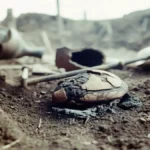
Early 20th-century excavations at Kish had already proved that the ziggurat had undergone at least three major phases of construction, modification, and repair. Over the years, archaeologists had uncovered stamped architectural bricks bearing Nebuchadnezzar II’s royal stamp.
However, until now, no formal dedicatory text had ever been recovered to explicitly document his personal directive to restore the site. These two cylinders represent the first definitive, official inscriptions explicitly linking Nebuchadnezzar II to the rebuilding of the Kish ziggurat.
Architecture as Imperial Propaganda
In the ancient Near East, temple restoration was rarely a purely altruistic or religious endeavor. For a Neo-Babylonian king, rebuilding a crumbling Sumerian ziggurat was a masterful exercise in political propaganda and statecraft.
By repairing a holy monument that had stood for thousands of years before Babylon ever rose to prominence, Nebuchadnezzar II effectively inserted himself into the long lineage of legendary Mesopotamian rulers.
This act of religious patronage sent a clear, unyielding message to both his subjects and his rivals: his empire was not an unstable, upstart regime, but rather the direct, legitimate heir to the oldest and most revered cultural traditions in human history.
Frequently Asked Questions
What are the clay cylinders discovered at Kish?
The objects are two barrel-shaped, baked clay foundation cylinders dating to the Neo-Babylonian Empire. They feature cuneiform inscriptions that officially document King Nebuchadnezzar II’s architectural restoration of the sacred ziggurat at Kish.
Where is the city of Kish located?
Kish is an ancient, highly influential Sumerian city-state located in central Iraq. Today, its physical ruins are preserved at the archaeological site known as Tell al-Uhaimir.
Who were the gods worshipped at the Kish Ziggurat?
The ziggurat at Kish was a monumental stepped tower dedicated primarily to Zababa, the ancient Mesopotamian god of war, and Ishtar, the powerful goddess of love, fertility, and warfare.
Why did ancient kings bury these cylinders?
Ancient Mesopotamian rulers buried inscribed cylinders, tablets, and prisms within the foundations or deep walls of major building projects. They served as a permanent, sacred record of the king’s piety and architectural achievements, intended to be read by the gods and future rulers who might later excavate the site.
How does this find change our understanding of Nebuchadnezzar II?
While Nebuchadnezzar II is famously known for building massive new monuments in his capital city of Babylon, these cylinders provide the first direct textual evidence of his restoration efforts outside of Babylon. It highlights how Neo-Babylonian kings used the repair of ancient, regional temples to reinforce their political legitimacy and claim a connection to Mesopotamia’s earliest history.