
Table of Contents
- 1. The Century-Long Investigation of Turlojiškė
- 1.1. The Modern Breakthrough
- 2. Reconstructing a Prehistoric Ecosystem
- 3. Forensic Evidence of Late Bronze Age Violence
- 3.1. Perimortem Blunt and Sharp Force Trauma
- 3.2. Weapons of War
- 3.3. A Distinct Demographic Profile
- 4. Mapping Prehistoric European Warfare
- 5. Frequently Asked Questions
- 5.1. Where is the Turlojiškė battlefield site located?
- 5.2. How old are the human remains found at the site?
- 5.3. What evidence proves this was a battlefield rather than a cemetery?
- 5.4. How did researchers reconstruct the ancient environment?
- 5.5. What other European sites are comparable to Turlojiškė?
3,000-Year-Old Mass Grave Confirms Bronze Age Battlefield in Lithuania
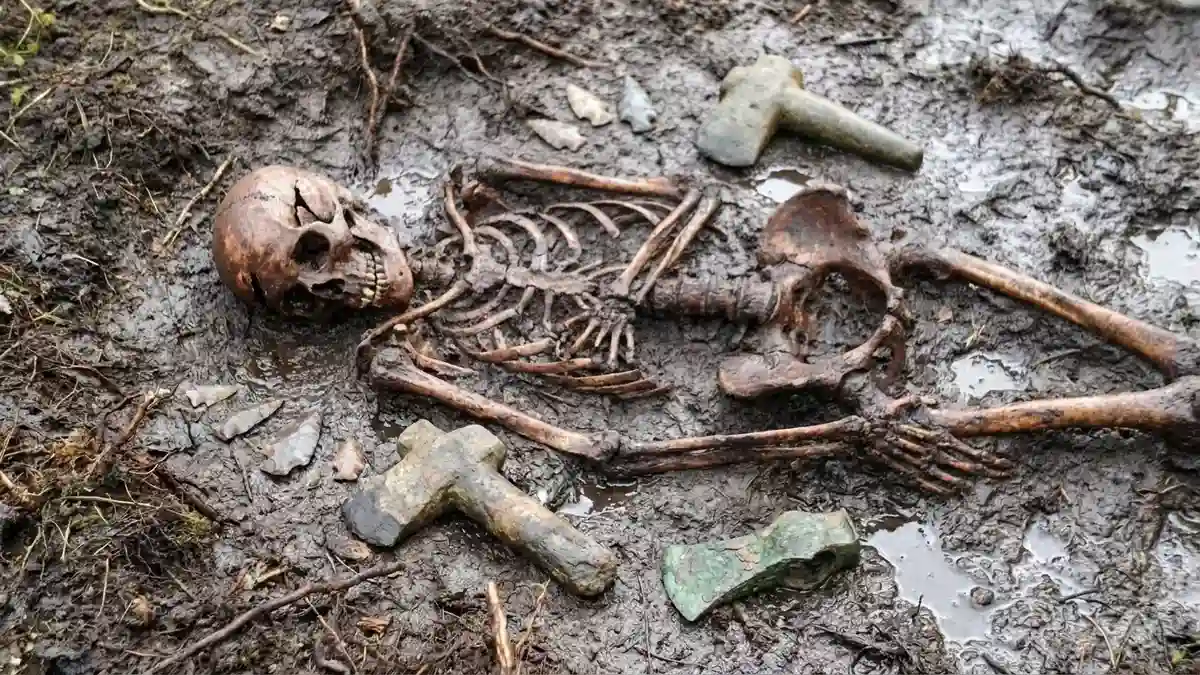
Deep within the wetlands of southern Lithuania, a team of international archaeologists has uncovered definitive evidence of a prehistoric catastrophe. Fresh excavations, advanced laboratory modeling, and forensic re-evaluations at the Turlojiškė peat bog have unmasked a 3,000-year-old mass grave.
The discovery documents a single, highly violent combat event from the Late Bronze Age. Rather than a standard communal burial ground, the site marks a prehistoric battlefield where a group of young warriors fell in combat and were abandoned in a shallow, marshy lake. This finding fundamentally changes our understanding of prehistoric warfare, revealing that large-scale, organized conflicts extended far into the eastern Baltic region.
3,000-Year-Old Mass Grave Confirms Bronze Age Battlefield in Lithuania
The Century-Long Investigation of Turlojiškė
The Turlojiškė peat bog, located within the Kalvarija eldership, has teased historians for nearly a century. The site first yielded its ancient secrets in 1930 when construction workers straightening the nearby Kirsna River unexpectedly dredged up a human skull alongside sophisticated prehistoric tools crafted from bone, antler, and flint.
As the decades progressed, peat cutting and agricultural drainage continuously exposed isolated human bones. Between 1996 and 2003, archaeologist Algimantas Merkevičius launched the first systematic, scientific excavations of the area. His pioneering team documented the remnants of an ancient lakeside settlement and retrieved a substantial collection of human remains. However, the exact nature of how these individuals died remained an open question.
The Modern Breakthrough
The mystery was finally solved following a major research initiative led by archaeologist Mantas Daubaras, working in collaboration with Vilnius University and expert partners from Poland. The team reopened Merkevičius’s historic trenches, conducted microscopic sediment sampling, and recovered the remains of additional individuals.
Crucially, the team gathered all previously excavated bones stored at the Faculty of Medicine of Vilnius University, subjecting the entire collection to modern forensic and technological testing.
Reconstructing a Prehistoric Ecosystem
To map out exactly what the landscape looked like when the violence occurred, researchers implemented an intensive environmental reconstruction strategy. The team drilled an astonishing 640 boreholes across the vast expanse of the peat bog. By analyzing the core strata, geologists built highly accurate two-dimensional and three-dimensional digital models of the ancient basin.
[15,000+ Years Ago] Glacier Retraction -> Deep, Clear Lake Basin Formed
        |
        | (Centuries of Soil & Organic Accumulation)
        |
[ 3,000  Years Ago] Water Becomes Shallow & Marshy -> Peat Forming (Battle Layer)
        |
        | (Modern Era)
        |
[ Present Day     ] Turlojiškė Peat Bog Wetland
Geological data revealed that a muddy layer of sapropel (dark, organic-rich sediment) began accumulating at the bottom of the basin more than 15,000 years ago, shortly after the retreat of the last Ice Age glaciers. Over the millennia, this deep lake gradually filled with sediment.
By roughly 3,000 years ago—the exact window of the massacre—the water body had become exceptionally shallow, transforming into a murky, reed-choked marshland. Zoologists from the Tadas Ivanauskas Zoological Museum confirmed this timeline by identifying specialized prehistoric mollusk species within the specific sediment layers where the human bones were embedded.
Forensic Evidence of Late Bronze Age Violence
When biological anthropologists subjected the skeletal remains to forensic analysis, the true nature of the Turlojiškė site became clear. The bones did not show the typical signs of natural death or post-mortem ritual manipulation. Instead, they bore the unmistakable hallmarks of warfare.
Perimortem Blunt and Sharp Force Trauma
Multiple skeletons exhibited severe perimortem injuries—trauma that occurred at or very close to the time of death, showing no signs of bone healing. The researchers identified deep, sharp-force gashes and fractures perfectly consistent with impact from bronze and stone weapons.
Weapons of War
The sedimentary layer containing the bones acted as an preservation capsule, yielding the very tools used in the slaughter. Scattered directly alongside and within the cluster of skeletons, archaeologists recovered:
Flint arrowheads
Heavy stone battle-axes
Specialized bronze axes
A Distinct Demographic Profile
The most damning piece of evidence supporting a battlefield scenario over a standard cemetery was the demographic makeup of the deceased. Normal community cemeteries contain a balanced mix of men, women, young children, and the elderly.
The Turlojiškė mass deposition contains exclusively young adult men. The absence of women and children, combined with the catastrophic nature of their injuries, proves that this was a homogenous group of warriors killed mid-combat.
Mapping Prehistoric European Warfare
Using ultra-precise Accelerator Mass Spectrometry (AMS) radiocarbon dating at the Center for Physical Sciences and Technology, specialists tested multiple sets of human remains. The results confirmed that at least 11 individuals died simultaneously during the Late Bronze Age.
The discovery places Turlojiškė among a very elite group of archaeological sites across Europe. It draws direct comparisons to legendary prehistoric conflict sites, such as the famous Tollense Valley in northern Germany and Alken Enge in Denmark, where massive, thousands-strong armies clashed during the Bronze Age.
Until now, evidence for this scale of organized, lethal group conflict was heavily weighted toward Western and Central Europe. The Turlojiškė site provides the definitive missing link for the Eastern Baltic, proving that the Bronze Age was an era of sweeping, interconnected regional instability and militarization.
With additional laboratory studies and field operations scheduled, the team is actively preparing several comprehensive scientific papers to detail the definitive environmental, artifactual, and osteological secrets of the Baltic’s oldest known battlefield.
Frequently Asked Questions
Where is the Turlojiškė battlefield site located?
The Turlojiškė battlefield mass grave is located in the Kalvarija eldership of southern Lithuania, positioned within a peat bog that was once a shallow prehistoric lake fed by the Kirsna River.
How old are the human remains found at the site?
AMS radiocarbon dating has revealed that the human remains are approximately 3,000 years old, placing the violent event squarely within the Late Bronze Age.
What evidence proves this was a battlefield rather than a cemetery?
Three main pieces of evidence point to a battlefield: the demographic profile consists entirely of young men; the bones exhibit severe perimortem sharp-force trauma from weapons; and warfare artifacts like flint arrowheads and bronze axes were found scattered directly in the same sediment layers as the skeletons.
How did researchers reconstruct the ancient environment?
Scientists drilled 640 geological boreholes across the peat bog to map the ancient lake basin in 3D. Additionally, zoologists analyzed prehistoric mollusk shells trapped within the sediment cores to determine the exact water levels and ecosystem features of the marsh from 3,000 years ago.
What other European sites are comparable to Turlojiškė?
Turlojiškė is highly comparable to other famous Bronze Age mass-conflict sites in Europe, most notably the Tollense Valley battlefield in Germany and the Alken Enge site in Denmark, both of which serve as evidence of large-scale, organized prehistoric warfare.