
Table of Contents
- 1. Resolving a Prehistoric Cold Case
- 2. The Anatomy of an Ice Age Mauling
- 2.1. The Claw and the Puncture
- 3. Evidence of Tender Compassion in the Stone Age
- 4. A Lifetime of Physical Hardship
- 5. The Royal Burial of Arene Candide
- 6. Frequently Asked Questions
- 6.1. Why is this specific skeleton called “The Prince”?
- 6.2. How did scientists prove a bear was responsible rather than another human?
- 6.3. What does the bone healing tell us about Stone Age society?
- 6.4. Which types of bears lived in Italy 28,000 years ago?
- 6.5. Why was the teenager unable to escape the bear?
28,000-Year-Old Ice Age “Prince” Was Mauled to Death by a Bear, Forensic Study Reveals
For over eighty years, the skeletal remains of a Stone Age teenager buried deep inside Italy’s Arene Candide Cave have fascinated archaeologists. Discovered in 1942 and affectionately dubbed “Il Principe” (The Prince) due to the astonishing wealth of his burial goods, the 15-year-old Gravettian hunter-gatherer has long kept the secret of his tragic, untimely demise.
While early excavators noticed catastrophic damage to the boy’s jaw and left shoulder, the precise cause of death remained a mystery. Now, a groundbreaking forensic reexamination of the skeleton has finally solved this prehistoric cold case, revealing that the teenager was brutally mauled by a massive Ice Age bear.
28,000-Year-Old Ice Age Prince Was Mauled to Death by a Bear, Forensic Study Reveals
Resolving a Prehistoric Cold Case
The historical breakthrough came after an international research team secured permission to temporarily remove the ancient bones from their museum display case for close physical inspection. To piece together the teenager’s final moments, the scientists utilized an array of modern forensic technologies, including:
High-magnification digital microscopy
Ultra-high-resolution macro photography
Three-dimensional digital surface modeling
The analysis exposed a horrific pattern of perimortem trauma—injuries that occurred at or very near the exact time of death. The upper body bore the brunt of a devastating, crushing force, characterized by massive fractures ripping through the lower face and the left shoulder region, alongside shattered teeth and severe trauma to the neck vertebrae.
+-------------------------------------------------------------+
|                  "IL PRINCIPE" CASE FILE                    |
+--------------------------+----------------------------------+
| Estimated Age at Death   | Approximately 15 years old       |
| Chronological Era        | Gravettian Period (~28,000 YA)   |
| Site of Discovery        | Arene Candide Cave, Liguria, IT  |
| Primary Trauma Zone      | Lower face, left shoulder, neck  |
| Definitive Forensic Cause | Lethal mauling by a large bear   |
+--------------------------+----------------------------------+
The Anatomy of an Ice Age Mauling
To distinguish a wild animal attack from alternative scenarios—such as a fatal fall from a cliff or inter-human warfare—the forensic team searched for specific skeletal signatures left behind by large carnivores. They discovered two undeniable smoking guns.
The Claw and the Puncture
First, researchers identified a short, distinct linear groove etched into the left side of the teenager’s skull. The depth, curvature, and spacing of the groove perfectly match the physical mechanics of a heavy swipe from a large predator’s claw.
Second, a deep, conical puncture wound was discovered piercing the right fibula (lower leg bone). The dimensions of this puncture fit the exact profile of a large canine tooth sinking into the leg. Given the fauna roaming Late Pleistocene Italy 28,000 years ago, scientists concluded that the attacker was either a massive brown bear (Ursus arctos) or the notorious, now-extinct Ice Age cave bear (Ursus spelaeus).
“The combination of crushing upper-body fractures, a claw groove on the cranium, and a deep tooth puncture in the leg bone eliminates human conflict or accidents. This is the unmistakable skeletal signature of a large carnivore mauling.”
Evidence of Tender Compassion in the Stone Age
One of the study’s most profound revelations came from a microscopic analysis of the damaged bone tissue. Within the fractures, researchers detected the very earliest stages of woven bone formation—specifically, the initial stages of intertrabecular repair. However, there was a total absence of advanced callus growth (the hard bone shell that forms during long-term healing).
This minute biological detail proves an extraordinary fact: The Prince did not die instantly.
He survived the initial bear attack for a brief window, likely lasting a few days. Given the immense trauma, the teenager would have been completely incapacitated, suffering from severe blood loss, agonizing pain, and massive swelling. His survival for several days implies that his hunter-gatherer clan chased off the bear, carried the mangled boy back to safety, and tenderly nursed him in his final hours. Ultimately, he succumbed to internal bleeding, organ failure, or brain trauma.
                  [ Bear Attack Occurs ]
                            │
                            ▼
          [ Clan Rescues Defenseless Teen ]
                            │
                            ▼
     [ Days of Compassionate, Intensive Group Care ]
                            │
                            ▼
          [ Death from Internal Complications ]
A Lifetime of Physical Hardship
The forensic study also shed light on the Prince’s life before the bear attack, documenting older, completely healed injuries that painted a picture of a difficult existence.
The teenager suffered from a poorly healed fracture in the smallest toe of his left foot, alongside a chronic, debilitating joint disorder in his right ankle. These long-standing lower-limb impairments would have severely restricted his agility, speed, and mobility. In the unforgiving terrain of Ice Age Europe, these physical limitations likely made him highly vulnerable to ambush predators, preventing him from successfully escaping when the bear charged.
The Royal Burial of Arene Candide
Despite his physical limitations and tragic end, the boy held an incredibly high, revered status within his community, as evidenced by the magnificent, royal-like burial he received inside Arene Candide Cave.
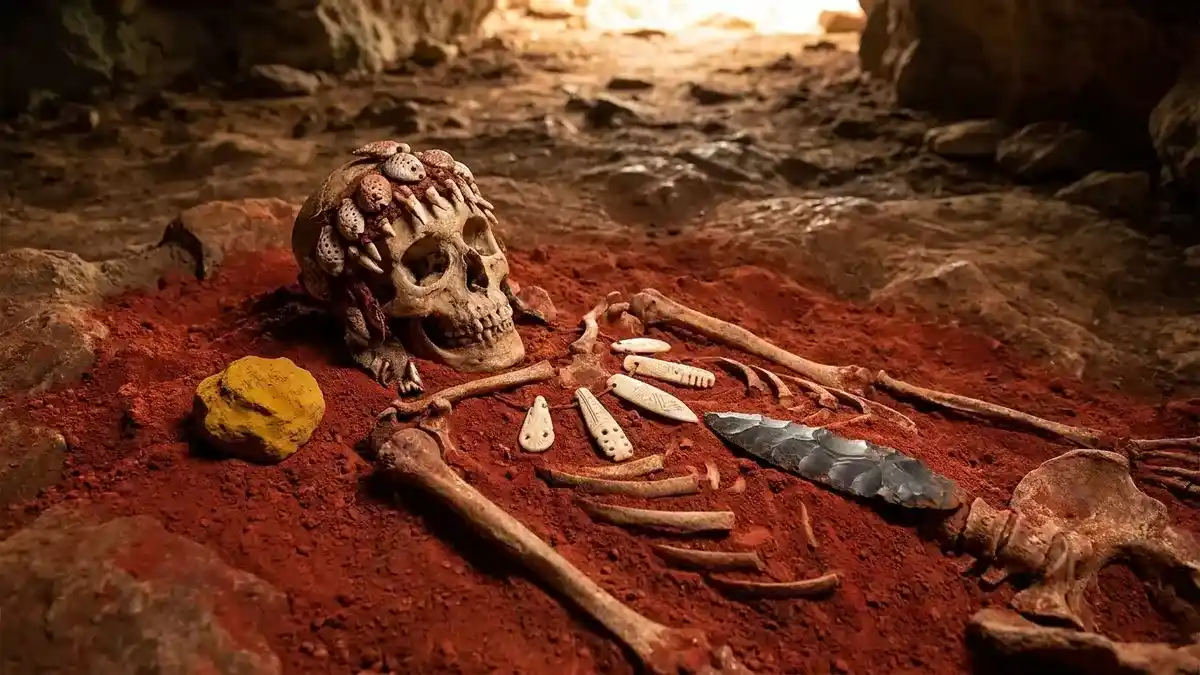
His group laid his body to rest on an opulent bed of brilliant red ocher, a natural earth pigment. They adorned his head with an elaborate, heavy headdress woven from hundreds of meticulously perforated marine shells and polished deer teeth.
+-------------------------------------------------------------+
|                 THE PRINCE'S GRAVE GOODS                    |
+--------------------------+----------------------------------+
| Burial Foundation        | Thick bed of vibrant red ocher   |
| Royal Adornment          | Headdress of shells & deer teeth |
| Imported Prestige Items  | Exotic flint blade from France   |
| Talismans                | Carved ivory pendants            |
| Ritual Placements        | Yellow ocher lumps near wounds   |
+--------------------------+----------------------------------+
He was accompanied by carved ivory pendants and an exotic, oversized flint blade that had been imported from hundreds of miles away in what is now southern France. Intriguingly, the mourners placed a large lump of contrasting yellow ocher directly next to his shattered jaw and shoulder—perhaps as a ritual poultice or a symbolic attempt to heal his catastrophic wounds in the afterlife.
While the fossil record contains ample evidence of early humans hunting dangerous carnivores, clear proof of wild animals successfully preying on humans is exceptionally rare. The tragic story of the Prince provides an invaluable skeletal baseline for ancient predator-prey dynamics, demonstrating how modern forensic science can breathe vivid, humanizing life into museum collections decades after they were first pulled from the dirt.
Frequently Asked Questions
Why is this specific skeleton called “The Prince”?
The skeleton earned the nickname “Il Principe” (The Prince) because it is one of the richest, most elaborate Upper Paleolithic burials ever discovered in Europe. The teenager was buried with hundreds of perforated shells, deer teeth, exotic imported flint, and ivory pendants, signaling an extraordinarily high social status within his clan.
How did scientists prove a bear was responsible rather than another human?
Modern 3D modeling and microscopic analysis revealed specific animal-inflicted trauma. This included a linear groove on the skull matching a heavy claw swipe and a deep, conical puncture wound on his lower leg bone that perfectly mirrors the size and force of a large bear’s canine tooth, distinct from human-made weapons.
What does the bone healing tell us about Stone Age society?
Microscopic examination showed the absolute earliest signs of bone cellular repair, meaning the teenager survived for a few days after the mauling. Because his injuries were completely disabling, his survival proves that his community rescued him from the predator and provided compassionate, short-term care before he passed away.
Which types of bears lived in Italy 28,000 years ago?
During the Gravettian period of the Late Pleistocene, Italy was home to two large bear species capable of such an attack: the ancestral brown bear (Ursus arctos) and the massive, extinct Ice Age cave bear (Ursus spelaeus). Both represent highly plausible candidates for the attacker.
Why was the teenager unable to escape the bear?
The forensic team identified older, long-healed injuries completely unrelated to the mauling, including a broken toe and a severe joint disorder in his right ankle. These chronic conditions would have severely limited his running speed and agility, making him an easy target for an ambush by a large predator.