
Table of Contents
**Mysterious Headless Skeletons Reveal Neolithic Burial Secrets in Slovakia**
Archaeologists have made a startling discovery at a 7,000-year-old farming settlement in Slovakia, where dozens of human skeletons were found without their skulls. This find at the Vráble site is reshaping our understanding of how Europe’s earliest farmers honored their dead during the Early Neolithic period.
The remains, dating back to between 5250 and 4950 BCE, come from one of the largest known communities of the Linear Pottery culture, also known as LBK. Rather than pointing to a single violent event like a massacre, new research suggests these headless bodies reflect complex, intentional rituals tied to beliefs about death, identity, and ancestry.
Mysterious Headless Skeletons Reveal Neolithic Burial Secrets in Slovakia

### The Scale of the Vráble Settlement
Vráble-Veľké Lehemby stands out as a major center for the LBK people, who were among the first to bring agriculture to Central Europe. This culture, which spread across regions from modern-day Hungary to parts of France and Ukraine, is famous for its distinctive pottery decorated with linear patterns, large timber longhouses, and early farming practices focused on crops like emmer wheat and livestock such as cattle.
At its peak, Vráble featured more than 300 house remains, with around 80 homes occupied simultaneously during certain phases. The community lived in a structured environment, including a section enclosed by a ditch system with multiple entrances. This enclosure likely served practical and symbolic purposes, marking boundaries while possibly playing a role in communal activities and rituals.

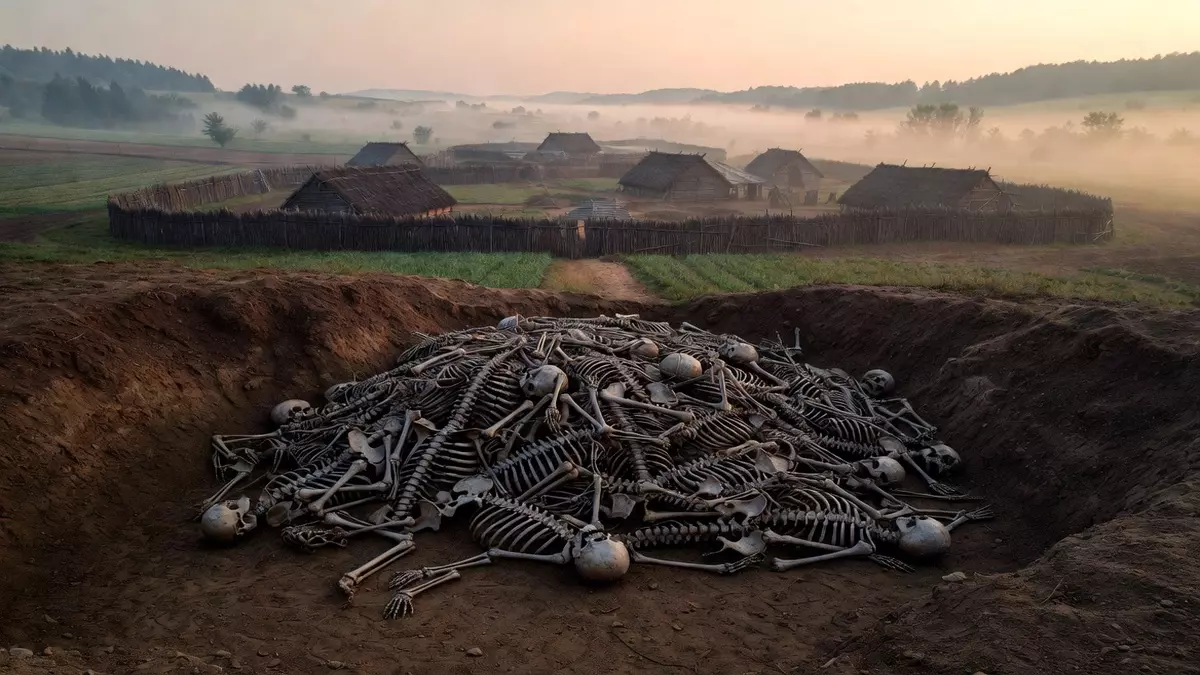
Previous excavations had uncovered some human remains in the ditches, but work since 2022 revealed an astonishing concentration in one particular section near an entrance. What started as 37 individuals quickly grew to at least 78 as digging continued. Of these, 77 were missing their skulls, with only a single child buried with its head intact.
### Inside the Mass Deposition: What the Evidence Shows
The bodies were deposited in a dense pile within the outer ditch, lying in various positions—some on their backs, others face down, and many twisted or overlapping. There was no clear pattern or consistent orientation, and scattered bones from additional individuals mixed in among the more complete skeletons.
Radiocarbon dating confirms that these remains align with the active period of the settlement. The tight clustering of dates indicates the depositions happened over a relatively short time, rather than accumulating gradually over centuries.
One of the most intriguing aspects is the deliberate removal of the skulls. Analysis of the neck vertebrae suggests the heads were carefully separated using sharp tools shortly after death. The cuts show precision rather than violent hacking, and many skeletons retained well-articulated joints, including delicate areas in the neck, hands, and feet. This articulation implies the bodies were not left exposed to decompose for long periods before placement in the ditch.
Only a few skull fragments have been recovered from the entire ditch system, leaving experts puzzled about where the heads were taken. In other prehistoric societies, particularly in the Near East during the Pre-Pottery Neolithic, skull removal and even plastering of crania were common practices possibly linked to ancestor veneration or ritual display. Similar ideas may have influenced LBK communities, though direct evidence at Vráble is still lacking.
### Broader Patterns of Body Treatment at the Site
The mass deposit is not an isolated anomaly but part of a larger pattern across Vráble. More than 100 individuals have been identified in and around the enclosure ditches. These include complete burials in traditional crouched positions, isolated bones, pairs of headless bodies, and mixed groups of remains.
This variety points to repeated, structured practices carried out over time. Pebbles were sometimes placed deliberately near the bodies or used to create pavings, adding another layer of symbolic meaning to the deposits.
The LBK culture as a whole shows diverse burial traditions. Early on, women and children were often interred beneath house floors, while later periods saw the rise of communal cemeteries. Grave goods, such as tools for men or pottery for women, hint at social distinctions. The unusual treatments at Vráble, especially in the later phases of the culture, coincide with a time of potential social stress or change across Central Europe.
While some Late LBK sites feature mass graves interpreted as evidence of conflict—such as one in Germany with signs of trauma—the Vráble findings lack clear indicators of widespread violence. Instead, researchers emphasize meaningful, ritualistic handling of the dead.
### What Skull Removal Might Mean for Neolithic Beliefs
The consistent focus on removing heads suggests they held profound importance in local worldviews. In many ancient cultures, the skull symbolized identity, spirit, or a connection to ancestors. Removing and possibly circulating or displaying them could have served social functions, such as reinforcing community bonds, marking status, or facilitating transitions in the afterlife.
At Vráble, the practice appears integrated into daily life within the enclosed settlement rather than a response to crisis. Ongoing studies, including DNA analysis to check familial ties and origins, isotope research on diet and mobility, and detailed examination of cut marks and decomposition, will provide deeper insights.
These investigations help paint a richer picture of LBK society: skilled farmers who built substantial longhouses, maintained trade networks for materials like obsidian and flint, and developed sophisticated ideas about life and death.
### Why This Discovery Matters Today
Findings like those at Vráble highlight the complexity of prehistoric European societies. They challenge simplistic views of the Neolithic as a straightforward transition to farming and reveal layers of cultural innovation, ritual, and adaptation.
As one of the largest LBK sites with such extensive human remains, Vráble offers a unique window into how early communities navigated mortality. The headless skeletons remind us that death was not just an end but an opportunity for meaning-making, social expression, and continuity with the past.
The research, published in the *Proceedings of the Prehistoric Society*, underscores the value of careful, multidisciplinary archaeology in uncovering these stories.
### Conclusion
The enigmatic headless remains at Vráble continue to captivate and challenge archaeologists. Far from a straightforward tale of violence, they point to thoughtful, varied funerary traditions among Slovakia’s ancient farmers. As studies progress, this site promises to illuminate broader questions about identity, ritual, and community in Neolithic Europe—offering lessons that resonate thousands of years later about how humans process loss and honor the dead.
**FAQ**
**1. Were the headless skeletons at Vráble victims of a massacre?**
No. While the piled bodies initially suggested violence, detailed analysis shows deliberate, careful skull removal and a lack of widespread trauma. Researchers interpret the site as part of ritual practices rather than a single catastrophic event.
**2. How old is the Vráble settlement?**
The site dates to the Early Neolithic, flourishing between approximately 5250 and 4950 BCE—making it about 7,000 years old.
**3. Why were the skulls removed?**
The exact reason remains unknown, but evidence points to cultural or religious significance. Skulls may have been kept separately for ancestor rituals, display, or other symbolic purposes common in Neolithic societies.
**4. What was daily life like in an LBK settlement like Vráble?**
Residents lived in large timber longhouses, practiced agriculture with crops from the Fertile Crescent, raised livestock, and used advanced tools. Villages often featured enclosures and showed signs of social organization.
**5. Are there other similar sites with headless remains?**
Yes. Skull removal and secondary burial practices appear in various Neolithic contexts, especially in the Near East and some European sites. Vráble is notable for the scale within the LBK culture.
**6. What new information will future studies reveal?**
DNA, isotope, and osteological analyses will clarify relationships among the dead, their origins, diets, and any signs of injury or health conditions, helping reconstruct the community’s story more fully.