
Table of Contents
- 1. The Wadi Tumilat Corridor: A Strategic Prehistoric Highway
- 2. The Architecture of a Guarded Community
- 2.1. The Defensive Perimeter and Urban Grid
- 2.2. High-Capacity Food Storage
- 3. The Fifteenth Dynasty Necropolis: Multi-Tiered Funerary Customs
- 3.1. Architectural Innovations
- 3.2. The Mystery of the Outer Burials
- 4. Artifacts of Commerce: The Tell el-Yahudiya Connection
- 5. What the Skeletons Tell Us: Health and Diet in the Delta
- 6. Witnessing the Rise of the New Kingdom
- 7. Frequently Asked Questions (FAQ)
- 7.1. What is the Second Intermediate Period?
- 7.2. Where is Tell el-Ku’a located?
- 7.3. Why are the storage silos and ovens important?
- 7.4. What are Tell el-Yahudiya flasks?
- 7.5. How did the burial styles differ at the site?
Second Intermediate Period Settlement Uncovered at Tell el-Ku’a Today
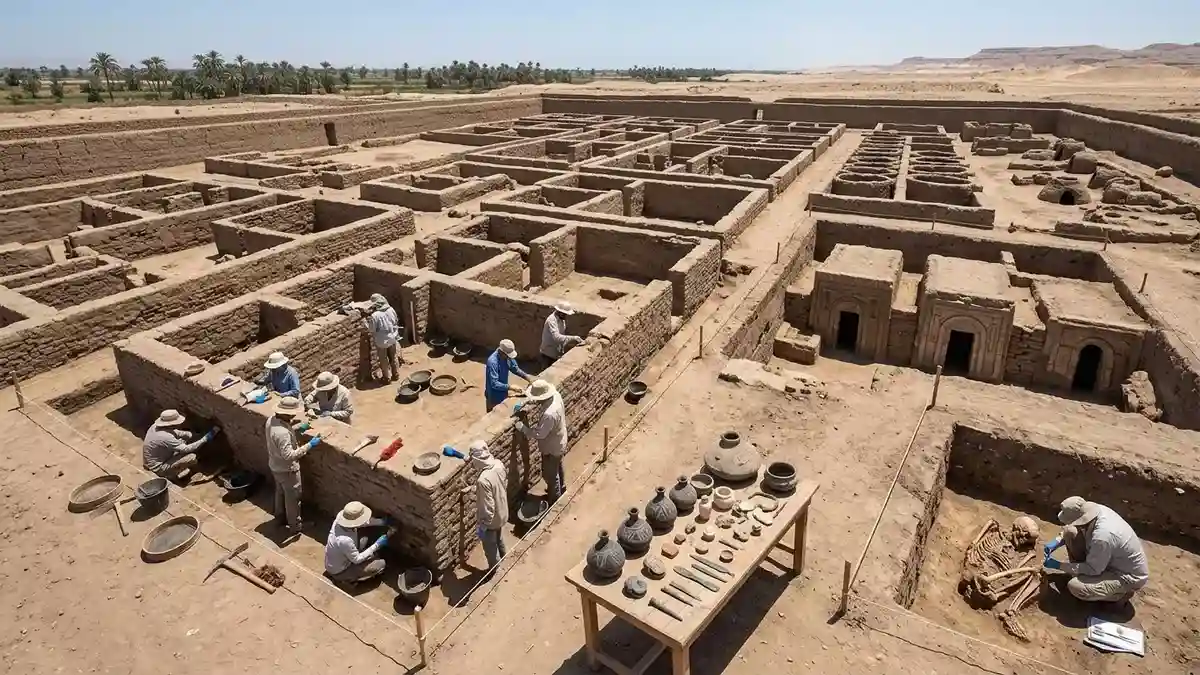
An extraordinary archaeological campaign in Egypt’s eastern Nile Delta has revealed a sprawling, heavily fortified urban center dating back to one of the most turbulent and enigmatic eras of pharaonic history. During extensive excavations at the site of Tell el-Ku’a, a research team of Egyptian archaeologists exposed an exceptionally preserved, self-sustaining settlement from the Second Intermediate Period.
The sprawling complex features an organized residential grid, high-capacity food storage silos, domestic production facilities, and an multi-tiered elite cemetery. This discovery offers an unprecedented, ground-level look at daily life, international trade, and shifting funerary customs during a profound period of political fragmentation and foreign rule in ancient Egypt.
Second Intermediate Period Settlement Uncovered at Tell el-Ku’a Today
The Wadi Tumilat Corridor: A Strategic Prehistoric Highway
The historic excavations were carried out at Tell el-Ku’a, a massive archaeological site covering roughly 55 feddans (approximately 57 acres) on the southern edge of the Wadi Tumilat corridor within the modern Ismailia Governorate. Throughout antiquity, the Wadi Tumilat functioned as a vital, high-traffic commercial and military artery. This natural valley system formed a direct bridge connecting the fertile lands of the Nile Delta with Egypt’s highly contested eastern frontier and the Sinai Peninsula.
Because of its unique geographic positioning, Tell el-Ku’a bore witness to the dramatic cultural intersections and geopolitical shifts that defined the Second Intermediate Period—most notably the rise and fall of the Hyksos, a dynamic population of Levantine origin who established the Fifteenth Dynasty and ruled Lower Egypt for over a century. The structural footprint exposed during this latest campaign records the continuous survival and adaptation of this community as political dominance shifted from Hyksos control into the triumphant dawn of the early New Kingdom under the Eighteenth Dynasty.
The Architecture of a Guarded Community
At the heart of the recent discovery is a highly structured, planned residential neighborhood measuring approximately 30 by 60 meters. Far from a random cluster of primitive mud shelters, this urban block reflects a sophisticated understanding of civic planning and physical security.

The Defensive Perimeter and Urban Grid
The entire residential quarter was completely enclosed by a massive mudbrick perimeter wall measuring an imposing 1.5 meters (nearly five feet) in thickness. This heavy fortification suggests that the inhabitants of Tell el-Ku’a lived under constant awareness of frontier vulnerabilities or regional military instability. Inside the defensive barrier, the community was arranged along an orderly, pre-planned street grid. The excavation exposed:
Large Assembly Halls: Spacious architectural units likely used for community administration, elite gatherings, or commercial transactions.
Multi-Room Domestic Residences: Dwellings of varying dimensions that accommodated different family structures and socio-economic classes.
Dedicated Industrial Zones: Positioned primarily on the eastern flank of the residential blocks, archaeologists uncovered a dense concentration of high-temperature cooking ovens and heavy industrial workspaces.
High-Capacity Food Storage
Directly adjacent to the production areas, researchers unearthed a series of large mudbrick storage silos. These specialized agricultural structures were engineered to isolate grain and other vital food reserves from moisture and pests. The presence of these high-capacity silos within the fortified walls indicates that Tell el-Ku’a was a highly organized, self-sufficient trading post capable of stockpiling resources to endure seasonal droughts or prolonged military blockades.
The Fifteenth Dynasty Necropolis: Multi-Tiered Funerary Customs
Immediately bordering the residential sector, archaeologists exposed an elite cemetery containing ten substantial mudbrick tombs firmly dated to the Hyksos-led Fifteenth Dynasty. The architectural diversity of these tombs highlights a stratified society with varied expressions of wealth and religious devotion.
Architectural Innovations
The tombs vary significantly in both scale and engineering complexity. Several burials were constructed in the classical rectangular mastaba style—a prestigious, flat-roofed monumental format traditionally reserved for high-ranking officials and royals. Other tomb structures featured highly elaborate, decorated mudbrick facades, arched entryways, and intricate interior structural detailing that reflected the high aesthetic standards and technical capabilities of the regional elite.
The Mystery of the Outer Burials
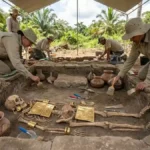
While the wealthy were interred inside these ornate mudbrick vaults, a striking discovery occurred just outside the cemetery walls. Archaeologists located several human skeletons buried directly in the earth without formal tomb structures. Intriguingly, a portion of these individuals were arranged in a tightly bound, crouched position.
This specific, flexed skeletal orientation has never been documented before at Tell el-Ku’a. Physical anthropologists are launching dedicated comparative studies to determine if these atypical outer burials represent a distinct lower socioeconomic class, foreign prisoners of war, or a specific ethnic sub-group within the multi-cultural Delta population practicing non-Egyptian mortuary rites.
Artifacts of Commerce: The Tell el-Yahudiya Connection
The domestic rooms, workshops, and graves of Tell el-Ku’a yielded a vast assemblage of material culture that cements the site’s status as a major regional trading hub and distribution depot.
Among the finest artifacts recovered were authentic Tell el-Yahudiya flasks. This highly distinct style of pottery—characterized by its dark, burnished surface punctuated by white, punctured geometric designs—is an absolute chronological marker for the Second Intermediate Period, illustrating deep cultural and economic ties between the eastern Delta and the Levant.
+-------------------------------------------------------------------------+
|                    KEY ARTIFACTS RECOVERED AT TELL EL-KU'A               |
+--------------------+----------------------------------------------------+
| Artifact Type      | Historical & Economic Significance                 |
+--------------------+----------------------------------------------------+
| Tell el-Yahudiya   | Distinct Levant-influenced pottery; confirms       |
| Flasks             | Second Intermediate Period dating.                |
+--------------------+----------------------------------------------------+
| Import Scarabs &   | Feature distinct production marks and official     |
| Clay Seals         | administrative stamps; proves active customs trade.|
+--------------------+----------------------------------------------------+
| Alabaster Kohl     | High-end luxury cosmetics; points to elite wealth  |
| Containers         | and access to prestigious raw materials.           |
+--------------------+----------------------------------------------------+
| Bronze Tools &     | Showcases local metallurgical skill and domestic   |
| Cooking Pottery    | food preparation habits dominated by tableware.    |
+--------------------+----------------------------------------------------+
The discovery of numerous clay stamps and official seals on imported pottery handles indicates that the local authorities monitored, taxed, and cataloged incoming cargo moving through the Wadi Tumilat highway, operating a highly efficient customs and logistics operation.
What the Skeletons Tell Us: Health and Diet in the Delta
Initial osteological examinations of the human remains recovered from the tombs reveal that the primary adult population died relatively young, with most individuals averaging between 25 and 40 years of age.
To reconstruct their daily lives and dietary profiles, scientists are analyzing the massive deposits of animal bones found scattered throughout the domestic trash heaps and left as ritual food offerings inside the tombs. The preliminary data shows a heavy reliance on domesticated livestock, complemented by local fishing and waterfowl hunting along the ancient Delta marshes.
Furthermore, a study of the household ceramics revealed that the overwhelming majority of everyday vessels consisted of elegant tableware and specialized cooking pots. This indicates a stable domestic lifestyle where food preparation, communal dining, and culinary presentation were central elements of the local household identity.
Witnessing the Rise of the New Kingdom
Perhaps the most historically significant aspect of Tell el-Ku’a is its chronological lifespan. Stratigraphic evidence proves that the city remained continuously occupied until the middle of the Eighteenth Dynasty—the golden age that initiated the New Kingdom under legendary pharaohs like Ahmose I and Thutmose III.
By spanning this massive political divide, the layers of soil at Tell el-Ku’a preserve a physical, unbroken archive of a critical historical transition. It showcases exactly how ordinary citizens, merchants, and craftsmen adjusted their daily habits, trading alliances, and architectural styles as Egypt violently expelled the Hyksos rulers, reunified the state, and transformed from a defensive delta kingdom into an aggressive, international superpower.
Frequently Asked Questions (FAQ)
What is the Second Intermediate Period?
The Second Intermediate Period (roughly 1700–1550 BCE) was an era of intense political division in ancient Egypt. It is most famous for the breakdown of centralized pharaonic rule and the rise of the Hyksos—a dynasty of Levantine rulers who controlled Lower Egypt from their capital at Avaris, while native Egyptian pharaohs maintained limited control over Upper Egypt from Thebes.
Where is Tell el-Ku’a located?
Tell el-Ku’a is situated in the Wadi Tumilat corridor within the modern Ismailia Governorate in the eastern Nile Delta. This natural valley was the primary trade, migration, and military route connecting ancient Egypt with its eastern desert borders and the Levant.
Why are the storage silos and ovens important?
The presence of large, fortified mudbrick silos and centralized cooking ovens proves that Tell el-Ku’a was a highly organized, self-sufficient community. It shows that the city was capable of storing mass food reserves to protect its population against agricultural shortfalls or military sieges.
What are Tell el-Yahudiya flasks?
Tell el-Yahudiya flasks are a unique type of ancient ceramic vessel distinguished by their dark clay, burnished finish, and incised geometric patterns filled with white paste. They were widely produced and traded across the Levant and Cyprus during the Second Intermediate Period, making them a key indicator of Hyksos-era trade networks.
How did the burial styles differ at the site?
The site exhibits a diverse range of mortuary customs. Wealthy or prominent individuals were interred inside formal, highly decorated mudbrick mastaba tombs within an official cemetery. Conversely, poorer individuals or distinct cultural groups were buried outside the tomb walls, occasionally placed in a tightly bound, crouched position never before seen at the site.