
Table of Contents
- 1. Anatomy of a Subterranean Mass Grave
- 2. Identifying the Victims: The Demographics of War
- 3. Close Combat: The Brutality of the Final Moments
- 4. Harsh Realities: Infections and Military Rations
- 5. A Multicultural Legions: The DNA Evidence
- 6. Connecting the Well to a Forgotten Civil War: 260 CE
- 7. Conclusion
- 8. Frequently Asked Questions
- 8.1. What was the Crisis of the Third Century in Roman history?
- 8.2. How did the researchers know these skeletons belonged to soldiers?
- 8.3. Why did the ancient people put dead bodies into a drinking well?
- 8.4. What did stable isotope analysis reveal about the soldiers’ diets?
- 8.5. What is a Sarmatian and why was one found in a Roman army context?
Mass Grave of Forgotten Roman Soldiers Uncovered in Croatia
The Roman Empire’s catastrophic Crisis of the Third Century was a dark, sixty-year period defined by constant civil wars, foreign invasions, and economic collapse. Emperors rose and fell in quick succession as rogue generals routinely attempted to violently usurp the throne. While historical texts from this era are filled with political betrayals and body counts, a gruesome archaeological discovery in eastern Croatia has provided an intimate, physical look at the human cost of these forgotten civil wars.
During a routine construction survey for a university building in the modern city of Osijek—the site of the ancient Roman military hub known as Mursa—archaeologists unburied a chilling scene: an ancient well packed to the brim with human skeletons. Now, a comprehensive, multi-disciplinary study published in the journal PLOS ONE has finally unlocked the identity of these individuals, revealing the final, violent moments of a multicultural squad of lost Roman soldiers.
Mass Grave of Forgotten Roman Soldiers Uncovered in Croatia
Anatomy of a Subterranean Mass Grave
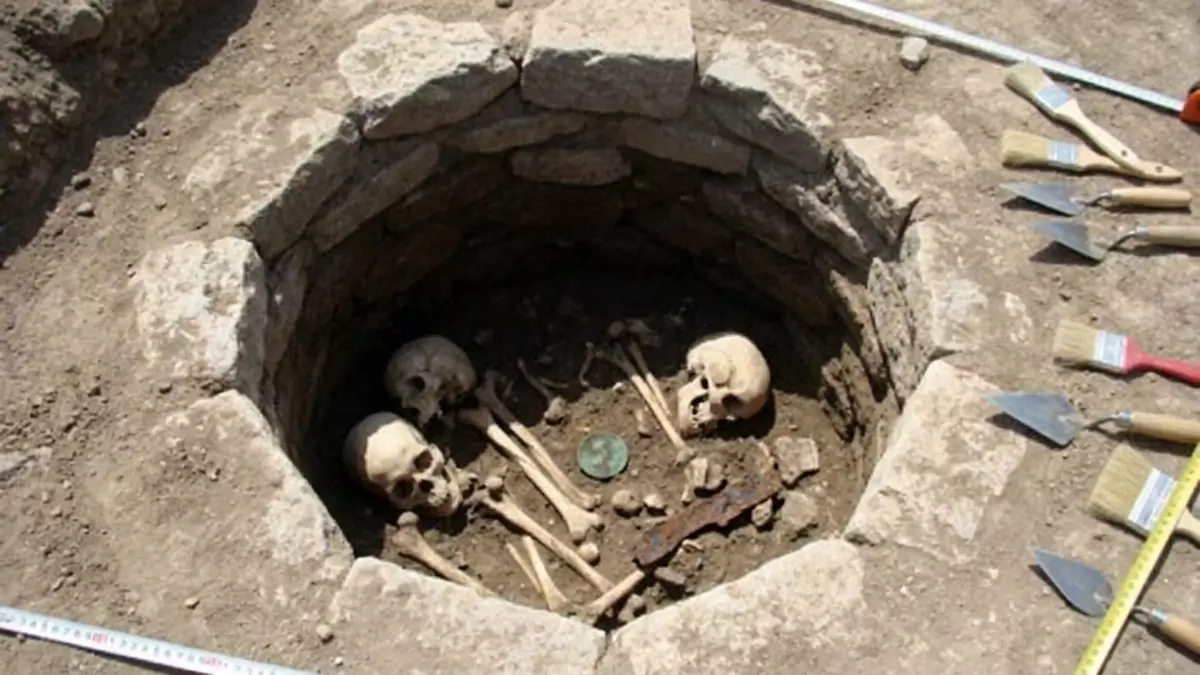
The discovery, initially made in 2011, centers on a stone-lined water well measuring two meters wide and plunging three meters into the earth. When excavation teams cleared the upper sediment layers, they were confronted with seven complete human skeletons stacked irregularly, with several individuals shoved headfirst into the shaft.
+------------------------+----------------------------------------------------+
| Burial Attribute       | Archaeological Discovery Details                    |
+------------------------+----------------------------------------------------+
| Initial Discovery Year | 2011 (Osijek, Croatia - ancient Roman city of Mursa)|
| Feature Dimensions     | Subterranean water well (2m wide, 3m deep)         |
| Skeletal Census        | Seven complete adult male skeletons                |
| Confirmed Age Range    | Radiocarbon dating & imperial coin minted in 251 CE |
| Strategic Context      | The Crisis of the Third Century civil wars         |
+------------------------+----------------------------------------------------+
The unique vertical layout of the bones proved that this was not a traditional, respectful cemetery burial. The bodies had been carelessly and hastily dumped in a single, sudden event. Furthermore, the presence of specific bone staining showed that the men still had intact muscle tissue and flesh when they were tossed into the shaft, indicating they were thrown into the well almost immediately after their deaths.
To establish a clear timeline, scientists used a combination of radiocarbon analysis and numismatic evaluation. Found deep within the well layers was a bronze imperial coin minted in 251 CE. This numismatic benchmark, paired with carbon dating, locked the horrific burial event squarely within the volatile second half of the third century CE.
Identifying the Victims: The Demographics of War
A detailed bioanthropological examination of the bones quickly painted a vivid picture of who these seven men were during their lifetimes. All seven skeletons belonged to adult males—four young adults and three middle-aged men.
                     BIOMECHANICAL SOLDIER PROFILE

  [ Above-Average Height ] ===> Average of 172.5 cm (Tall for the 3th Century).
  [ Heavy Bone Density ]   ===> Advanced muscle insertion scars on arms & shoulders.
  [ Stress Markers ]       ===> Structural changes in spine & joints from heavy gear.
The men were exceptionally tall for the Roman world, boasting an average height of 172.5 centimeters (roughly 5 feet 8 inches). Their skeletons exhibited profound biomechanical stress markers, including advanced muscle insertion scars on the shoulders, arms, and legs. These bone reactions develop only through years of intense, repetitive physical conditioning, such as marching under heavy loads, building fortifications, and wielding heavy iron weapons. The researchers concluded that these seven individuals were seasoned, professional soldiers.
Close Combat: The Brutality of the Final Moments
The forensic trauma etched into the bones of the seven men tells a terrifying story of close-quarters combat on an ancient battlefield. Several skulls exhibited well-healed fractures from earlier, non-lethal fights, proving these men were career combatants who had survived previous deployments.
However, it was the unhealed, perimortem injuries—trauma inflicted right at the time of death—that exposed the absolute savagery of their final hours:
The Punctured Breastbone: One individual suffered a violent, front-on thrust to the chest, leaving a clean puncture wound through the sternum likely caused by a heavy military spear (pilum) or a projectile arrow.
The Cleaved Arm: Another soldier bore a deep sword slash on his left humerus (upper arm bone), a classic defensive wound sustained while raising an arm to block an incoming blade strike.
Shattered Teeth & Broken Ribs: Multiple skeletons displayed fractured jaws, broken teeth, and sharp puncture wounds cutting into the ribs and pelvic hip bones.
The multi-directional angles of these wounds indicate that the men were surrounded, attacked by multiple adversaries simultaneously during the chaos of a collapsing battle line. Before they were tossed into the watery depths of the well, the bodies were systematically stripped of their iron armor, bronze helmets, military belts, and personal valuables, leaving them completely naked in death.
Harsh Realities: Infections and Military Rations
Beyond the violent trauma of the battlefield, the study revealed that these soldiers were already suffering from the brutal everyday conditions of Roman camp life. All seven men exhibited distinct bone reactions on the interior surfaces of their ribs. These lesions are a classic indicator of chronic lung infections, proving that the entire squad was suffering from active respiratory diseases, such as pneumonia, when they went into battle.
To understand how these men lived, scientists performed stable isotope testing on their teeth and bones. The isotopic signatures revealed that all seven individuals shared an identical, highly standardized diet. Their meals consisted primarily of cultivated grains like wheat and millet, supplemented by tiny quantities of animal protein.
This narrow dietary profile aligns perfectly with known historical records detailing standard Roman military rations, which relied heavily on hard tack bread (panis militaris), salted pork, olive oil, and sour wine.
A Multicultural Legions: The DNA Evidence
One of the most profound revelations of the 2025 study came from advanced ancient DNA (aDNA) testing. The genetic results shattered the outdated concept that the Roman army was made up strictly of Italian-born soldiers, showcasing instead a highly diverse, international force.
                      GENETIC ORIGINS OF THE WELL SQUAD

  [ Individual 1-2 ] ===> Northern & Central Europe (Germanic frontier)
  [ Individual 3 ]   ===> Eastern Mediterranean (Levant / Greece)
  [ Individual 4 ]   ===> Black Sea Region
  [ Individual 5 ]   ===> Possible Sarmatian Ancestry (Nomadic Steppe Auxiliaries)
Four of the seven men had completely distinct ancestral lines, hailing from opposite ends of the Roman world. Most notably, one individual showed clear genetic affinities to the Sarmatians—a nomadic, horse-riding people from the Eurasian steppes who frequently clashed with Rome before being integrated into the empire’s auxiliary legions. This genetic snapshot confirms that by the third century, Roman defense forces had transformed into a sweeping multicultural melting pot, recruiting heavily from foreign borders to keep its depleted legions staffed.
Connecting the Well to a Forgotten Civil War: 260 CE
By weaving together the coin data, the skeletal trauma, the military demographics, and the hasty disposal method, the research team identified the exact historical catastrophe that sealed these soldiers’ fates: The Battle of Mursa in 260 CE.
During this phase of the Crisis of the Third Century, a rogue Roman commander named Ingenuus rebelled, declaring himself emperor along the Danubian frontier. The legitimate emperor, Gallienus, marched swiftly north to crush the uprising. The two massive Roman armies collided outside the walls of Mursa in a bloody, fratricidal civil war.
                     THE CRISIS OF THE THIRD CENTURY

  [ Emperor Gallienus ] ============= CLASHES =============> [ Usurper Ingenuus ]
  (Legitimate Ruler)             Battle of Mursa (260 CE)     (Rebel Commander)
                                           ||
                                           v
                        * Rebel forces completely crushed
                        * Emperor Gallienus orders mass executions
                        * Naked bodies dumped hastily into a city well
Emperor Gallienus’s professional forces utterly shattered the rebel lines. Historical chronicles record that Gallienus, furious at the betrayal, showed absolute ruthlessness following his victory, ordering the systematic execution of any surviving rebel soldiers.
The seven men in the Mursa well were either cut down as their lines collapsed or captured and executed shortly after the rout. Thrown into a defunct drinking well to quickly clear the battlefield and poison the local water supply of the rebel-sympathizing city, these forgotten warriors were lost to history—until a modern construction crew uncovered their subterranean tomb.
Conclusion
The skeleton-filled well of Osijek stands as an incredible, sobering monument to the brutal realities of ancient Roman warfare. Through the marriage of modern bioanthropology, chemical isotopes, and ancient DNA tracking, scientists have successfully transformed anonymous bones back into living, breathing history. These seven men—sick with pneumonia, far from their ancestral homes, and bound together by shared rations and a shared military oath—remind us that behind the grand narratives of imperial Rome lie the tragic, forgotten sacrifices of the ordinary soldiers who fought in its shadows.
Frequently Asked Questions
What was the Crisis of the Third Century in Roman history?
The Crisis of the Third Century (235–284 CE) was a prolonged period of extreme instability where the Roman Empire nearly collapsed under the combined pressures of rampant civil wars, economic hyperinflation, plague, and constant foreign invasions by Germanic tribes and the Sasanian Empire. Over 30 different men claimed the title of emperor during this 50-year window.
How did the researchers know these skeletons belonged to soldiers?
The soldiers were identified through distinct physical clues on their bones: an above-average height (172.5 cm), heavy bone density from lifelong physical labor, advanced muscle attachment scars on their shoulders and limbs, and clear perimortem combat wounds from specialized military weapons like swords and spears.
Why did the ancient people put dead bodies into a drinking well?
Dumping bodies into a well served a dual purpose in the aftermath of a massive battle. Logistically, it was a fast, hidden way to clear decomposing corpses from a city landscape without spending days digging deep graves. Tactically, it was an effective form of biological warfare, permanently contaminating the local groundwater supply to punish a rebellious population.
What did stable isotope analysis reveal about the soldiers’ diets?
Stable isotope testing reads the chemical signatures locked inside tooth enamel and bone structures. The testing proved that all seven men ate an identical diet composed almost entirely of grains like wheat and millet, with very little meat. This precisely mirrors the standard, documented food rations issued to Roman legions.
What is a Sarmatian and why was one found in a Roman army context?
The Sarmatians were a large confederation of Iranian-speaking nomadic horse archers who lived on the Eurasian steppes north of the Black Sea. By the third century, the Roman military frequently utilized a recruitment policy that forced defeated barbarian tribes or hired foreign mercenaries to serve as “auxiliaries” in the Roman legions, explaining why a man of Sarmatian descent was fighting and dying in Croatia.