
Table of Contents
- 1. Rise of the Nomadic Superpower: The Avar Khaganate
- 2. Inside the Tomb: Surviving an Ancient Heist
- 3. Masterpieces in Metal: The Warrior’s Personal Treasure
- 3.1. The Crown Jewel: A Rare Early Sabre
- 4. Science in the Trenches: The High-Stakes Extraction Process
- 5. Conclusion
- 6. Frequently Asked Questions
- 6.1. Why is the discovery of an Avar sabre considered so rare?
- 6.2. If grave robbers broke into the tomb, why did they leave the weapons?
- 6.3. Exactly how old is this burial site, and where is it located?
- 6.4. What was the purpose of the gilded braid rings found in the grave?
- 6.5. How did the community archaeology program help save the artifacts?
1,300-Year-Old Tomb of Ancient Elite Warrior Discovered in Europe
Deep within the historic heart of Central Europe, a remarkable discovery has suddenly transported historians back to the age of nomadic empires and fierce cavalry warfare. While conducting field research along the border region between the municipalities of Aba and Székesfehérvár in Hungary, an expert excavation team uncovered the resting place of a high-ranking warrior from a largely forgotten yet immensely influential civilization.
Dating back approximately 1,300 years, this rare burial chamber provides an unprecedented look into the material wealth, military technology, and complex funerary customs of the early medieval period. Despite being target by grave robbers long ago, the tomb still holds an astonishing array of weapons and personal ornaments, including an incredibly rare, perfectly intact curved sword.
1,300-Year-Old Tomb of Ancient Elite Warrior Discovered in Europe
Rise of the Nomadic Superpower: The Avar Khaganate
To truly appreciate the value of this archaeological find, one must understand the identity of the people who created it: the Avars. Arriving as a formidable confederation of nomadic horse warriors from the Eurasian steppes, the Avars established a massive sovereign territory known as the Avar Khaganate during the sixth century. At its absolute zenith, this powerful nomadic empire completely dominated the Pannonian Basin, dictating political life across vast swaths of Central and Eastern Europe.

+---------------------+-------------------------------------------------------+
| Empire Attribute    | Historical Details                                    |
+---------------------+-------------------------------------------------------+
| Sovereign Entity    | The Avar Khaganate                                    |
| Geographic Domain   | Pannonian Basin (Central and Eastern Europe)          |
| Peak Conflict Era   | Warred with the Byzantine Empire (CE 568–626)        |
| Lasting Influence   | Accelerated and shaped early Slavic migrations        |
+---------------------+-------------------------------------------------------+
The Avars are perhaps most famous in Western history for their brutal, shifting conflicts with the Eastern Roman (Byzantine) Empire, culminating in a historic, massive siege of Constantinople in the early seventh century. Furthermore, their sweeping territorial control acted as a massive geopolitical catalyst, fundamentally driving and reshaping the migration patterns of Slavic peoples into Southeastern Europe.
The newly uncovered grave dates specifically between CE 670 and 690, a critical window known to historians as the Middle Avar era. During this timeframe, the nomadic elite were gradually transitioning toward a more sedentary lifestyle while maintaining their distinct, highly sophisticated metallurgical traditions and warrior code.
Inside the Tomb: Surviving an Ancient Heist
When the excavation team from the Szent István Király Museum first peeled back the soil layers of the burial site, they quickly realized that the grave had been breached by thieves centuries ago. In antiquity, tomb raiding was an organized, high-risk profession, often occurring shortly after a funeral when the location of the wealth was fresh in collective memory.

The ancient intruders focused their destructive efforts entirely on the upper portion of the interred warrior. The skull, chest cavity, and abdominal region of the skeleton had been heavily disturbed and scattered by the raiders as they searched for valuable necklaces, pectorals, or gold coins.
                    ANATOMICAL STATE OF THE EXCAVATION

     [Upper Body Section]                     [Lower Body Section]
  ==========================               ==========================
  * Head, chest, and torso                 * Arms and legs completely
    heavily scrambled by                      untouched and pristine
    ancient grave robbers                  * Weapons left perfectly intact
However, in a bizarre twist that continues to baffle researchers, the ancient thieves suffered a major lapse in judgment or were suddenly interrupted. While they ransacked the skeletal remains, they completely overlooked or ignored the warrior’s primary weapons and personal garments. The bones of the lower extremities and arms remained locked in their original anatomical positions, surrounded by pristine, highly valuable military gear that should have been a looter’s primary target.
Masterpieces in Metal: The Warrior’s Personal Treasure
The sheer variety and artistic quality of the items left behind confirm that this individual occupied a rarefied tier within the Avar military hierarchy. The grave served as a final showcase for the dynamic craftsmanship of ancient steppe metalworkers.

Among the exceptional personal items recovered from the soil were:
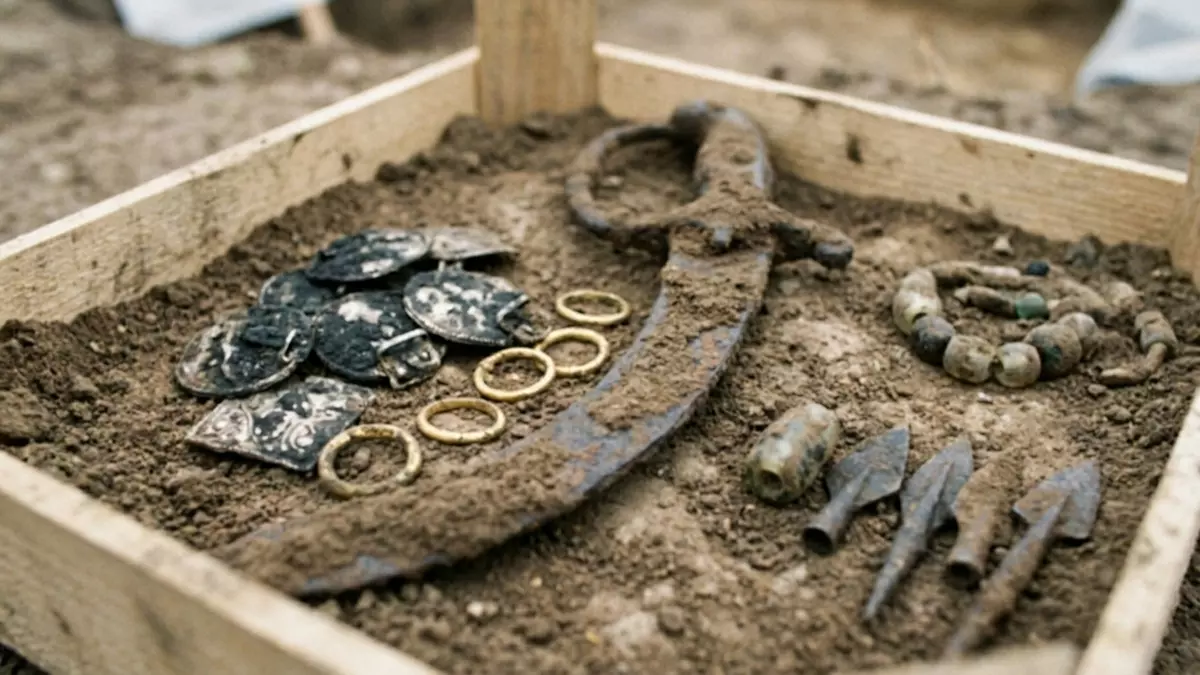
Silver Belt Fittings: Intricately designed plaques that once adorned a heavy leather warrior’s belt, a crucial status symbol in nomadic culture.
Gilded Braid Rings: Beautifully forged gold-washed bands designed to hold long, traditional plaited hair extensions.
Glass Bead Earrings: Delicate jewelry featuring vibrant beadwork, showing a keen eye for personal fashion and luxury trade connections.
Quiver and Arrowheads: A collection of specialized iron projectile tips, originally housed inside a leather or birch-bark container that has since decayed.
The Crown Jewel: A Rare Early Sabre
The absolute highlight of the entire find is an incredibly rare, single-edged sabre. Unlike the heavy, straight swords popular in Western Europe during this time, the Avar sabre featured a gentle, elegant curve engineered specifically for sweeping, slashing strikes from the back of a galloping horse.
Finding an Avar sabre with both its blade and hilt structurally intact is an exceptionally rare event in European archaeology. The weapon represents a critical evolutionary stepping stone in medieval metallurgy, showing how Asian weapon designs permanently altered the landscape of European warfare.
Science in the Trenches: The High-Stakes Extraction Process
Recovering a metal weapon that has spent more than thirteen centuries subjected to subterranean pressure, moisture, and chemical decay is a terrifying logistical challenge. The ancient iron of the sabre had become incredibly brittle, threatening to shatter into dust if lifted directly from the dirt.
To solve this problem, elite scientists teamed up with trained volunteers from the museum’s specialized Community Archaeology Program. Working carefully in the trench, the team constructed a custom wooden support cradle directly around the weapon. Instead of trying to pry the sword loose, they carefully carved out the entire surrounding block of earth, lifting weapon and soil together as a single, heavy unit.
                     SUBTERRANEAN EXTRACT STRATEGY

  [ Brittle Sabre ] ===> [ Enclosing Soil Block ] ===> [ Custom Wooden Cradle ]
  (Highly Fragile)        (Left Intact Around Blade)    (Secured for Safe Transport)
This brilliant methodology kept the artifact completely stabilized during transport to the laboratory. Once safely inside the controlled conservation environment, expert conservator Petra Bódisné Szalontai performed a meticulous micro-excavation. She carefully peeled back the remaining encrusted dirt millimeter by millimeter, applying specialized chemical stabilizers to preserve the structural integrity of the ancient metal.
The subsequent restoration revealed breathtaking, subtle design elements along the weapon’s curved profile. Additionally, the cleaning of the silver and gilded belt components showcased an advanced mastery of filigree and metal casting, reaffirming that the Avar Khaganate possessed a highly sophisticated domestic luxury economy.
Conclusion
The discovery of the Aba/Székesfehérvár warrior reminds us that the dark ages were far from culturally dark. Though ancient raiders managed to scramble the physical remains of this nomadic leader, they inadvertently left behind an archaeological goldmine. The recovered sabre, silver mountings, and personal finery stand as a glittering testament to a forgotten empire that once held the balance of power in Europe, bridging the artistic styles of the Eastern steppes with the changing realities of the early medieval West.
Frequently Asked Questions
Why is the discovery of an Avar sabre considered so rare?
While straight swords were common across early medieval Europe, the curved sabre was a highly specialized technological innovation brought over by Eurasian nomads. Very few intact specimens have survived thirteen centuries in the ground without completely corroding, making this well-preserved blade a critical benchmark for studying ancient weapon development.
If grave robbers broke into the tomb, why did they leave the weapons?
Archaeologists cannot say for certain, but several theories exist. The raiders may have been looking strictly for easily accessible, highly portable gold jewelry around the neck and torso. Alternatively, they may have been interrupted in the middle of their crime, forcing them to flee before they could systematically strip the rest of the burial chamber.
Exactly how old is this burial site, and where is it located?
The tomb dates precisely to the Middle Avar period, specifically between CE 670 and 690. It was uncovered in western Hungary, specifically along the geographic boundary separating the towns of Aba and Székesfehérvár.
What was the purpose of the gilded braid rings found in the grave?
In Avar culture, hairstyles were deeply tied to social status, military rank, and tribal identity. Men, particularly noble warriors, wore their hair long and woven into intricate braids. Gilded rings were used to secure, decorate, and weight these braids, serving as a highly visible marker of their elite standing.
How did the community archaeology program help save the artifacts?
Volunteers from the museum’s community archaeology program provided the rapid fabrication skills needed to design a custom wooden support frame directly inside the excavation pit. This allowed the team to safely extract the fragile sword inside a solid block of soil, avoiding the catastrophic structural failures that often happen during traditional open-air lifting.