
Table of Contents
- 1. Inside the Brougham Burial Grounds
- 1.1. Wealth, Weapons, and Exotic Trade Networks
- 2. Advanced Recovery and Micro-Excavation Techniques
- 2.1. Deciphering the Demographics of the Edge
- 3. Frequently Asked Questions
- 3.1. Where is Brougham located, and why was it important to Rome?
- 3.2. What is the difference between inhumation and cremation?
- 3.3. What does the Dorset pottery tell us about Roman Britain?
- 3.4. What is block lifting in archaeology?
- 3.5. Why did some excavated Roman jars contain no bones?
Extensive Roman Cemetery Uncovered Near Brougham Fort, Expanding Frontier History
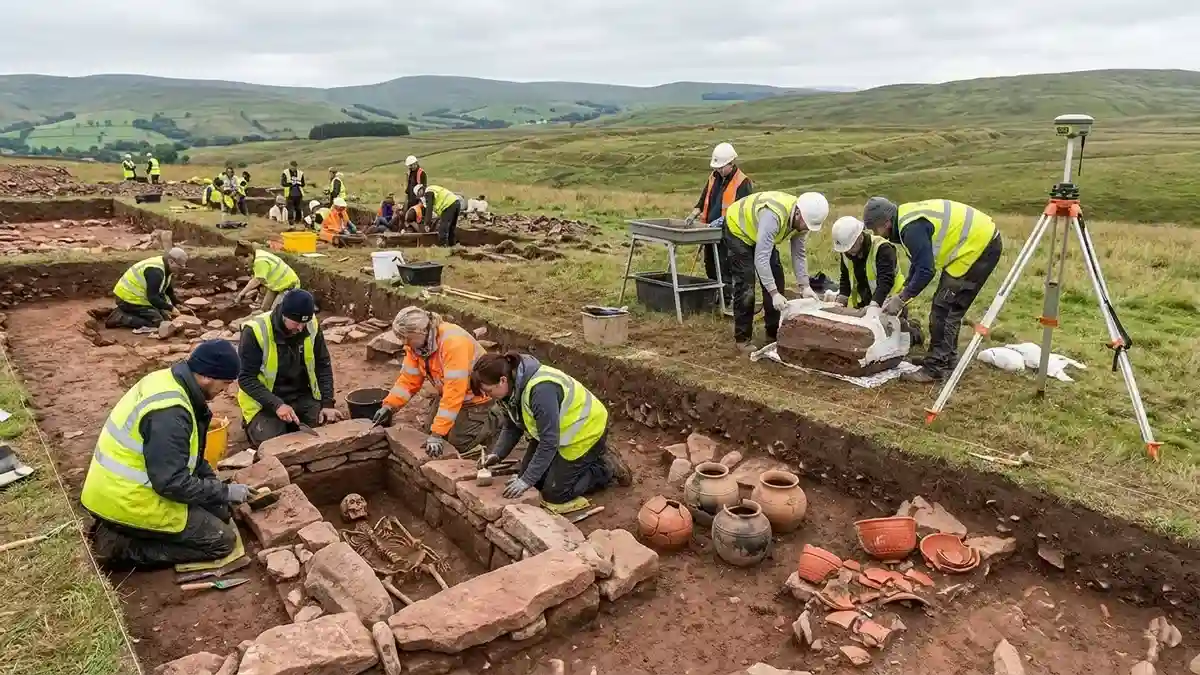
A massive archaeological investigation along Rome’s northernmost frontier has yielded an extraordinary look into the lives, rituals, and diverse identities of people living at the edge of the ancient world. Excavatation teams operating in Cumbria, England, have exposed the true scale of a sprawling Roman cemetery closely linked to the historic fort and civilian settlement at Brougham.
The extensive project, managed by Oxford Cotswold Archaeology as part of the infrastructure upgrades for the A66 Northern Trans-Pennine Project, successfully documented several hundred ancient graves. While initial road construction in the 1960s unmasked isolated portions of the burial ground, this modern, systematic investigation provides the first comprehensive view of the complex funeral landscapes that developed near the absolute limits of Roman imperial authority in Britain.
Extensive Roman Cemetery Uncovered Near Brougham Fort, Expanding Frontier History
Inside the Brougham Burial Grounds
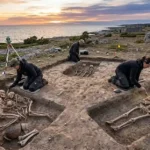
The excavation area yielded a high density of both inhumation (flesh-burial) and cremation sites, highlighting a stark diversity in personal, cultural, and financial choices. The cremation burials, in particular, presented themselves in a fascinating array of architectural styles, which indicates that the local frontier population did not follow a single uniform ritual.

Frontier Burial Architecture:
├── Simple Pits: Charcoal and skeletal ash deposited directly into the earth
├── Ceramic Urns: Intact earthenware jars acting as ossuaries
├── Wooden Modules: Organic boxes identified via soil stains and iron nails
└── Stone-Lined Cists: Rigid subterranean boxes crafted from regional red sandstone
Adjacent to these individual graves, field archaeologists discovered intact pyre sites (known historically as bustuaria) and deep ash disposal pits. The discovery of these features proves that the entire funerary process—from public cremation rituals to final systematic interment—was actively managed directly on the cemetery grounds.
Wealth, Weapons, and Exotic Trade Networks
The grave goods recovered from the Brougham cemetery reveal deep social stratifications within the frontier community. While a significant portion of the cremation pits contained only minimal charcoal deposits, other high-status graves were richly furnished with luxury items, exotic trade imports, and personal military gear.
Among the standout artifacts were fully intact glass cups, finely decorated serving bowls, and imported red gloss samian ware bearing the legible stamps of continental manufacturers. The presence of specialized items, such as meticulously carved animal bone fragments once utilized as decorative inlays for wooden jewelry boxes or funeral biers, demonstrates a high level of aesthetic refinement.
Artifact Distribution Map (Brougham Frontier Site):
[Dorset, Southern England] ─── Black Burnished Jar ───> [Brougham Cemetery, Cumbria]
[Gaul/Continental Europe] ─── Stamped Samian Ware ───> [Brougham Frontier Zone]
One particularly illuminating find was a intact black-burnished ceramic jar manufactured hundreds of miles away in Dorset. This specific utilitarian vessel acts as tangible evidence of highly organized, long-distance supply routes and military logistics networks that seamlessly connected the remote northern frontier back to prosperous manufacturing hubs in southern Roman Britain.
Advanced Recovery and Micro-Excavation Techniques
Because of the extreme fragility of the human remains and accompanying grave goods, field teams implemented meticulous archaeological recovery strategies. Rather than rapidly exposing the artifacts, researchers shaved away the matrix in thin layers using specialized hand tools.
To ensure that miniature objects, beads, and tiny osteological fragments were not lost, 100% of the soil matrix from the features underwent a wet-sieving process. Furthermore, spatial coordinates for every single pot, bone, and coin were mapped digitally via high-precision GPS units before the items were lifted from the ground.
 20 Interesting Books About Archaeology
Laboratory Micro-Excavation (Block Lifting Process):
[Intact Field Block] ──> [Controlled Lab Micro-Layering (2cm intervals)] ──> [3D Spatial Skeletal Profile]
To preserve maximum context, many fragile cremation vessels were subjected to a technique known as block lifting. Instead of excavating the vessels in the windy, rain-swept field, archaeologists cut out the entire block of surrounding earth, stabilized it, and transported it to a clean laboratory environment.
Inside the lab, osteoarchaeologists systematically excavated the interior contents of the urns in controlled micro-layers measuring just two centimeters deep. This forensic approach allowed scientists to isolate the internal distribution of bone fragments, melted metal trinkets, and distorted glass bits. This precise stratigraphy helps determine the exact order in which items were placed on the funeral pyre relative to the body of the deceased.
Deciphering the Demographics of the Edge
Initial osteoarchaeological analysis of the recovered bone material has started to yield invaluable data regarding the age, biological sex, and pathological profiles of the frontier inhabitants. Even in cases where the intense heat of the pyre heavily warped or shrank the bone material, modern analytical models have successfully isolated signs of childhood stress, degenerative joint disease, and trauma.
Interestingly, several analyzed vessels contained absolutely zero traces of human skeletal material. Experts suggest these empty jars served purely symbolic or votive roles within the grave—likely filled with perishable food items, libations, or organic offerings intended to sustain the spirit of the deceased on their journey into the afterlife.
Frequently Asked Questions
Where is Brougham located, and why was it important to Rome?
Brougham is located in modern-day Cumbria, in northwest England. During the Roman occupation, it served as a critical military fort and supporting civilian settlement (vicus). Positioned near Hadrian’s Wall, it acted as a vital strategic hub managing logistics, communication, and security along Rome’s volatile northern frontier.
What is the difference between inhumation and cremation?
Inhumation refers to the practice of burying an intact body directly in the ground or within a sarcophagus. Cremation involves burning the deceased on a timber pyre, after which the remaining bone fragments and ash are gathered for ritual burial. Both practices coexisted at the Brougham site.
What does the Dorset pottery tell us about Roman Britain?
The discovery of black-burnished pottery originating from Dorset (hundreds of miles to the south) proves that northern frontier outposts were not isolated. Instead, they were deeply integrated into highly efficient, empire-wide commercial trade routes and military distribution networks.
What is block lifting in archaeology?
Block lifting is a conservation technique where a fragile artifact and its surrounding matrix of soil are encased in plaster or bandages and removed as a single unit. This allows archaeologists to safely excavate the contents layer-by-layer inside a controlled laboratory environment rather than risking damage in the field.
Why did some excavated Roman jars contain no bones?
Vessels devoid of skeletal material are commonly interpreted as offering jars. Within Roman funerary traditions, it was customary to place food, wine, oils, or other organic gifts inside the grave to accompany the deceased, leaving behind clean, empty jars once the organic material decayed.