
Table of Contents
- 1. The Rigid Mortuary Traditions of the Corded Ware Culture
- 1.1. The Strict Code of Prehistoric Graves
- 1.2. Breaking the Funerary Mold
- 2. Three Theories Behind the Battered Skull
- 2.1. 1. An Act of Prehistoric Murder
- 2.2. 2. A Casualty of Copper Age Warfare
- 2.3. 3. A Dark Ritualistic Sacrifice
- 3. A Dark Pattern of Rituals in Saxony-Anhalt
- 3.1. Predecessors of the Salzmünde Culture
- 4. Unlocking the Future of the Excavation
- 5. Frequently Asked Questions
- 5.1. What makes this particular German burial so unusual for archaeologists?
- 5.2. What was the Corded Ware culture known for?
- 5.3. What kind of injuries did the skeleton possess?
- 5.4. Why do experts suspect human sacrifice over a standard murder?
- 5.5. How long will the archaeological dig at Gerstewitz continue?
5,000-Year-Old Battered Skeleton in German Kiln Suggests Human Sacrifice
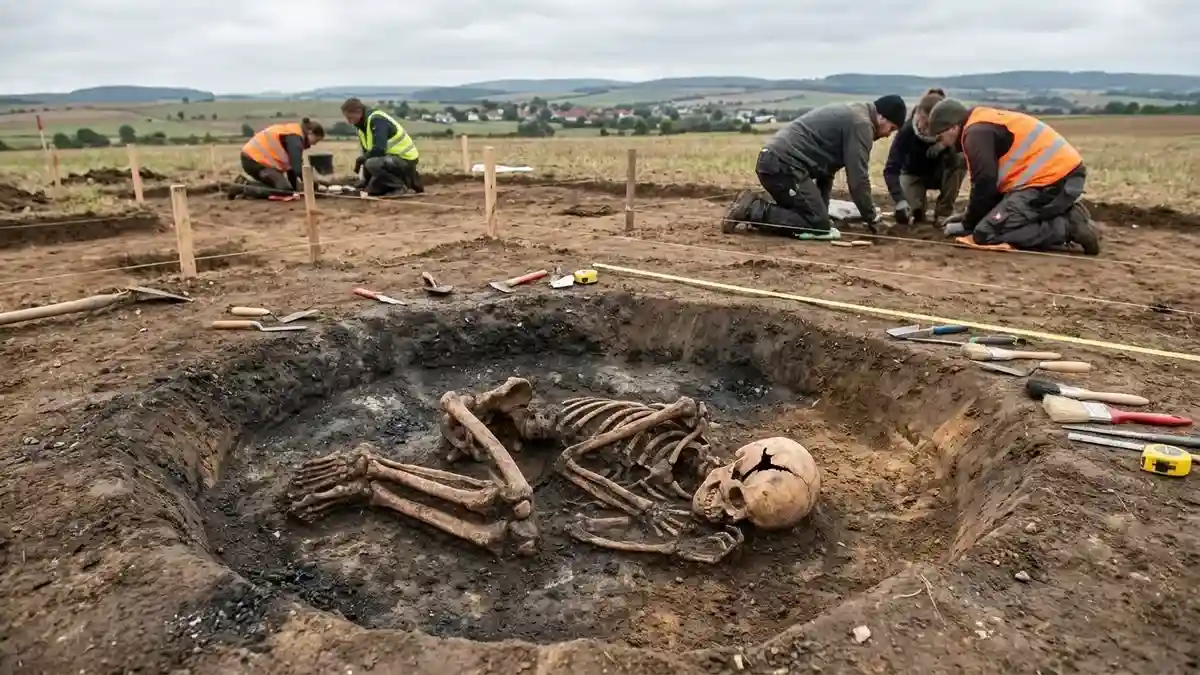
A remarkable archaeological discovery in central Germany has uncovered the 5,000-year-old remains of a young man buried inside an ancient earthen kiln. Found with severe cranial trauma, the unusual positioning and location of the skeleton have led experts to consider a chilling possibility: this individual may have been a prehistoric human sacrifice.
The find occurred near Gerstewitz, a village in Saxony-Anhalt, during routine excavations ahead of a major power line construction project. Because human remains are virtually unheard of within ancient firing pits, the discovery provides a dramatic deviation from the highly standardized burial customs of the Late Neolithic period.
5,000-Year-Old Battered Skeleton in German Kiln Suggests Human Sacrifice
The Rigid Mortuary Traditions of the Corded Ware Culture
The skeleton has been identified as a member of the Corded Ware culture, a widespread European population named for the distinctive cord-like patterns pressed into their ceramic pottery. This culture flourished across Northern, Central, and Eastern Europe between 2900 B.C. and 2050 B.C., bridging the Late Stone Age and the Early Bronze Age.
The Strict Code of Prehistoric Graves
The Corded Ware people are well-known among anthropologists for adhering to a highly rigid, gender-segregated binary in their funerary practices:
Male Burials: Men were traditionally laid to rest on their right side.
Female Burials: Women were systematically interred on their left side.
Universal Standards: Regardless of biological sex, individuals were placed in a tightly flexed or “crouched” position, positioned to face directly south, and typically housed under small earth mounds or dedicated graves.

Breaking the Funerary Mold
The individual unearthed at Gerstewitz was a young man, roughly 25 years old at his time of death. While his body was arranged in the customary crouched position facing south, his final resting place completely violated social standards. Rather than receiving a proper burial plot, his body was deposited into a subterranean kiln pit—an earthen hole heavily scorched from burning wood, fuel, and clay.

Three Theories Behind the Battered Skull
The presence of a severe skull injury has forced researchers from the State Office for Heritage Management and Archaeology (LDA) Saxony-Anhalt to evaluate three distinct historical scenarios to explain how this young man met his end.
                  ┌───────────────────────────────┐
                  │   Gerstewitz Cranial Trauma   │
                  └───────────────┬───────────────┘
                                  │
         ┌────────────────────────┼────────────────────────┐
         ▼                        ▼                        ▼
┌─────────────────┐      ┌─────────────────┐      ┌─────────────────┐
│ Criminal Murder │      │ Battlefield War │      │ Ritual Sacrifice│
│  Violent fatal  │      │ Unrecorded clash│      │ Offered up to   │
│ assault or feud │      │  in Copper Age  │      │ ancient deities │
└─────────────────┘      └─────────────────┘      └─────────────────┘
1. An Act of Prehistoric Murder
The skull trauma could simply be the result of interpersonal violence. A fatal domestic dispute, a localized family feud, or a sudden ambush could have resulted in the man’s death, with his killers using the convenient opening of an abandoned industrial kiln to hastily conceal the body.
2. A Casualty of Copper Age Warfare
The Late Neolithic and early Copper Age saw significant migrations and territorial transitions across Central Europe. The young man may have been a warrior who perished in an unrecorded regional skirmish, with his community quickly utilizing an existing trench or kiln pit to inter casualties during or immediately after the conflict.
3. A Dark Ritualistic Sacrifice
The most compelling theory leans toward ritualistic offering. Earthen kiln pits from the Corded Ware period occasionally yield domestic animal remains, such as cows or dogs, which are widely accepted as sacred offerings dedicated to unknown deities. Placing a severely injured or executed human into the same functional space suggests his death may have been orchestrated as a profound, higher-stakes ritual offering.
A Dark Pattern of Rituals in Saxony-Anhalt
The idea of human sacrifice at Gerstewitz is heavily reinforced by prior archaeological discoveries in the immediate vicinity. The region boasts a highly complex, multi-layered history of ritual activity spanning thousands of years.
Predecessors of the Salzmünde Culture
Just last year, the LDA Saxony-Anhalt excavated an even older ritual complex at the exact same site, belonging to the Salzmünde culture (3400 B.C. to 3050 B.C.). This prehistoric group predated the Corded Ware culture by several centuries but left behind explicit evidence of dark ceremonial traditions, including:
Ritual Enclosures: Twelve distinct pits completely encircled by a defensive, moat-like ditch.
Sacrificial Deposits: Pits packed with dog skeletons, complete ceramic vessels, and isolated human skulls.
Oven Interments: Another complete human skeleton deliberately buried inside a repurposed oven pit, which was then permanently sealed with the charred rubble of burned houses.
The fact that two entirely distinct cultures utilized the exact same landscape for unusual, fire-structure human interments centuries apart indicates that this specific geographic area held deep, long-standing spiritual or ceremonial significance.
Unlocking the Future of the Excavation
The rich soil of Gerstewitz has confirmed over 6,000 years of continuous human occupation and settlement. To determine which of the three theories holds true for the man in the kiln, researchers are moving the discovery from the dirt into the laboratory.
Advanced forensic testing will soon provide definitive answers. Osteological analysis will determine whether the cranial fracture shows signs of healing, which would indicate an old wound, or if it occurred exactly at the time of death. Additionally, isotopic analysis of his teeth will reveal his childhood diet and geographic origins, proving whether he was a local community member or a captured outsider.
Because the extensive power line project is slated to continue through at least 2027, the ancient plains of Germany will likely continue to yield secrets regarding the complex spiritual lives and violent realities of our prehistoric ancestors.
Frequently Asked Questions
What makes this particular German burial so unusual for archaeologists?
In the Corded Ware culture, dead individuals were systematically buried in designated graves or under small mounds following gender-specific rules. Finding a skeleton thrown into a utilized kiln pit—an area reserved for firing clay or burning wood—is an unprecedented departure from their cultural laws.
What was the Corded Ware culture known for?
The Corded Ware culture was a prehistoric European population existing between 2900 B.C. and 2050 B.C. They are primarily identified by their unique pottery, which featured decorative impressions made by pressing twisted cords into wet clay before firing.
What kind of injuries did the skeleton possess?
Initial examinations revealed clear signs of traumatic injury to the young man’s skull. Further laboratory analysis is required to determine whether the blow was delivered by a weapon and if it was the definitive cause of death.
Why do experts suspect human sacrifice over a standard murder?
While murder is entirely possible, the choice of location mirrors other ritual deposits. The Corded Ware people occasionally placed sacrificial animals like dogs and cows into kilns as offerings. Furthermore, older cultures in the exact same area previously buried humans in ovens alongside animal sacrifices, pointing to a long regional tradition of ritualized fire-pit burials.
How long will the archaeological dig at Gerstewitz continue?
The archaeological excavations are being conducted in tandem with a major power line infrastructure project. Due to the high density of ancient artifacts spanning over 6,000 years of history, the formal digs are scheduled to last until at least 2027.