
Table of Contents
- 1. A Groundbreaking Duo of Discoveries at the Mission
- 1.1. Unearthing the Texan Iron Shot
- 1.2. The Mexican Bronze Predecessor
- 2. Anatomy of the 1836 Siege: 13 Days of Destiny
- 2.1. The Siege Begins
- 2.2. Artillery Duels at the Church
- 3. Why These “Solid Shots” Matter to Modern Historians
- 3.1. The Significance of Intact Munitions
- 4. A Multi-Layered History Beneath the Soil
- 4.1. From Spanish Mission to Commercial Hub
- 5. Preserving the Legacy for Future Generations
- 6. Frequently Asked Questions
- 6.1. What is the difference between the two cannonballs found at the Alamo?
- 6.2. Where exactly were these artifacts discovered on the grounds?
- 6.3. Why is finding a “solid shot” cannonball considered so rare?
- 6.4. Who were the Tejanos mentioned in the history of the battle?
- 6.5. What happened to the defenders after the Battle of the Alamo?
7 Cannonballs & Artifacts Reshaping Alamo History in 2026
For nearly two centuries, the Battle of the Alamo has stood as a towering symbol of sacrifice, defiance, and Texas identity. Yet, beneath the soil of the iconic San Antonio mission, history is still yielding secrets. In a stunning series of archaeological breakthroughs, researchers have unearthed two intact cannonballs from the 1836 siege just months apart—giving historians a rare, physical look at the deadly crossfire between Texan defenders and the Mexican army.
The latest discovery, an iron projectile believed to have been fired by Texan forces, marks a monumental milestone for the historic site. Coming on the heels of a bronze Mexican cannonball found earlier in the year, this dual discovery provides an unprecedented tangible connection to the legendary 13-day siege.
7 Cannonballs & Artifacts Reshaping Alamo History in 2026
A Groundbreaking Duo of Discoveries at the Mission
Archaeologists working with the Alamo Trust have long uncovered fragments of history, from shattered grape shot to uniform buttons. However, finding intact, solid-shot projectiles is an exceedingly rare event. To find two within a three-month window has sent shockwaves through the historical community.
Unearthing the Texan Iron Shot
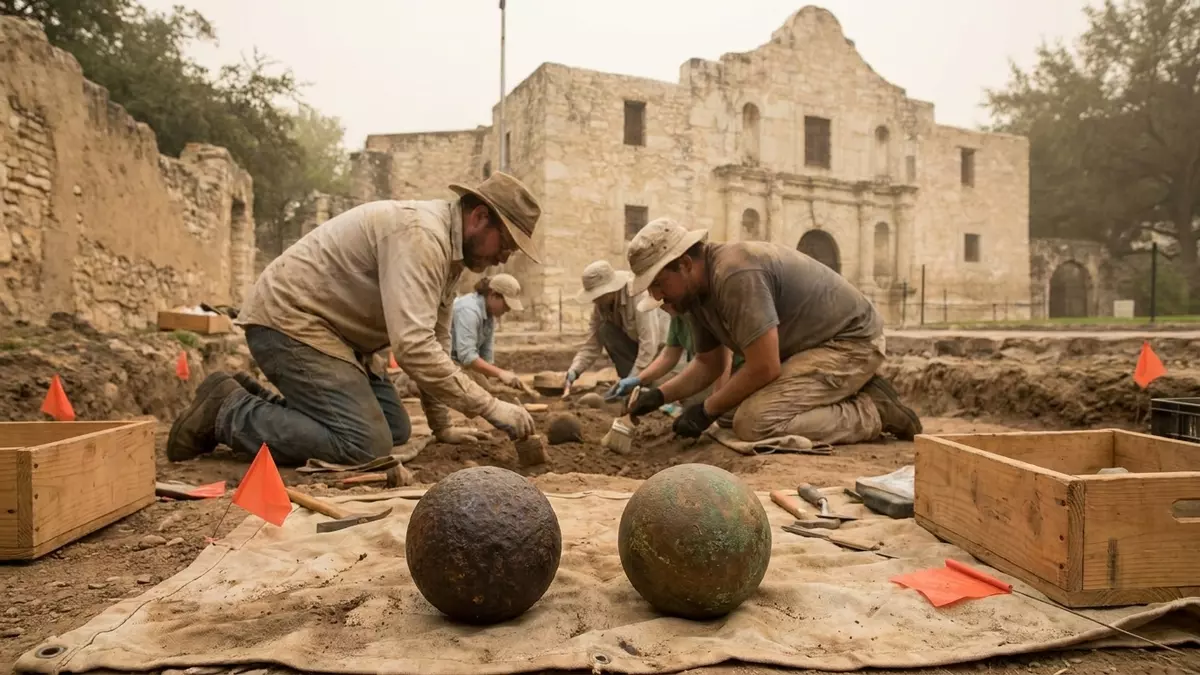
On June 2, excavation teams working near the northeast corner of the Alamo church uncovered a beautifully preserved iron cannonball. Weighing in as a likely 6-pound projectile, the artifact’s material and dimensions are highly telling. During the Texas Revolution, Texan rebels heavily relied on iron ordnance.
Historians and researchers indicate that this specific piece of ammunition was almost certainly loaded, aimed, and fired by the Alamo’s defenders as they attempted to hold off the overwhelming forces of General Antonio López de Santa Anna.
The Mexican Bronze Predecessor
The discovery of the iron cannonball mirrors an equally thrilling find from earlier in the spring. On March 5—just one day prior to the 190th anniversary of the fall of the Alamo—archaeologists extracted a bronze cannonball from the exact same sector of the grounds. Because the Mexican military predominantly utilized bronze artillery during their Texas campaign, experts quickly attributed this first projectile to Santa Anna’s batteries.
The close physical proximity of these two opposing artifacts suggests they are the long-buried remnants of a direct, heavy artillery exchange between the two warring factions.
“It’s just a huge kind of once-in-a-lifetime deal,” noted Kolby Lanham, a senior researcher and historian at the Alamo, emphasizing the sheer improbability of uncovering back-to-back intact specimens. “But obviously, it’s happened twice.”
Anatomy of the 1836 Siege: 13 Days of Destiny
To truly understand the weight of these artifacts, one must look back to the winter of 1836. The Texas Revolution was reaching a boiling point as Anglo-American settlers and local Hispanic Texans, known as Tejanos, united to secede from the Republic of Mexico, fighting against the centralized government of Santa Anna.
The Siege Begins
In late February 1836, the vanguard of the Mexican army arrived in San Antonio de Béxar, trapping a small garrison of roughly 180 Texan rebels inside the fortified walls of the former Spanish mission. Led by co-commanders William Barret Travis and James Bowie, and featuring famed frontiersman Davy Crockett, the defenders refused to surrender despite being vastly outnumbered.
Artillery Duels at the Church
For nearly two weeks, Mexican forces bombarded the compound with heavy artillery, while the Texans answered with their own mismatched arsenal of captured Mexican cannons. The northeast corner of the church, where both cannonballs were discovered, was a critical defensive sector.
The newly discovered 6-pound iron ball provides physical evidence of the desperate counter-fire the Texans maintained from their fortified positions before the final, brutal infantry assault on the morning of March 6, 1836, which claimed the lives of all the Texan combatants.
Why These “Solid Shots” Matter to Modern Historians
While the Alamo Trust archaeology team has cataloged thousands of historical fragments over the decades, these two discoveries represent a distinct class of artifacts known as “solid shots.”
The Significance of Intact Munitions
Unlike exploding shells or scattered shrapnel, a solid shot is a single, spherical mass designed to smash through fortifications and disrupt enemy lines. Because they don’t break apart upon impact, they offer pristine data regarding:
Caliber and Weaponry: Confirming the exact sizes of the cannons deployed on the battlefield.
Manufacturing Origins: Revealing the industrial capabilities and supply lines of both the Texan rebels and the Mexican state.
Trajectory Mapping: Helping military historians pinpoint exactly where artillery batteries were stationed and where their fire was concentrated.
Furthermore, because these artifacts have remained undisturbed in the Texas soil since they came to rest nearly two centuries ago, they offer an uncompromised look at the battlefield’s original layout.
A Multi-Layered History Beneath the Soil
The ongoing excavations at the Alamo are proving that the site’s historical value extends far beyond a single military engagement. Long before the battle cries of “Remember the Alamo!” echoed across the grounds, the site served diverse communities across multiple eras.
From Spanish Mission to Commercial Hub
Originally established in 1718 as the San Antonio de Valero Mission, the site served as an outpost for Spanish friars and Indigenous converts. Archaeologists frequently uncover stone tools and pottery that predate European contact by centuries.
Following its secularization, the complex evolved into a military fortress, a political flashpoint, and eventually a late-19th-century commercial hub utilized as a warehouse and general store. The preservation of these distinct layers ensures that every dig yields a holistic view of Texan and Native American heritage.
Preserving the Legacy for Future Generations
The dual discovery of the Mexican and Texan cannonballs injects fresh energy into the ongoing preservation efforts at the historic site. As millions of visitors travel to San Antonio each year to pay their respects and learn about the birth of Texas independence, these artifacts bridge the gap between myth and reality. Seeing the very iron and bronze that flew through the smoky air of March 1836 transforms historical legends into undeniable, physical truths.
Frequently Asked Questions
What is the difference between the two cannonballs found at the Alamo?
The first cannonball, discovered in March, is made of bronze and is believed to have belonged to the Mexican Army. The second cannonball, discovered in June, is slightly larger, made of iron, and was likely fired by the Texan defenders from a 6-pound cannon.
Where exactly were these artifacts discovered on the grounds?
Both projectiles were unearthed from the northeast corner of the iconic Alamo church structure, a location that saw heavy combat and artillery exchange during the 1836 siege.
Why is finding a “solid shot” cannonball considered so rare?
While shrapnel, bullets, and fragmented artillery pieces are relatively common in historical battlefields, intact solid-shot cannonballs are rarely found fully preserved in their original resting positions without having been disturbed by later construction or relic hunters.
Who were the Tejanos mentioned in the history of the battle?
Tejanos were Hispanic Texans who lived in the region. Many Tejanos fought alongside Anglo-American settlers within the Alamo garrison, opposing Santa Anna’s centralist government in pursuit of Texas independence.
What happened to the defenders after the Battle of the Alamo?
Following a 13-day siege, Mexican troops launched a final assault on March 6, 1836. The entire garrison of roughly 180 Texan defenders, including famous figures like Davy Crockett, Jim Bowie, and William B. Travis, was killed in the battle.