
Table of Contents
- 1. The Skeletal Detective Work: Reading Micro-Wear on Bones
- 2. Polgár-Ferenci-hát: A Community of Shared Hardship
- 3. Polgár-Csőszhalom: Ritual Separation and a High-Stress Economy
- 4. The Common European Trend: The Dominant Male Right Arm
- 5. Breaking the Mold: The Exceptions That Prove Fluidity
- 6. Reconstructing Prehistoric Identities
- 7. Frequently Asked Questions
- 7.1. What is spondylolysis and what does it tell archaeologists?
- 7.2. Why did the two communities have different burial practices if they were in the same region?
- 7.3. How do scientists know a skeleton’s biological sex if the bones are damaged?
- 7.4. What are polished stone tools and why were they important?
- 7.5. Does this study mean ancient societies were entirely egalitarian?
Neolithic Study Finds Ancient Gender Roles Were Distinct Yet Remarkably Flexible
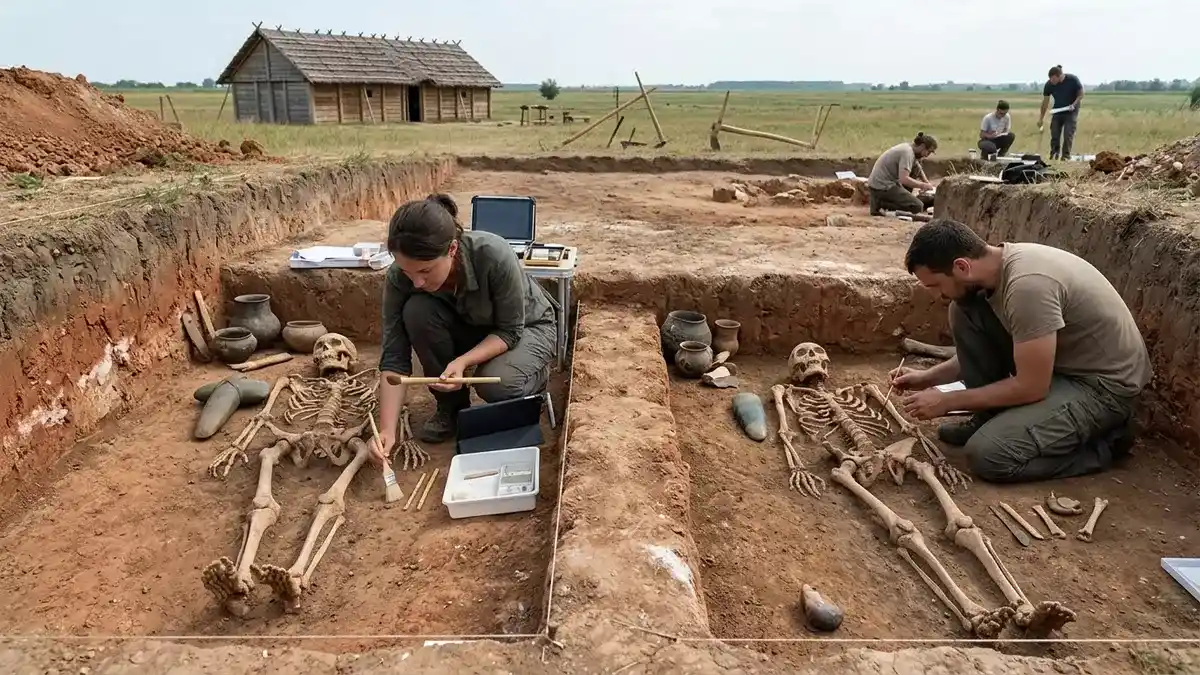
A groundbreaking bioarchaeological study published on February 16, 2026, in the American Journal of Biological Anthropology is turning long-held assumptions about prehistoric society on their head. By examining the physical wear-and-tear on 5,500-year-old human bones alongside the layout of their graves, researchers have discovered that while Neolithic communities did have gendered divisions of labor, these roles were surprisingly fluid and allowed for significant individual variation.
The study, spearheaded by a collaborative international research team, focused on 125 adult skeletons unearthed from two distinct Stone Age settlements in eastern Hungary: Polgár-Ferenci-hát (occupied from roughly 5300 to 5070 BCE) and Polgár-Csőszhalom (occupied from around 4800 to 4650 BCE). Although these two communities existed within the exact same geographical microregion, their daily routines, social structures, and funerary rituals could not have been more different.
Neolithic Study Finds Ancient Gender Roles Were Distinct Yet Remarkably Flexible
The Skeletal Detective Work: Reading Micro-Wear on Bones
To understand how these ancient peoples spent their days, the research team went far beyond simply looking at grave decorations. They utilized advanced skeletal forensic analysis to read “activity markers” left directly on the bones by repetitive physical labor.
 Were Neanderthals capable of making art?
The researchers meticulously cross-examined three primary physical markers across all 125 skeletons:
Spondylolysis (Spinal Stress Fractions): Micro-fractures and wear in the lower spine that serve as an direct indicator of heavy lifting, bending, and overall physical workload.
Humeral Enthesopathies (Arm Muscle Strain): Bony adaptations at the points where muscles attach to the humerus (upper arm bone), revealing repeated, intense strain on one specific arm.
Metatarsal Facets (Foot Joint Adaptations): Distinct modifications on the toe and foot bones caused by habitual kneeling, squatting, or severe toe hyperextension over many years.
By comparing these physical skeletal scars with the biological sex of each individual and the types of artifacts buried with them, the team built a vivid picture of how labor and identity intersected in the Stone Age.
Polgár-Ferenci-hát: A Community of Shared Hardship
At the older site of Polgár-Ferenci-hát, the dividing line between male and female labor was incredibly blurry. When analyzing the graves, archaeologists found no standardized pattern separating men from women. Men and women were buried in similar body positions and were surrounded by the same types of everyday tools.
The skeletal evidence backed up this egalitarian burial style. The physical workload markers showed no stark contrast between the sexes. Both men and women displayed the skeletal scars of physically demanding, grueling lifestyles. While workloads varied immensely from person to person within the community, those variations were based on individual capability rather than a strict gender divide.
Polgár-Csőszhalom: Ritual Separation and a High-Stress Economy
Moving forward in time to the younger settlement of Polgár-Csőszhalom, the social landscape shifted dramatically. Overall, the individuals living at Csőszhalom showed significantly higher levels of total body physical strain than their ancestors at Ferenci-hát, suggesting a more intense, specialized economy.
Furthermore, Csőszhalom practiced a highly ritualized, strictly gendered burial system:
[Polgár-Csőszhalom Strict Funerary Ritual]
├── Biological Females: Laid on LEFT side ──> Neutral Grave Offerings
└── Biological Males:   Laid on RIGHT side ─> Polished Stone Tools (Shoulder Placement)
In this community, biological females were systematically positioned on their left sides, while males were laid to rest on their right sides. Furthermore, polished stone tools—symbols of wood-chopping, forest clearing, and construction—were almost exclusively placed near the left shoulders of male skeletons.
The Common European Trend: The Dominant Male Right Arm
Despite the social differences between the two Hungarian communities, the study identified a fascinating biological link that connected both sites to a much broader prehistoric European trend.
At both Ferenci-hát and Csőszhalom, male skeletons consistently displayed intense overuse and muscular lesions on their right upper limbs. This severe, single-sided strain points to repeated, heavy unilateral tasks.
+-------------------------------------------------------------+
|             NEOLITHIC MALE LABOR WEAR PATTERNS              |
+----------------------+--------------------------------------+
| Repetitive Action    | Skeletal Adaptation / Lesion Location|
+----------------------+--------------------------------------+
| Spear/Tool Throwing  | Severe right humerus muscle scarring |
| Tree Felling         | Unilateral dominant elbow strain     |
| Heavy Wood Chopping  | Asymmetric shoulder joint wear       |
| Stone Tool Hacking   | Isolated right forearm enlargement   |
+----------------------+--------------------------------------+
Archaeologists believe this widespread physical marker, visible across various Neolithic sites throughout Europe, represents a shared cultural expectation of male labor, centered around land-clearing, carpentry, defense, or hunting with thrown weapons.
Breaking the Mold: The Exceptions That Prove Fluidity
The most remarkable finding of the 2026 study occurred when the researchers noticed individuals whose daily lives defied their community’s strict rules.
At the heavily gendered site of Csőszhalom, nine male skeletons buried with polished stone tools also featured prominent metatarsal facets on their feet, proving they spent hours in a deep, hyper-extended kneeling posture—likely a stance associated with intensive woodworking or agricultural tasks.
However, the team discovered a highly unusual female burial that turned the site’s rules upside down. This biological female was buried with the polished stone tools typically reserved exclusively for men. More importantly, her skeleton displayed the exact same severe foot bone facets and upper body strain as the specialized male laborers.
“This exceptional burial provides undeniable physical proof that ancient gender roles were not an absolute prison. When a person possessed the skill, strength, or social drive to perform a different societal role, Neolithic communities were flexible enough to let them live it—and bury them with the honors of that identity.”
— CNRS Bioarchaeology Research Team
Reconstructing Prehistoric Identities
The authors of the study, Sébastien Villotte, Tamás Szeniczey, Sacha Kacki, and Alexandra Anders, urge caution against making overly broad generalizations, noting that activity markers cannot pinpoint identical day-to-day tasks with perfect precision.
Even so, by fusing bone forensic data directly with local burial contexts, the team has managed to peel back the layers of time. The dual faces of Neolithic gender roles are now clear: they were structural enough to organize massive communal labor, yet fluid enough to embrace individual variation, showing that human identity has been a complex, negotiable concept for thousands of years.
Frequently Asked Questions
What is spondylolysis and what does it tell archaeologists?
Spondylolysis is a stress fracture or defect that occurs in the pars interarticularis of the lumbar (lower) vertebrae. In archaeological contexts, it serves as a reliable marker for intense physical stress on the lower back, typically caused by repetitive bending, lifting of heavy commodities, or vigorous manual agriculture.
Why did the two communities have different burial practices if they were in the same region?
Even though Polgár-Ferenci-hát and Polgár-Csőszhalom existed in the same microregion, they were separated by centuries of time. Over those generations, the local population grew, economic pressures changed, and the social structure became more complex and intense, leading to a shift from an egalitarian social model to a highly ritualized, specialized, and gender-segregated society.
How do scientists know a skeleton’s biological sex if the bones are damaged?
Anthropologists determine biological sex by examining specific areas of the skeleton that show sexual dimorphism. The pelvis is the most reliable indicator, as female pelvic bones are anatomically shaped for childbirth. Additionally, researchers analyze the skull’s robustness, the size of the joint heads, and, if preservation allows, underlying chromosomal DNA.
What are polished stone tools and why were they important?
Polished stone tools, such as ground stone axes and adzes, were the cutting-edge technology of the Neolithic era. Made by grinding tough rocks like jadeite or flint against abrasive stones, these tools allowed humans to efficiently chop down trees, clear thick prehistoric forests for agriculture, build permanent wooden longhouses, and shape wooden artifacts.
Does this study mean ancient societies were entirely egalitarian?
No, it suggests that prehistoric social structures were varied and non-linear. While the older site showed an egalitarian distribution of labor and burial rites, the younger site showed a highly stratified, gender-segregated setup. However, the discovery of exceptions (like the female artisan-warrior burial) proves that even in highly structured societies, institutional rules could be bent for individuals based on their lived experiences.