
Table of Contents
- 1. An Unexpected Discovery at Skaill Farm
- 2. The Striking Craftsmanship and Features of the Sandstone Head
- 2.1. Exquisite Medieval Artistry
- 3. The Mystery of the Broken Nose: Accidental Damage or Iconoclasm?
- 4. The St. Magnus Cathedral Connection and the Mirror Image Riddle
- 5. Preserving Orkney’s Norse Legacy
- 6. Frequently Asked Questions
- 6.1. How old is the carved stone head found in Orkney?
- 6.2. Where exactly was the artifact discovered?
- 6.3. Who was Sigurd of Westness?
- 6.4. Why is the broken nose on the carving significant?
- 6.5. How does the carving relate to St. Magnus Cathedral?
Viking-Era Carved Head Discovered in Orkney Astonishes Archaeologists
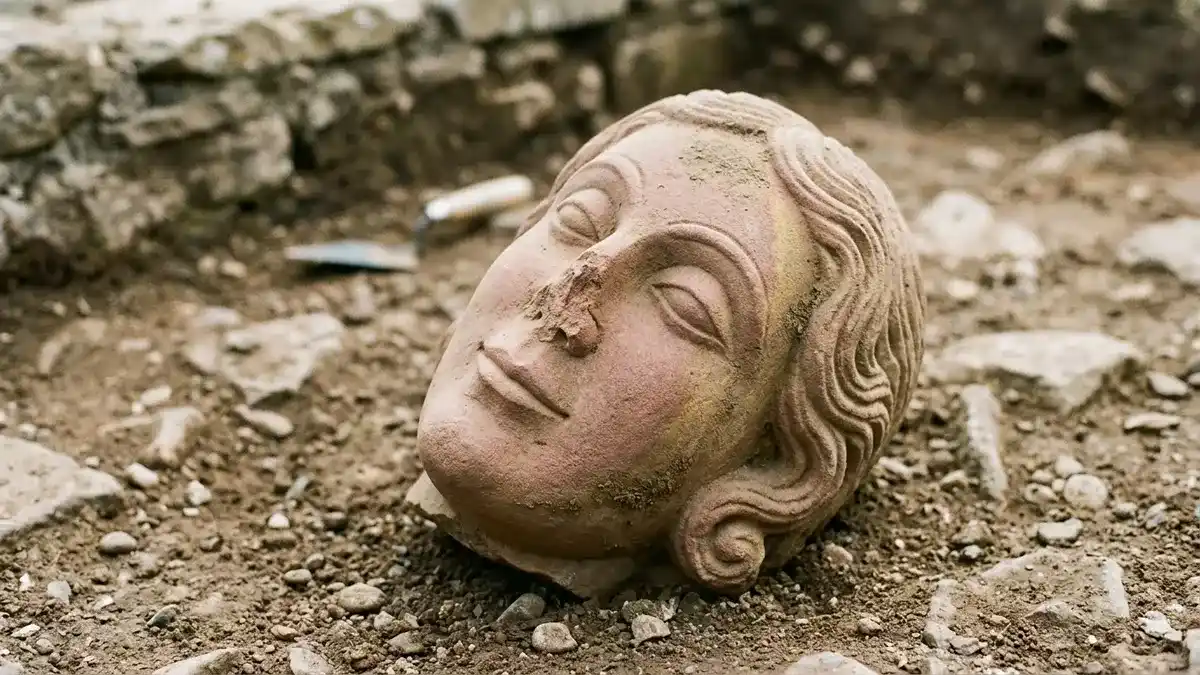
A remarkable archaeological discovery on the remote island of Rousay in Orkney has stunned researchers and rewritten our understanding of medieval Scottish craftsmanship. During a summer excavation at the historic Skaill Farm site, a student unearthed a beautifully preserved, 900-year-old carved sandstone head from the Viking era. The artifact, boasting an unexpected level of detail and a remarkably serene expression, offers an unprecedented glimpse into the artistic and political world of the 12th-century Norse elite.
Viking-Era Carved Head Discovered in Orkney Astonishes Archaeologists
An Unexpected Discovery at Skaill Farm
The dramatic find occurred during routine fieldwork led by the University of the Highlands and Islands (UHI) Archaeology Institute. Undergraduate student Katie Joss was carefully investigating the structural foundations of a massive medieval wall when she noticed a distinctively shaped block of red sandstone.
Upon clearing away the centuries of packed earth, Joss realized she was looking at a meticulously sculpted human face. The object was immediately recognized as an artifact of extraordinary cultural value, sparking intense excitement across the excavation team.
While the visible structures of Skaill Farm largely date back to the 18th century, archaeologists have long known that the site holds much older secrets. The farm sits directly on top of an ancient Norse settlement once belonging to Sigurd of Westness, a powerful 12th-century Viking chieftain. Sigurd was a prominent figure in the Orkneyinga Saga and a close companion of Earl Rognvald—the legendary Norse ruler who commissioned the construction of St. Magnus Cathedral in Kirkwall. This deep historical connection provides crucial context for the mysterious carved head.
The Striking Craftsmanship and Features of the Sandstone Head
What makes the Skaill Farm head so significant to European archaeology is its astonishing artistic quality. Medieval stone carvings from this region are frequently rigid or abstract, yet this piece exhibits a rare realism and emotional depth.
Exquisite Medieval Artistry
The artifact features elegant, flowing curls of hair, softly closed eyes, defined eyebrows, and a subtle, tranquil smile. Together, these elements give the face a peaceful, almost meditative countenance that is incredibly rare for Norse-era stone carvings found in Scotland.
 2,500-Year-Old Celtic Chariot Burial With Gold and Etruscan Treasures Discovered in Germany
Geological analysis indicates that the head was sculpted from local red sandstone characterized by distinct yellow inclusions. This specific type of stone matches material quarried on the neighboring island of Eday. It is the same stone used to create the molded architectural fragments found at the nearby ruins of St. Mary’s old parish church, suggesting a shared regional workshop or standard trade route for high-status building materials during the High Middle Ages.
The Mystery of the Broken Nose: Accidental Damage or Iconoclasm?
Despite its excellent state of preservation, the carved head is not entirely unblemished. The most prominent damage is its broken nose, a feature that has ignited an intense debate among historians and archeologists regarding the life history of the artifact.
          [ Artifact Lifecycle & The Iconoclasm Mystery ]

   1. Creation       -->   2. Display        -->   3. Defacement?
   Meticulously            Positioned at an        Was the nose broken
   sculpted from           angle to show off       intentionally during
   Eday sandstone.         the hair curls.         religious/political shifts?
There are two primary theories surrounding this targeted damage:
Accidental Trauma: The nose could have been broken during a structural collapse when the medieval building it adorned fell into ruin, or it may have been damaged by agricultural activity in later centuries.
Deliberate Iconoclasm: The defacement may have been an intentional act of iconoclasm—the purposeful destruction of religious or revered imagery. During political transitions or shifts in religious dominance, defacing the nose of a statue was a common method to symbolically “blind” or strip power from an image representing an old regime or spiritual belief system.
The St. Magnus Cathedral Connection and the Mirror Image Riddle
In their quest to identify the origins of the artifact, researchers compared the Skaill Farm head to known medieval stonework across the Orkney archipelago. They discovered fascinating parallels—and one glaring anomaly—at St. Magnus Cathedral in Kirkwall.
Dr. Sarah Jane Gibbon, co-director of the Skaill archaeological excavation, noted that while the team had previously uncovered interesting molded sandstone fragments, they had never encountered a figurative sculpture of this caliber. Dr. Gibbon’s research revealed that the stylistic rendering of the eyes closely mirrors carvings from the very earliest construction phases of St. Magnus Cathedral.
“The eyes are remarkably similar to carvings dating from the earlier phases of cathedral construction, but I could find no comparison for the serene expression.” — Dr. Sarah Jane Gibbon, Dig Co-Director
However, a bizarre stylistic twist keeps the researchers guessing. On the authorized carvings within St. Magnus Cathedral, the elegant curls of hair sweep distinctly toward the left side of the face. On the newly discovered Skaill head, the curl is positioned on the right side. It behaves exactly like a mirror image of the cathedral masterworks, raising questions about whether it was crafted by a rogue apprentice, a different workshop using shared templates, or designed to sit on an opposing, symmetrical side of an architectural archway.
Preserving Orkney’s Norse Legacy
The 900-year-old carved head has been safely removed from the Rousay excavation site and placed into conservation. Specialized artifact conservators are managing a meticulous cleaning and stabilization process to preserve the delicate sandstone details.
Once conservation is complete, museum curation teams intend to put the nameless Norse face on public exhibition. The artifact will serve as a centerpiece for interpreting Orkney’s rich Viking heritage, illustrating the profound connection between rural island chieftains like Sigurd of Westness and the grand architectural achievements of the medieval Norse earldom.
Frequently Asked Questions
How old is the carved stone head found in Orkney?
The carved sandstone head is estimated to be over 900 years old, dating back to the 12th century. This places its creation firmly within the Viking and Norse periods of Orkney’s history.
Where exactly was the artifact discovered?
The artifact was discovered at the Skaill Farm excavation site on the island of Rousay, one of the northern islands of the Orkney archipelago in Scotland. It was found within the foundations of an ancient medieval wall.
Who was Sigurd of Westness?
Sigurd of Westness was a powerful 12th-century Viking chieftain who lived on Rousay. He is prominently featured in the historical Orkneyinga Saga and was a close ally of Earl Rognvald, the ruler responsible for building St. Magnus Cathedral. The excavation site sits directly over Sigurd’s historical settlement.
Why is the broken nose on the carving significant?
The broken nose is significant because it suggests two potential historical paths: it was either accidentally damaged when the surrounding structure collapsed over time, or it was a deliberate act of iconoclasm, where people intentionally defaced revered symbols during times of political or religious upheaval.
How does the carving relate to St. Magnus Cathedral?
The style of the carved head’s eyes matches stonework from the earliest construction periods of St. Magnus Cathedral in Kirkwall. However, the hair curl on the Skaill head is on the right, while the cathedral versions feature the curl on the left, creating a mysterious mirror-image effect.