
Table of Contents
- 1. The Corded Ware Culture and the SuedOstLink Project
- 2. Shrouded in Luxury: The Secret of the Canine-Adorned Pouches
- 3. High-Status Motherhood and Advanced Childcare Practices
- 4. Markers of a Prehistoric Aristocracy
- 5. Sacred Geography: Why the Dead Shared Space Across Millennia
- 6. Strict Rules for the Final Journey
- 7. Frequently Asked Questions
- 7.1. What exactly were the 4,500-year-old bags made of?
- 7.2. Why did ancient people use dog teeth to decorate baby carriers?
- 7.3. What was the Corded Ware culture?
- 7.4. How do archaeologists know these women were elites?
- 7.5. What is the SuedOstLink project, and why are excavations happening there?
Neolithic Elite Graves in Germany Reveal 4,500-Year-Old Dog-Tooth Bags
An extraordinary archaeological discovery in eastern Germany is rewriting what we know about motherhood, social status, and spiritual beliefs in Europe’s Late Stone Age. During excavations ahead of a major green energy project, researchers uncovered the final resting places of high-ranking prehistoric women buried with lavishly decorated pouches.
Crafted 4,500 years ago, these intricate bags required immense resources to create and provide an unprecedented window into the lives of the Corded Ware culture’s elite. Beyond their aesthetic value, these artifacts challenge traditional views of ancient social structures, revealing a society that deeply revered maternal identity and elite lineage.
Neolithic Elite Graves in Germany Reveal 4,500-Year-Old Dog-Tooth Bags
The Corded Ware Culture and the SuedOstLink Project
The remarkable finds came to light near the village of Krauschwitz in Saxony-Anhalt, Germany. Archaeologists from the State Office for Heritage Management and Archaeology (LDA) of Saxony-Anhalt have been conducting extensive rescue excavations along the route of the SuedOstLink. This 170-kilometer-long power transmission line corridor stretches from Wolmirstedt to Droyßig, cutting through a landscape rich in prehistoric heritage.

Working in close cooperation with transmission system operator 50Hertz, scientists have documented a dense network of ancient features within the construction zone. Among the most prominent are:
15 Baalberge culture burial mounds dating back roughly 6,000 years.
15 Corded Ware culture graves originating from around 2500 BCE.

The Corded Ware culture was a vast, influential community that spanned Neolithic Europe, stretching from Alsace to Ukraine and from Scandinavia to the Alps. Known for their distinct pottery decorated with cord impressions, these people maintained highly structured social systems and deeply ingrained mortuary rituals that are clearly visible at the Krauschwitz site.
Shrouded in Luxury: The Secret of the Canine-Adorned Pouches
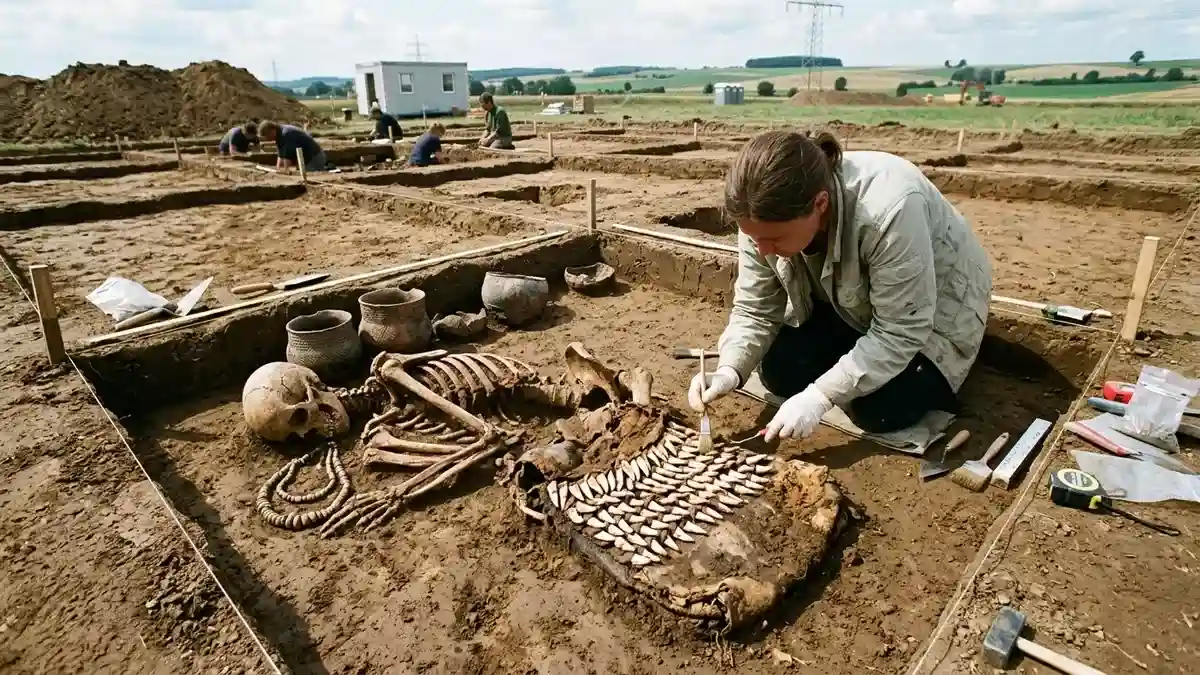
Among the 15 Corded Ware burials investigated, three stand out as truly exceptional. These graves contained the remains of women interred with highly decorative, prestigious pouches. While the organic materials of the bags—most likely leather or woven textiles—completely decayed over the millennia, their stunning ornamentation survived.
Archaeologists discovered hundreds of pierced dog teeth meticulously arranged within the soil. Measuring approximately 30 centimeters in length and 20 centimeters in height, each pouch was covered in overlapping rows of canine teeth.

+-------------------------------------------------------------+
|                ANCIENT CRAFTSMANSHIP BY THE NUMBERS         |
+-------------------------------------------------------------+
|  Pouch Dimensions:  ~30 cm x 20 cm                          |
|  Teeth per Pouch:   ~350 canine teeth                       |
|  Layout Style:      Overlapping, like roofing tiles          |
|  Source Species:    Medium-sized domestic dog breed         |
+-------------------------------------------------------------+
The Cost of Prestige: To gather 350 specific teeth for a single bag, multiple animals had to be harvested. Researchers believe a specific medium-sized dog breed, physically similar to the modern Small Münsterländer, was intentionally bred and sacrificed at a young age specifically to produce these lavish status symbols.
High-Status Motherhood and Advanced Childcare Practices
The physical placement of these bags within the graves offers profound insights into their real-world utility. Worn at the front of the body, the pouches were suspended from wide, imposing belts that were themselves adorned with fierce wolf teeth.
Most strikingly, several of these tooth-encrusted bags were found directly associated with the fragile skeletal remains of infants or fetuses. This evidence strongly indicates that these items served a dual purpose: they were highly prestigious baby carriers and protective maternal symbols.
The elite nature of childcare among these prehistoric families is further demonstrated by accompanying textiles. Archaeologists identified protective cloths, including 20-centimeter-wide shawls embellished with sequins and lined with sharp dog molars. This indicates an advanced, highly specialized approach to infant care where clothing served as functional protection, physical comfort, and an unmistakable marker of aristocratic birth.
Markers of a Prehistoric Aristocracy
The canine-adorned bags were not standard issue for every woman in the community. Detailed analysis reveals that these exquisite items appear in only about 20% of the female burials examined so far.
The incredible investment of time, labor, and animal resources required to craft just one pouch confirms that these were deeply personal, hereditary items restricted to a ruling class. This elite maternal identity is not isolated to Krauschwitz. A matching burial discovered in nearby Nessa—just 1.7 kilometers away—also contained a woman buried with an identical tooth-adorned pouch and the remains of an unborn child, confirming a regional pattern of elite burial customs.
Sacred Geography: Why the Dead Shared Space Across Millennia
The Krauschwitz excavations also revealed a fascinating connection between separate prehistoric eras. Long before the Corded Ware people arrived, the Baalberge culture dominated the region around 4000 BCE. They constructed massive, trapezoidal wooden huts over their dead, covering them with heavy loess soil to create towering burial mounds.
Timeline of Regional Landscape Use
│
├── 6,000 Years Ago ( Baalberge Culture )
│   └── Construction of massive, trapezoidal wooden burial huts
│
└── 4,500 Years Ago ( Corded Ware Culture )
    └── Elite burials deliberately positioned alongside older mounds
Though erosion flattened these mounds centuries ago, their foundational trenches and grave pits remain perfectly preserved below the plow line.
Intriguingly, the Corded Ware communities deliberately chose to place their own graves directly alongside these older, 6,000-year-old monuments. By anchoring their cemeteries to these ancient landmarks, the Corded Ware elites effectively legitimized their own social power and territorial ownership, linking their lineage to the respected ancestors of the past.
Strict Rules for the Final Journey
When a member of the Corded Ware culture died, their community followed an unyielding religious protocol. Every burial adhered to a strict spatial grid based on gender and social role:
Orientation: The deceased were always positioned facing directly south.
Men: Placed on their right side, accompanied by stone battle-axes and weapons.
Women: Placed on their left side, accompanied by ceramic vessels, fine jewelry, and the prestigious tooth-decorated pouches.
To preserve every shred of delicate context, archaeologists have extracted the rare tooth-pouch burials in massive blocks of intact earth. These blocks are being safely transported to the specialized laboratories of the State Office for Heritage Management and Archaeology in Halle, where conservators will use microscopic analysis and advanced dating techniques to unlock further secrets.
Field excavations at the Krauschwitz site will run through July, after which the area will be officially cleared for the construction of the SuedOstLink power line, ensuring Germany’s future energy needs are met without sacrificing its deepest historical roots.
Frequently Asked Questions
What exactly were the 4,500-year-old bags made of?
The primary bodies of the bags were crafted from organic materials like animal leather or woven fabric. Because these materials decay quickly in acidic soil, they disappeared long ago. However, the exact shape and size of the bags were preserved by the durable, pierced dog teeth that were sewn onto them.
Why did ancient people use dog teeth to decorate baby carriers?
In Neolithic European cultures, animal teeth held deep symbolic and protective meanings. Using dog and wolf teeth likely served a triple purpose: demonstrating the family’s immense wealth, showcasing hunting prowess or animal management, and acting as a protective amulet to ward off spiritual harm from vulnerable infants.
What was the Corded Ware culture?
The Corded Ware culture was a major European archaeological horizon that existed between roughly 2900 BCE and 2350 BCE. They are famous for their cord-impressed pottery, distinct pastoral lifestyle, specific burial positions based strictly on gender, and their role in spreading Indo-European languages across the continent.
How do archaeologists know these women were elites?
The bags are found in only 20% of the documented female graves. Because each bag required around 350 matched teeth from a specific dog breed, creating one required sacrificial animals, skilled labor, and significant time. This highly restricted distribution and high resource cost point directly to an aristocratic or ruling class.
What is the SuedOstLink project, and why are excavations happening there?
The SuedOstLink is a major underground power transmission line project designed to transport green electricity from northern Germany to the south. Because German law mandates that historic heritage must be preserved ahead of major infrastructure development, rescue excavations are carried out to safely document and recover ancient sites before construction begins.