
Table of Contents
- 1. The Ancient Gallery of the Altai Crossroads
- 2. From Living Beast to Denatured Symbol
- 2.1. 1. The Paleolithic Era: Masterful Realism
- 2.2. 2. The Bronze Age: Action and Distortion
- 2.3. 3. The Iron Age: The “Wolf-Like” Transformation
- 3. How Climate Change Forced a Nomadic Revolution
- 4. Boulders as Ancient Monuments of Identity
- 5. The Horse, the Horde, and the End of an Era
- 6. The Miracle of Cave Survival
- 7. Frequently Asked Questions
- 7.1. What did the earliest elk carvings in Mongolia look like?
- 7.2. Why did the elk carvings start to look like wolves over time?
- 7.3. What caused this dramatic change in artistic style?
- 7.4. Can painted ancient artwork survive in the Altai Mountains?
- 7.5. When did the elk completely disappear from Mongolian rock art?
Ancient Elk Rock Art in Mongolia Reveals Radical 12,000-Year Evolutionary Shift
Deep within the rugged Altai Mountains of western Mongolia, ancient hunters left behind a sprawling library of stone carvings. For more than 12,000 years, generations of humans etched images of the natural world into these high-altitude boulders. However, a groundbreaking new study has revealed that these petroglyphs contain a hidden, dramatic story of survival and psychological transformation.
Over a twelve-millennium span, the way ancient artists depicted a single animal—the majestic elk—underwent a radical evolution. Images that began as highly accurate, biologically realistic portraits slowly morphed into distorted, otherworldly, wolf-like symbols. This remarkable stylistic shift provides modern researchers with a direct timeline of a society navigating severe climate change, shifting lifestyles, and a complete redefinition of human identity.
Ancient Elk Rock Art in Mongolia Reveals Radical 12,000-Year Evolutionary Shift
The Ancient Gallery of the Altai Crossroads
The Altai region is a stark, mountainous landscape where the modern borders of Mongolia, Russia, China, and Kazakhstan converge. This remote territory boasts one of the longest, most stable, and most continuous traditions of open-air rock art found anywhere on Earth. The artistic timeline stretches all the way from the Late Paleolithic era (around 12,000 years ago) through the Bronze Age, extending straight into the Early Iron Age.
Among the menagerie of creatures carved into the mountain stones, the Siberian elk (Cervus elaphus sibiricus) held a uniquely sacred and central position in the minds of prehistoric people.
By analyzing the stylistic changes across thousands of individual petroglyphs, Dr. Esther Jacobson-Tepfer published a comprehensive study in the Cambridge Archaeological Journal detailing how this iconic animal transitioned from a living part of nature into a highly abstract cultural symbol.

From Living Beast to Denatured Symbol
The long stylistic evolution of Mongolian rock art can be broken down into three distinct, fascinating historical phases, showing a steady march away from biological realism toward complete abstraction.
1. The Paleolithic Era: Masterful Realism
In the earliest carvings, dating back roughly 12,000 years, the elk was rendered with breathtaking anatomical accuracy. Prehistoric artists drew the animals in natural, peaceful poses. It was common to see maternal elk standing alongside their young, or interacting peacefully with other megafauna of the era, including now-extinct beasts like woolly mammoths and woolly rhinoceroses.
These early hunter-gatherers possessed a profound, intimate observational knowledge of animal anatomy. They carved the elk in profile, matching true biological proportions, complete with carefully shaped legs and distinct muscles. To look at these ancient images is to see the elk exactly as it existed in the wild.

2. The Bronze Age: Action and Distortion
As the centuries rolled forward into the Bronze Age, the nature of the artwork shifted dramatically. The passive, realistic portraits disappeared. Instead, elk were increasingly placed into dynamic action sequences directly involving human beings.
[ Evolution of Altai Rock Art ]
Paleolithic: Anatolical Realism ──► Bronze Age: Hunting Action ──► Iron Age: Abstract Wolf-Like Symbols
Petroglyphs from this era frequently depict large elk surrounded by hunters. Simultaneously, the physical forms of the animals began to distort. The legs became elongated, the bodies unnaturally stretched, and the majestic antlers grew massively exaggerated, dominating the stone canvases.
3. The Iron Age: The “Wolf-Like” Transformation
By the twilight of the Bronze Age and the onset of the Early Iron Age, realism was completely abandoned. The facial features of the elk were intentionally warped by artists into long, predatory snout- or beak-like shapes.
The resulting figures no longer resembled real, living elk. Instead, they had transformed into an idealized, denatured beast that blended the traits of an elk with the predatory silhouette of a wolf. The elk was no longer a food source to be observed; it had become an abstract symbol representing clan status, tribal identity, or complex spiritual mythologies.
How Climate Change Forced a Nomadic Revolution
According to the study, this striking visual transformation was not a simple matter of changing artistic tastes. Instead, it was driven by catastrophic environmental shifts across the Eurasian steppe during the Holocene epoch.
Over millennia, the climate of the region grew steadily colder and significantly drier. As a direct result of this desertification, the lush, dense forests that the moisture-loving elk relied on for food and shelter began to recede. The elk populations were forced to migrate westward in search of surviving woodlands.
Faced with the disappearance of their primary game animal, the human populations of the Altai Mountains had to adapt to survive. They gradually abandoned their traditional hunter-gatherer lifestyle and embraced pastoralism—the herding of domesticated livestock.
As these early pastoralists moved their herds higher up into the mountain valleys to find fresh pastures, their rock art moved with them. Archaeologists can track this forced migration over time, noting that newer, more abstract petroglyphs consistently appear at significantly higher elevations than the older, realistic carvings.
Boulders as Ancient Monuments of Identity
Dr. Jacobson-Tepfer’s extensive decades of fieldwork in the region highlight how deeply these environmental pressures impacted the collective human psyche.
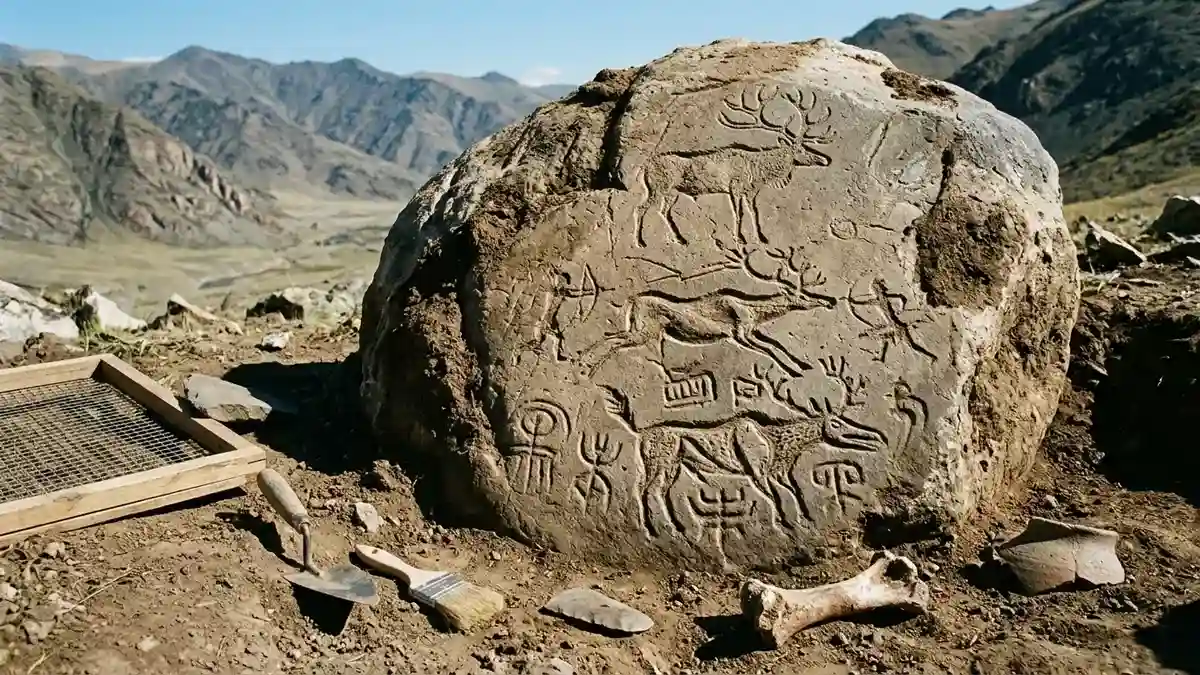
While conducting a survey of a site known as Tsagaan Salaa IV in 1995, she encountered a massive glacial boulder overlooking a sprawling valley floor. Among hundreds of traditional carvings etched into the stone, one particular image of an elk stood out. It was heavily distorted, stylized, and entirely otherworldly.
In her research, she noted that this single boulder was far more than an ancient canvas; it was a profound cultural monument. The distorted elk image reflected a complex interweaving of deep geological time, evolving religious iconography, and the shifting social structures of a people struggling to redefine who they were in a rapidly changing world.
The Horse, the Horde, and the End of an Era
The final nail in the coffin for realistic animal art came with the widespread adoption of the domesticated, mounted horse. The ability to ride horses completely revolutionized human mobility and warfare across the Eurasian steppe, giving rise to highly stratified nomadic societies and powerful warrior hierarchies.
With this new level of speed and power, the relationship between humans and the animal kingdom shifted permanently. Animals were no longer seen as equal spiritual neighbors in nature. Instead, highly stylized animal motifs were used as insignias of power, carved onto personal items, weapons, and horse tack to denote military rank and noble bloodlines.
The living, breathing elk of the Paleolithic had been completely hollowed out, replaced by a rigid heraldic symbol. By the arrival of the Turkic period, the image of the elk vanished from the Altai rock art tradition entirely, replaced by the symbols of a completely new era.
The Miracle of Cave Survival
Because the Altai Mountains are subjected to brutal, freezing winters, intense winds, and thousands of years of regular weathering, it is physically impossible for ancient painted images to survive outdoors on exposed rock faces. Over the millennia, any pigment applied to open-air cliffs has been completely erased, leaving behind only the deeply chiseled petroglyphs.
However, there is one incredible exception to this rule. Deep inside the sheltered interior of Khoit Tsenkir Cave, located in Mongolia’s Khovd Aimag, archaeologists discovered the only surviving set of painted Paleolithic elk images in the entire region. Protected from the devastating mountain weather by the cave’s stone walls, these rare, mineral-pigment drawings provide an invaluable color reference for the realistic artistic style that defined the dawn of human history in Mongolia.
Frequently Asked Questions
What did the earliest elk carvings in Mongolia look like?
The earliest petroglyphs, dating back 12,000 years to the Paleolithic era, were highly realistic and anatomically accurate. They showed elk in natural, lifelike poses, often alongside their calves or other ancient animals like woolly mammoths, demonstrating the hunters’ deep knowledge of wildlife.
Why did the elk carvings start to look like wolves over time?
As the centuries progressed into the Iron Age, artists abandoned realism for symbolism. They elongated the elk’s body, exaggerated the antlers, and distorted the mouth into a long, predatory snout or beak-like shape. This transformed the elk from a literal animal into a mythological, wolf-like symbol used to represent clan identity or spiritual status.
What caused this dramatic change in artistic style?
The shift was primarily driven by climate change. As the Eurasian steppe became colder and drier, forests shrank, and the elk migrated away. Humans had to adapt by shifting from hunting to livestock herding (pastoralism). This massive change in daily survival altered their spiritual relationship with nature, which was reflected in their increasingly abstract art.
Can painted ancient artwork survive in the Altai Mountains?
No, open-air painted art cannot survive the harsh, freezing winters and intense weathering of the Altai Mountains. The only surviving painted images from this early era are located safely inside the protected interior of Khoit Tsenkir Cave; all other outdoor discoveries are chiseled petroglyphs.
When did the elk completely disappear from Mongolian rock art?
The elk motif steadily declined as nomadic horse riding became dominant, turning the animal into a rigid status symbol on weapons and tools. By the Turkic period, the elk disappeared entirely from the regional rock art tradition, signaling a total shift in cultural focus.