
Table of Contents
- 1. The Anatomy of an Ancient Masterpiece
- 2. From Greek Stage to Roman Graves: The Theater Influence
- 3. Unearthing Ceuclum: An Ancient Imperial Outpost
- 4. A Prosperous Community Plugged Into Global Trade
- 5. Frequently Asked Questions
- 5.1. What makes this particular Roman oil lamp unique?
- 5.2. Who was the face on the lamp supposed to represent?
- 5.3. Where exactly was this artifact discovered?
- 5.4. Why did ancient Romans bury oil lamps inside graves?
- 5.5. What does the discovery tell us about the ancient people of Cuijk?
1,900-Year-Old Roman Mask Lamp Discovered in Dutch Cemetery
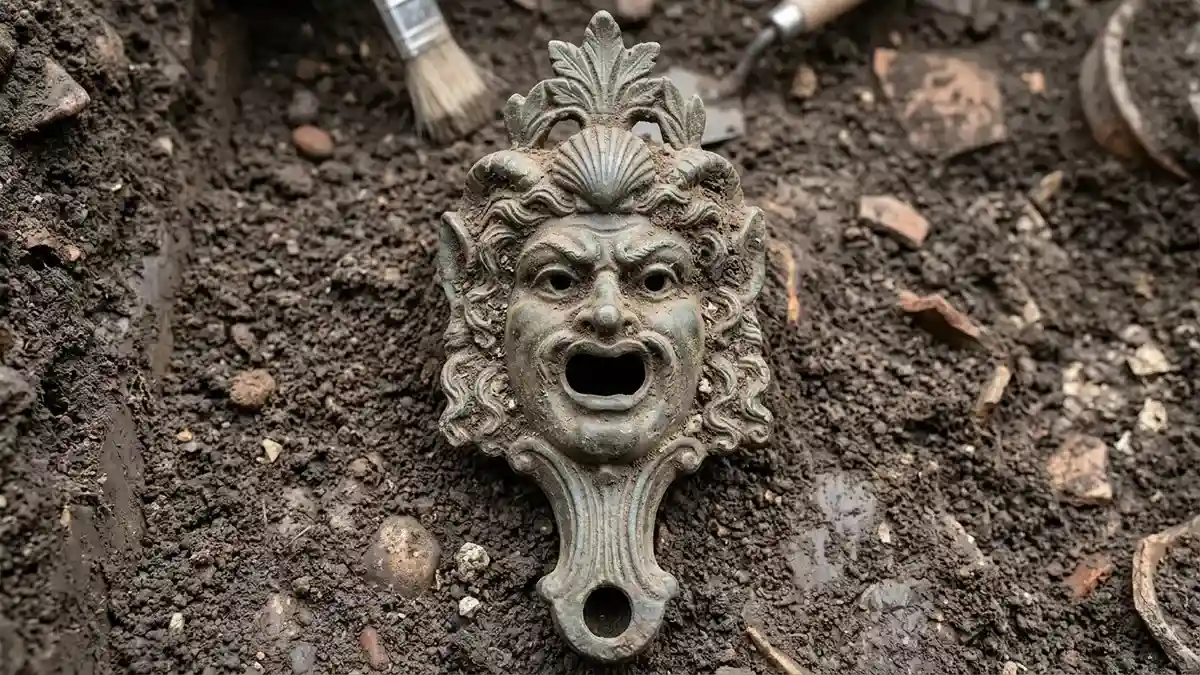
Archaeologists excavating a historic burial ground in the Dutch town of Cuijk have unearthed a stunningly well-preserved Roman oil lamp sculpted in the likeness of a dramatic theatrical mask. Dated to the second century CE, the 1,900-year-old artifact was discovered tucked inside an ancient grave. The site is rapidly emerging as the largest Roman-era cemetery ever documented in the North Brabant province of the Netherlands.
The find has captivated historians not just because of its incredible structural survival, but due to its highly intricate, theatrical design. While ordinary Roman oil lamps typically featured simple relief carvings stamped onto flat surfaces, this luxury piece was cast as a fully three-dimensional sculptural masterpiece, bridging the worlds of ancient entertainment, religious ritual, and daily life.
1,900-Year-Old Roman Mask Lamp Discovered in Dutch Cemetery
The Anatomy of an Ancient Masterpiece
The craftsmanship of the Cuijk mask lamp stands completely apart from conventional Roman pottery. Every functional component of the oil lamp was cleverly integrated into the anatomical features of a mythological face:
The Fuel Inlet: Rather than a standard boring hole, the opening where oil was poured is positioned directly inside the gaping, wide-open mouth of the mask.
The Mythological Face: The mouth is framed by hollowed-out, wide eyes and thick, heavy brows. Experts believe these exaggerated features represent a satyr—a half-human, half-goat creature from Greek and Roman mythology deeply tied to wine, theater, and celebration.
The Elaborate Headdress: A beautifully detailed scallop shell crowns the figure’s forehead, from which an intricate, leafy botanical ornament rises upward to form a crown. Thick curls of textured hair spill down both sides of the face.
The Fluted Wick Nozzle: Beneath the face, the elongated nozzle designed to hold the burning wick tapers downward, forming a elegant, fluted “neck” structure.

From Greek Stage to Roman Graves: The Theater Influence
The design of the lamp draws inspiration directly from classical Greek theater. In antiquity, actors wore stylized masks with highly exaggerated expressions. These features served a dual practical purpose: they allowed large audiences sitting in massive open-air amphitheaters to easily distinguish different characters and read specific emotional shifts from a distance.
As Roman culture absorbed Greek traditions, these dramatic mask motifs spread rapidly into everyday art, home architecture, luxury furniture, and personal items. However, when placed inside a tomb, a mask-shaped lamp took on a deeply solemn, spiritual role.
 Seizure of Carthaginian Bronze Coins Highlights Ancient Economy and Illicit Antiquities Trade
In Roman funerary rituals, leaving a working lamp inside a grave was a symbolic act of devotion. The flame was believed to guide the wandering soul through the eternal darkness of the underworld, lighting their final path to the afterlife.
Unearthing Ceuclum: An Ancient Imperial Outpost
The cemetery where the lamp was discovered initially surrounded the ancient settlement of Ceuclum. During the second century, this town was inhabited by the Batavi, a powerful Germanic tribe that formed a close, strategic military alliance with the Roman Empire.
       [Ancient Roman Town of Ceuclum]
                     │
         Modern Development Overlap
                     │
                     ▼
          [Modern Town of Cuijk]
    (15% Excavated ──► 85+ Rich Graves)
Today, the footprint of ancient Ceuclum sits directly beneath the modern municipality of Cuijk, located near the German border. Although the vast majority of the historic graveyard is sealed away beneath modern asphalt roads, houses, and commercial buildings, ground surveys reveal that the burial grounds once spanned a minimum of 15 acres.
To date, archaeologists have managed to systematically excavate only 15 percent of the total site. Despite this limited window into the past, they have already uncovered more than 85 complex graves.
A Prosperous Community Plugged Into Global Trade
The sheer variety and high quality of the items buried alongside the dead prove that Ceuclum was far from a poor, isolated frontier outpost. Instead, it was a prosperous trading community with direct access to luxury goods manufactured thousands of miles away across the Roman Empire.
Excavations have yielded a diverse array of artifact wealth, providing an intimate look into daily life and regional trade connections:
Terra Sigillata: Archaeologists discovered numerous fine red glossy plates. This was an exotic, high-end luxury pottery imported directly from workshops in Gaul (modern-day France).
Local Ceramics: The graves contained a massive variety of everyday regional pottery, including white clay wares, single-handled jugs, drinking cups, and storage vessels.
Luxury Household Items: Delicate glass vessels, cast bronze bowls, and intricate personal jewelry were recovered from individual burial pits.
Cremation Offerings: In several cremation pits, layers of dark, ash-blackened soil were found mixed with shattered, exploded pottery shards. This reflects a common Roman funerary practice where mourners threw vessels filled with food, oils, or perfumes directly into the active funeral pyres as sacrificial offerings, destroying the material goods alongside the deceased.
As development continues and further archaeological plots open up for study, the rich soil of Cuijk will undoubtedly continue to rewrite our understanding of how theater, imperial commerce, and deep-seated religious rites converged on the northern frontiers of the Roman world.
Frequently Asked Questions
What makes this particular Roman oil lamp unique?
While most Roman oil lamps feature simple, flat drawings stamped onto the surface, this rare second-century artifact is sculpted as a complete, three-dimensional theatrical mask. Its fuel opening is built directly inside the wide-open mouth of the figure.
Who was the face on the lamp supposed to represent?
The lamp’s exaggerated facial features, thick eyebrows, and wide eyes strongly resemble a satyr—a half-human, half-goat companion of Bacchus, the Roman god of wine, theater, and festivity.
Where exactly was this artifact discovered?
The lamp was unearthed during an excavation in Cuijk, a modern municipality in the North Brabant province of the Netherlands. In ancient times, this area was a Roman-allied settlement known as Ceuclum.
Why did ancient Romans bury oil lamps inside graves?
Oil lamps held an important symbolic purpose in Roman funerary rites. Mourners placed lit lamps inside tombs because they believed the physical flame would guide the spirits of the deceased through the underworld, illuminating their journey to the afterlife.
What does the discovery tell us about the ancient people of Cuijk?
The presence of luxury items like this mask lamp, fine terra sigillata pottery imported from Gaul, and bronze bowls proves that the local Batavi people were prosperous and deeply connected to the trade networks of the wider Roman Empire.