
Table of Contents
- 1. Rediscovering a Hidden Treasure in a Local Museum
- 1.1. High-Tech Scientific Forensic Analysis
- 2. Dating the Shift into the Copper Age
- 2.1. A Pioneering Northeastern Find
- 3. Idol of Worship or Master Textile Tool?
- 3.1. Hypothesis 1: A Ritualistic Idol or Figurine
- 3.2. Hypothesis 2: A Specialized Weaving Tool
- 4. Mapping the Ancient Webs of Exotic Commerce
- 4.1. Multiple Pathways of Exchange
- 5. Frequently Asked Questions
- 5.1. Where was this historic ivory object originally found?
- 5.2. Why did it take nearly 50 years to identify it as hippopotamus ivory?
- 5.3. How old is the artifact and what era does it belong to?
- 5.4. What was the object used for by the ancient inhabitants?
- 5.5. What does this discovery tell us about ancient Mediterranean trade?
Oldest Hippopotamus Ivory Artifact in Iberia Unlocks Secrets of Copper Age Trade
A fascinating re-examination of a decades-old archaeological find has rewritten the history of ancient trade in the western Mediterranean. Researchers studying a small, mysterious artifact excavated in 1977 have officially identified it as the oldest piece of hippopotamus ivory ever discovered in the Iberian Peninsula.
The breakthrough study, spearheaded by the Prehistoric Studies and Research Seminar (SERP) at the University of Barcelona and published in the Journal of Archaeological Science: Reports, confirms that communities in modern-day Spain and Portugal were deeply integrated into long-distance luxury trade networks more than 4,000 years ago. This tiny object proves that prehistoric European societies were far more globally connected than once assumed, pulling in exotic materials from as far away as North Africa and the Near East.
Oldest Hippopotamus Ivory Artifact in Iberia Unlocks Secrets of Copper Age Trade
Rediscovering a Hidden Treasure in a Local Museum
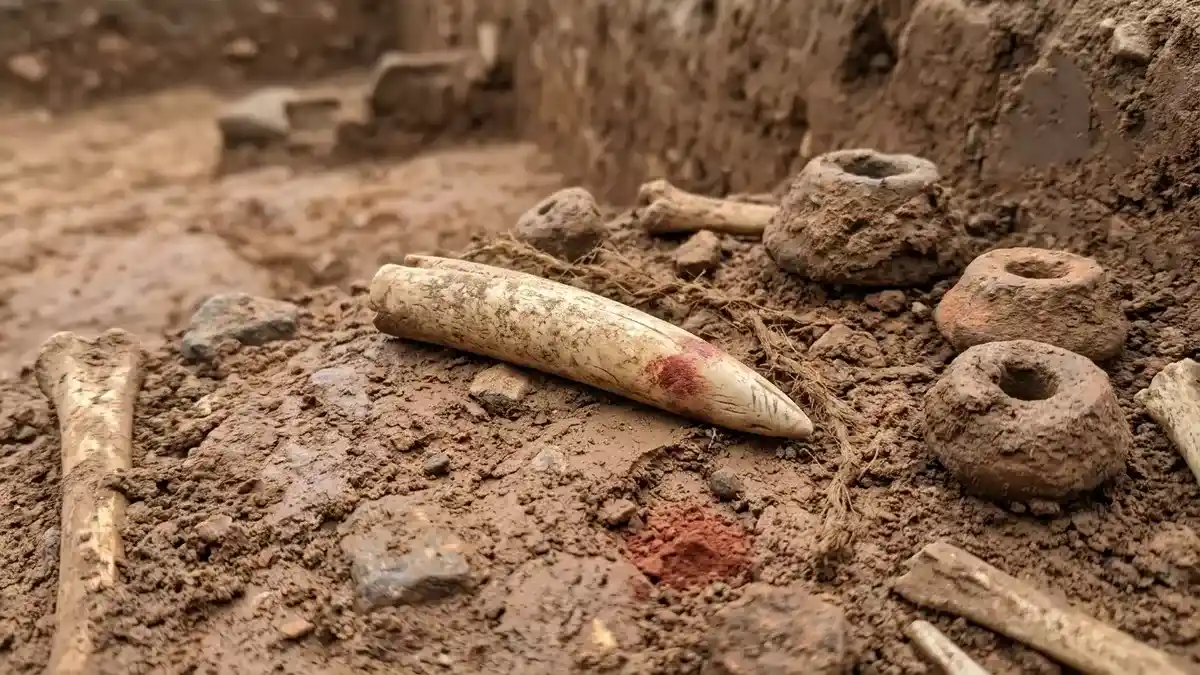
The artifact was originally uncovered at the Copper Age (Chalcolithic) settlement site of Bòbila Madurell, located in Sant Quirze del Vallès near Barcelona, Spain. Measuring just over 10 centimeters (about 4 inches) in length and weighing a meager 11 grams, the item was quietly placed into storage at the nearby Museu d’Història de Sabadell.

For nearly half a century, the true nature, composition, and extreme rarity of the object remained completely unknown. It was widely assumed to be a standard piece of local animal bone or common deer antler.
High-Tech Scientific Forensic Analysis
To unlock the object’s true identity, modern scientists subjected it to an array of advanced laboratory testing methods. The team utilized Fourier Transform Infrared Spectrometry (FTIR)—a technique that shines infrared light through a sample to map its molecular structure—alongside microscopic traceological (wear-pattern) analysis.
The results yielded several major scientific revelations:

The Material: The item was not bone; it was carved exclusively from the dense lower incisor tusk of a hippopotamus (Hippopotamus amphibius).
The Pigment: Residue analysis revealed the surface was coated in a deliberate red pigment made from iron oxyhydroxides (red ochre).
The Binder: The red paint was mixed with an organic binding agent, likely animal fat, to help the color adhere permanently to the glossy ivory surface.

Dating the Shift into the Copper Age
By executing precise radiocarbon dating on the secure archaeological soil layers surrounding the find, researchers placed the artifact’s creation within the second quarter of the third millennium BCE (roughly 2750–2500 BCE). This dates the object to the critical transitional threshold moving from the Late Neolithic into the early Chalcolithic, or Copper Age.
A Pioneering Northeastern Find
While archaeologists have previously found scattered examples of imported ivory in the grand tomb complexes of southern Iberia (such as Andalusia), this piece represents the earliest hippopotamus ivory object ever recognized in the northeastern region of the peninsula.
Its early date proves that northern communities were not merely passive recipients catching the tail-end of southern trade lines. Instead, local groups in what is now Catalonia were active, pioneering participants in international maritime and overland distribution channels.
Idol of Worship or Master Textile Tool?
The exact functional purpose of this 4,500-year-old ivory object remains a subject of intense, fascinating academic debate among researchers. Its physical characteristics allow for two completely distinct, yet equally compelling, interpretations.
Hypothesis 1: A Ritualistic Idol or Figurine
Because of its sleek, stylized contours and the presence of the sacred red ochre pigment, some archaeologists hypothesize that the object served a purely symbolic, spiritual, or religious function. In prehistoric Europe, red-painted figurines or stylized “idols” were frequently kept as household talismans or utilized as grave goods to assist souls transitioning into the afterlife.
Hypothesis 2: A Specialized Weaving Tool
Conversely, the physical wear patterns and micro-scratches visible along the object’s tapered tip support a highly practical alternative. The item shares a striking structural resemblance to a “beater”—a tool utilized by ancient weavers to pack down horizontal threads tightly into a vertical loom.
Contextual Evidence: This utilitarian theory is heavily reinforced by the immediate archaeological environment. Divers and excavators recovered the ivory object in close proximity to a cluster of prehistoric ceramic spindle whorls, proving that high-volume textile and fabric production was actively occurring at the Bòbila Madurell campsite.
Mapping the Ancient Webs of Exotic Commerce
Beyond the debate over its function, the raw presence of hippopotamus ivory in prehistoric Catalonia carries immense geopolitical significance. Hippopotamus ivory is significantly rarer and more difficult to source than elephant ivory, requiring specialized hunting and trading connections to access the river ecosystems of North Africa or the Levant.
The discovery expands an already impressive inventory of exotic materials known to have circulated through Chalcolithic Iberia, creating a vivid picture of a highly complex, interconnected ancient economy.
[North Africa / Near East] ---> [Southern Iberia / Andalusia] ---> [Bòbila Madurell (Catalonia)]
                                           OR
[Sardinia & Balearic Islands] ----> (Maritime Routes) ----------> [Northeastern Coastline]
Multiple Pathways of Exchange
Historians are currently evaluating two potential routes by which this rare tusk arrived in northern Spain:
The Southern Continental Route: Strong archaeological evidence proves that southern Iberia maintained intense, cross-strait contact with North Africa during this period. The tusk could have landed in the south and traveled slowly northward via overland networks.
The Northwestern Maritime Route: Alternatively, the Catalan find might have bypassed the south entirely, moving across the sea via older Neolithic maritime channels established by the local Sepulcres de Fossa (Pit Grave) culture. This network heavily interacted with Sardinia and the Balearic Islands, where elephant ivory has been well-documented within Bell Beaker cultural contexts.
Ultimately, this exceptional discovery does far more than simply add a new artifact to a museum display case. By proving that a rare piece of sub-tropical African wildlife found its way into a prehistoric Spanish weaving camp, the ivory of Bòbila Madurell highlights the incredible resourcefulness, expanding geographic horizons, and sophisticated economic ambitions of Europe’s early Copper Age societies.
Frequently Asked Questions
Where was this historic ivory object originally found?
The artifact was excavated in 1977 at the prehistoric settlement site of Bòbila Madurell, located in the municipality of Sant Quirze del Vallès within the province of Barcelona, Catalonia, Spain.
Why did it take nearly 50 years to identify it as hippopotamus ivory?
When it was first unearthed in the late 1970s, the object was assumed to be made from common local animal bone or antler. It wasn’t until modern researchers applied advanced Fourier Transform Infrared Spectrometry (FTIR) and microscopic traceological testing that its true identity as a hippopotamus lower incisor was revealed.
How old is the artifact and what era does it belong to?
Radiocarbon dating places the object in the second quarter of the third millennium BCE (around 2750–2500 BCE). This establishes it as the oldest known hippopotamus ivory artifact in the Iberian Peninsula, originating during the transition from the Late Neolithic to the Copper Age (Chalcolithic).
What was the object used for by the ancient inhabitants?
Its exact function is uncertain. Some scholars believe its stylized shape and red ochre coatings suggest it was a ritual figurine or religious idol. Others point to distinct tip wear and the presence of nearby loom pieces to argue it was a practical textile tool used to beat threads into place on a loom.
What does this discovery tell us about ancient Mediterranean trade?
The find proves that Copper Age European societies were not isolated. To obtain a rare material like hippopotamus ivory, local Iberian populations had to be linked into a sophisticated, highly organized network of maritime and overland trade that stretched across the Mediterranean Sea to source areas in North Africa or the Near East.