
Table of Contents
- 1. The Workshop of the Dead: Types of Bone Modifications
- 2. Mass Production at the Peak of Power
- 3. The “Anonymous Dead” of the Ancient Metropolis
- 4. Conclusion
- 5. Frequently Asked Questions
- 5.1. What was the Liangzhu civilization?
- 5.2. What kinds of objects were made from the human bones?
- 5.3. Was this practice the result of warfare or human sacrifice?
- 5.4. Why were so many of the bone objects left unfinished?
- 5.5. What does this discovery tell us about ancient urban life?
Neolithic Discovery Reveals Systematic Human Bone Modification in China
The Liangzhu civilization, which flourished in the Yangtze River Delta of China between 5,300 and 4,500 years ago, is celebrated for its monumental water-control systems, advanced urban centers, and exquisite ceremonial jade artifacts. However, a groundbreaking study has added a startling new dimension to our understanding of this highly stratified Neolithic society.
According to research published in the journal Scientific Reports, archaeologists have uncovered the first and only known evidence of systematic human bone modification in prehistoric China. Rather than treating all human remains with traditional ritualistic care, the Liangzhu people deliberately gathered, cut, and shaped human skeletal remains into highly standardized objects—a practice that reflects profound shifts in social bonds and the value of human identity during the dawn of urban life.
Neolithic Discovery Reveals Systematic Human Bone Modification in China
 10th-Century Bronze Cross Found in Germany Reveals Early Christian Influence on Slavic Tribes
The Workshop of the Dead: Types of Bone Modifications
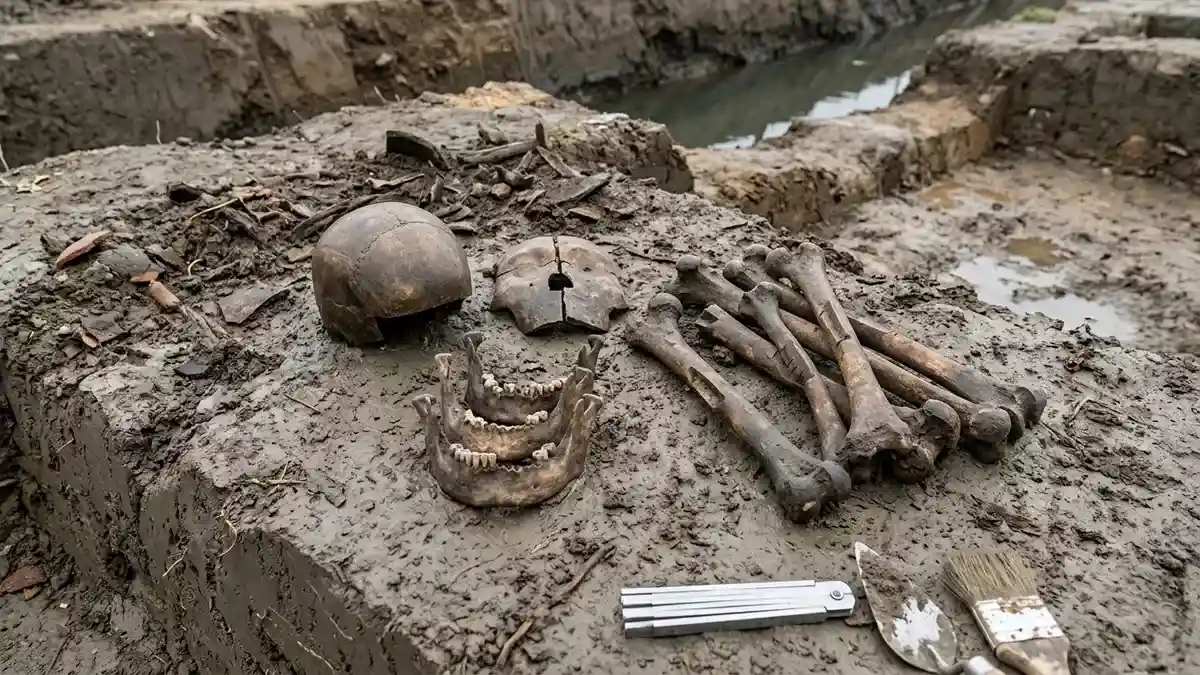
The extensive study analyzed a collection of 183 human bones excavated within the core urban complex of Liangzhu. To the surprise of researchers, 52 of these bones—nearly 30 percent—showed clear signs of deliberate, highly technical modification.
Far from being isolated or random experiments, the artifacts fell into distinct categories, pointing to a standardized manufacturing process. The primary forms discovered include:
Skull Cups: Created by cleanly cutting the upper portion of the skull (the calvarium) horizontally to form a bowl or cup-like vessel.
Mask-Like Facial Skulls: Cranial remains that were systematically split right across the facial structure, creating flat, mask-like bone plates.
Flattened Mandibles: Human jawbones that had their bases meticulously shaved and flattened, altering their natural anatomy.
Limb-Bone Tools: Long leg or arm bones heavily modified and shaped, potentially to serve as utilitarian tools or handles.
Perforated Child’s Skull: An exceptionally rare and poignant find consisting of a young child’s skull bearing two perfectly polished, drilled holes alongside intentional surface abrasions—an object with absolutely no parallel in Chinese archaeology.
The majority of these modified remains were found discarded in ancient moats, canals, and waterways. Strikingly, nearly 80 percent of the items were left unfinished, discarded midway through the modification process. This high ratio of half-finished material suggests that the human bone was treated as a common, low-value raw material rather than a rare, highly sacred substance.
Mass Production at the Peak of Power
The geographic location of the finds provides essential context for the behavior. Most of the modified bones were recovered from Zhongjiagang, a primary industrial workshop sector located directly inside the heavily fortified Liangzhu urban complex.
The presence of human bones alongside workshop debris proves that this was an organized, centralized routine. Radiocarbon analysis dates the height of this activity to between 4,800 and 4,600 years ago. This 200-year window corresponds precisely with the absolute zenith of Liangzhu’s cultural, political, and economic power, demonstrating that bone modification was a stable, long-lasting cultural tradition that thrived during the civilization’s golden age.
The Absence of Violence: Forensics revealed no evidence of traumatic injuries, cut marks from fresh butchery, or ritual human sacrifice on the bones. The hominins collected these remains after natural decomposition had already taken place, gathering weathered bones from graves or exposure sites to use as material.
The “Anonymous Dead” of the Ancient Metropolis
The discovery of human bone workshops challenges long-held assumptions regarding early Chinese mortuary traditions, which traditionally centered on intense ancestor worship, family lineages, and deeply respectful burials.
In smaller, earlier Neolithic villages, communities were bound together by tight kinship networks, and every individual was typically given a formal burial to honor their place in the family line. However, as Liangzhu exploded into a massive, highly stratified metropolis, the nature of human relationships fundamentally transformed.
Social Evolution: Village vs. Metropolis
======================================================
Village Life    -> Strong kinship -> Ancestor worship -> Ritual burials
Metropolitan Life -> High stratification -> Social alienation -> The "Anonymous Dead"
In an urban landscape populated by tens of thousands of individuals divided by rigid social classes, many people likely fell outside the protection of prominent family clans. Archaeologists hypothesize that the modified bones belonged to this class of the “anonymous dead”—migrant laborers, low-status outcasts, or prisoners whose personal identities and family ties were erased by the scale of city life.
Lacking anyone to perform ancestor-worship rituals for them, their skeletal remains ceased to be viewed as sacred vessels of loved ones. Instead, in the eyes of the Liangzhu state, they simply became a practical, abundant raw material to be processed, utilized, and eventually discarded into the city’s industrial canals.
Conclusion
The worked bones of Zhongjiagang offer a sobering look at the hidden costs of early civilization. The sudden appearance of systematic bone modification reveals that the rise of Asia’s earliest cities did not just change architecture and technology; it radically re-engineered human psychology and the concept of mortality. By transforming the forgotten dead into tools and vessels, the Liangzhu civilization left behind a haunting testament to how urbanization can reshape the boundary between personhood and raw matter.
Frequently Asked Questions
What was the Liangzhu civilization?
The Liangzhu culture was a highly sophisticated Neolithic society that flourished in the Yangtze River Delta of China between 5,300 and 4,500 years ago. They are globally renowned for their advanced jade carving, urban planning, massive earthwork dams, and complex social hierarchy.
What kinds of objects were made from the human bones?
Archaeologists identified several standardized object types, including skull cups (bowl-shaped vessels cut from the top of the skull), flattened jawbones, mask-like facial plates, and long limb bones modified to serve as tools or handles.
Was this practice the result of warfare or human sacrifice?
No. Microscopic forensic analysis showed no signs of violent trauma, execution cuts, or fresh dismemberment. The bones were harvested long after death, following natural decomposition, meaning the Liangzhu artisans were utilizing long-dead skeletons rather than killing victims.
Why were so many of the bone objects left unfinished?
Nearly 80 percent of the modified bones found in the workshop zone were discarded before completion. This indicates that human bone was treated as a low-prestige, abundant, and common industrial material, rather than a precious or highly revered sacred medium.
What does this discovery tell us about ancient urban life?
It reveals that rapid population growth and intense social stratification changed how people viewed human worth. In a vast city, individuals outside of prominent family clans became the “anonymous dead,” allowing society to detach emotionally from the deceased and treat their remains as simple manufacturing resources.