
Table of Contents
- 1. Rediscovering the Southern Levant’s Bronze Age Masterpiece
- 1.1. The Scene of Primordial Emergence and Chaos
- 1.2. The Transition to Cosmic Order and Stability
- 2. A Journey Across the Ancient Near Eastern Cosmos
- 2.1. Parallels with Sumerian and Akkadian Cosmology
- 2.2. The Symbolism of the Celestial Boat
- 3. Tracing the Origin and Ancient Trade of the Vessel
- 3.1. The Hand of a Traveling Mesopotamian Master
- 3.2. From Syrian Workshops to Judean Tombs
- 4. Redefining Bronze Age Religious Traditions
- 5. Frequently Asked Questions
- 5.1. What is the ˁAin Samiya goblet?
- 5.2. Where was the goblet originally discovered?
- 5.3. Why did scholars previously link it to the Enuma Elish?
- 5.4. What does the new study suggest about the imagery?
- 5.5. Where was the goblet made and how did it travel?
New Study Decodes Secrets of 4,000-Year-Old Levant Artifact
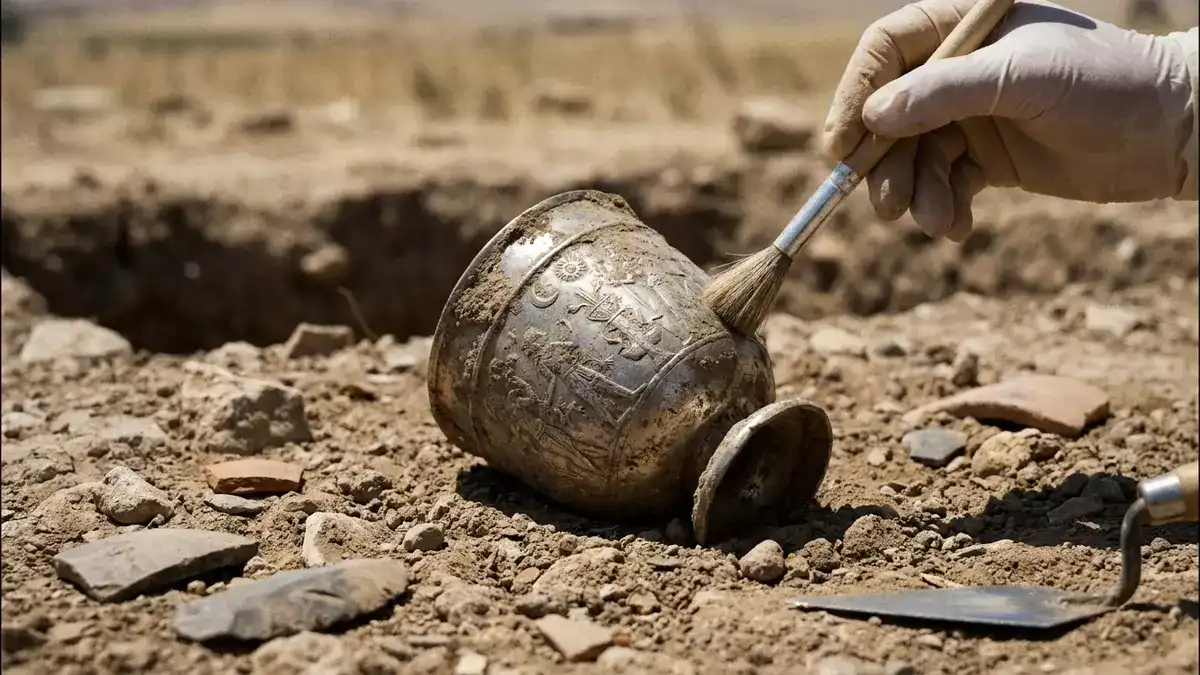
Archaeologists and historians are taking a fresh look at one of the most enigmatic treasures ever recovered from the southern Levant. The ˁAin Samiya goblet—a tiny, extraordinarily detailed silver vessel dating back to the Intermediate Bronze Age—is challenging long-held assumptions about ancient religious beliefs.
For more than half a century, this remarkable artifact has mystified the scientific community. Uncovered in a prominent, high-status tomb within the Judean Hills, the goblet measures a mere 8 centimeters in height. Despite its diminutive size, its surface is packed with sophisticated, dense mythological imagery. For decades, the mainstream consensus linked these engravings to the famous Babylonian creation epic, the Enuma Elish. However, a groundbreaking new study flips this narrative on its head, suggesting the vessel actually illustrates a much older, foundational perspective on how early human civilizations viewed the birth and maintenance of the universe.
New Study Decodes Secrets of 4,000-Year-Old Levant Artifact
Rediscovering the Southern Levant’s Bronze Age Masterpiece
The ˁAin Samiya goblet holds a unique position in biblical archaeology and Near Eastern history. Experts widely consider it the only surviving true work of complex narrative art from its specific era in the Levant. Because the Intermediate Bronze Age is often characterized by a collapse of urban centers and a shift toward pastoral societies, finding such a highly sophisticated luxury item indicates that elite craftsmanship and long-distance trade networks remained alive and well.
Though time has taken its toll, leaving a portion of the silver surface damaged and the visual story partially incomplete, the surviving segments offer an astonishing window into ancient iconography. The exterior of the goblet features two separate but profoundly interconnected scenes. These panels are densely populated with hybrid mythological creatures, winding serpents, stylized plant motifs, and powerful celestial symbols that speak to a complex understanding of the natural and supernatural worlds.
The Scene of Primordial Emergence and Chaos
On one side of the vessel, the narrative begins with a striking, chimera-like figure positioned next to a massive serpent. This hybrid being features a human upper torso that seamlessly morphs into the lower body and legs of two bulls. Positioned directly between its limbs is a small, carefully engraved rosette.

In traditional Near Eastern art, the rosette is a well-known symbol for the sun. Scholars participating in the recent study interpret this specific emblem as a representation of a newborn sun. Historically, analysts viewed this side of the goblet as a depiction of raw, untamed chaos, where the looming serpent embodied the dangerous, unpredictable forces of primordial disorder threatening the universe.
The Transition to Cosmic Order and Stability
Rotating the goblet reveals a starkly contrasting scene that represents the exact opposite of chaos. Here, two distinct human figures are depicted lifting the ends of a prominent crescent-shaped form. This crescent acts as a cradle for a radiant, fully developed sun, which is shown facing the viewer head-on.
Notably, the large serpent from the previous panel has not disappeared, but its role has changed entirely. It now lies completely flat and subdued beneath the celestial crescent, no longer serving as the dominant or threatening feature of the composition. According to the authors of the new study, this visual progression signifies the establishment of an organized, structured universe that successfully emerges once the forces of chaos have been brought under control.
A Journey Across the Ancient Near Eastern Cosmos
Rather than acting as a literal, frame-by-frame illustration of a specific mythological battle or a singular deity’s triumph, the new research suggests the ˁAin Samiya goblet communicates a broader, more universal philosophy. It symbolizes the overarching ancient Near Eastern concept of cosmic organization, balance, and cyclical renewal.
+------------------------------------+       +------------------------------------+
|            SCENE ONE               |       |            SCENE TWO               |
|  • Chimera (Human/Bull Hybrid)     | ----> |  • Subdued, Flat Serpent           |
|  • Large, Dominant Serpent         |       |  • Two Figures Lifting Crescent     |
|  • Small Rosette (Newborn Sun)     |       |  • Radiant, Fully Developed Sun    |
|  Meaning: Primordial Chaos & Birth |       |  Meaning: Cosmic Order & Stability  |
+------------------------------------+       +------------------------------------+
Parallels with Sumerian and Akkadian Cosmology
The design elements on the goblet mirror the deeply rooted traditions found in Sumerian and Akkadian mythologies. These Mesopotamian cultures famously viewed the cosmos as a finely balanced duality divided into two distinct hemispheres: one dedicated to the living and another reserved for the dead.
Both realms operated under the strict governance of predictable cosmic cycles, dictated by the regular rebirth of the sun, the phases of the moon, and the changing of the seasons. The new analysis highlights that the visual narrative on the silver vessel depicts a cosmological journey of growth and transition rather than a violent, destructive war between gods and monsters.
The Symbolism of the Celestial Boat
The crescent shape lifted by the human figures is another vital clue connecting the goblet to a vast intercultural network. Researchers have identified this shape as the Celestial Boat, a highly prominent motif found across the ancient world, including Egypt, Mesopotamia, Anatolia, and surrounding regions.
Ancient peoples believed the Celestial Boat was the spiritual vessel responsible for safely transporting the sun across the heavens each day and navigating the underworld at night. The transition on the goblet from a tiny, newly born sun in the first scene to a powerful, fully realized solar deity in the second scene perfectly captures this eternal cycle of daily and seasonal rebirth.
Tracing the Origin and Ancient Trade of the Vessel
Beyond its spiritual and symbolic meaning, the ˁAin Samiya goblet provides fascinating insights into the economic realities and migration of skilled artisans during the Bronze Age. By performing meticulous iconographic comparisons, researchers have pieced together a likely backstory for how this luxury object came to exist and travel through the ancient world.
The Hand of a Traveling Mesopotamian Master
The intricate style and specific choices of imagery strongly indicate that the creator of the goblet was an artist trained in southern Mesopotamia. This master craftsman likely traveled north during the 23rd century BCE, carrying advanced metalworking techniques and deep cosmological knowledge to new regional markets.
From Syrian Workshops to Judean Tombs
While the designer may have hailed from Mesopotamia, the actual physical production of the silver vessel most likely took place in northern Syria. This region boasted far greater access to silver resources and established silver-refining networks during the Bronze Age.
Once manufactured, the goblet traveled south along busy commercial trade routes, eventually changing hands multiple times before reaching its final resting place. When it was deposited into the Judean Hills tomb around 2200 BCE, it was no longer just a luxury item. Experts believe the goblet was likely used in elite funerary rituals, serving as a spiritual guide to help the soul of the deceased navigate the afterlife by following the same cyclical, renewing path as the rising sun.
Redefining Bronze Age Religious Traditions
While some archaeological circles urge caution before throwing out decades of traditional interpretations, this fresh perspective successfully repositions the ˁAin Samiya goblet. It moves the artifact out of the shadow of later Babylonian myths and plants it firmly within a much older, interconnected tradition of cosmological storytelling that spanned across the entire ancient Near East.
By analyzing these tiny, ancient engravings through a broader lens, modern science is unlocking a sophisticated vision of the universe kept alive by the peoples of the Bronze Age—a vision where chaos always gives way to light, order, and eternal renewal.
Frequently Asked Questions
What is the ˁAin Samiya goblet?
The ˁAin Samiya goblet is an 8-centimeter-tall silver vessel dating to the Intermediate Bronze Age, approximately 4,000 years ago. Discovered in a high-status tomb in the Judean Hills, it is famous for its intricate, dense engravings of mythological and cosmological scenes.
Where was the goblet originally discovered?
The artifact was discovered over 55 years ago in the southern Levant, specifically within a prominent tomb located in the Judean Hills.
Why did scholars previously link it to the Enuma Elish?
For decades, researchers assumed the imagery represented scenes from the Enuma Elish, the famous Babylonian creation epic, because of the prominent depiction of a large serpent, which many believed represented Tiamat, the dragon-like embodiment of primordial chaos.
What does the new study suggest about the imagery?
The new study argues that the goblet does not show a specific mythic battle, but rather a much older, broader Near Eastern concept of cosmic order and renewal. It depicts the transformation of the universe from a state of raw chaos into a structured, orderly system governed by the cyclical journey of the sun.
Where was the goblet made and how did it travel?
Iconographic analysis suggests the goblet was designed by a southern Mesopotamian artist traveling through northern Syria, where the vessel was likely manufactured due to the availability of silver. It then moved south through ancient trade networks before being buried in the Levant around 2200 BCE.