
Table of Contents
- 1. Unlocking a 2,500-Year-Old Chemical Signature
- 2. From Royal Palaces to Everyday Graves
- 2.1. Mapping the Persian Empire’s Trade Networks
- 3. The Strategic Choice of Egyptian Calcite
- 4. Re-examining the Treasures of King Tutankhamun
- 5. Future Frontiers in Ancient Pharmacology
- 6. Frequently Asked Questions
- 6.1. What did scientists discover inside the 2,500-year-old Persian vase?
- 6.2. Who was Xerxes I and why is his name on the vase?
- 6.3. Was opium use limited only to wealthy elites in the ancient world?
- 6.4. Why did ancient people prefer alabaster/calcite jars for storing opium?
- 6.5. Does this discovery have anything to do with King Tutankhamun?
Scientific Analysis of Ancient Persian Vase Confirms Widespread Opium Use
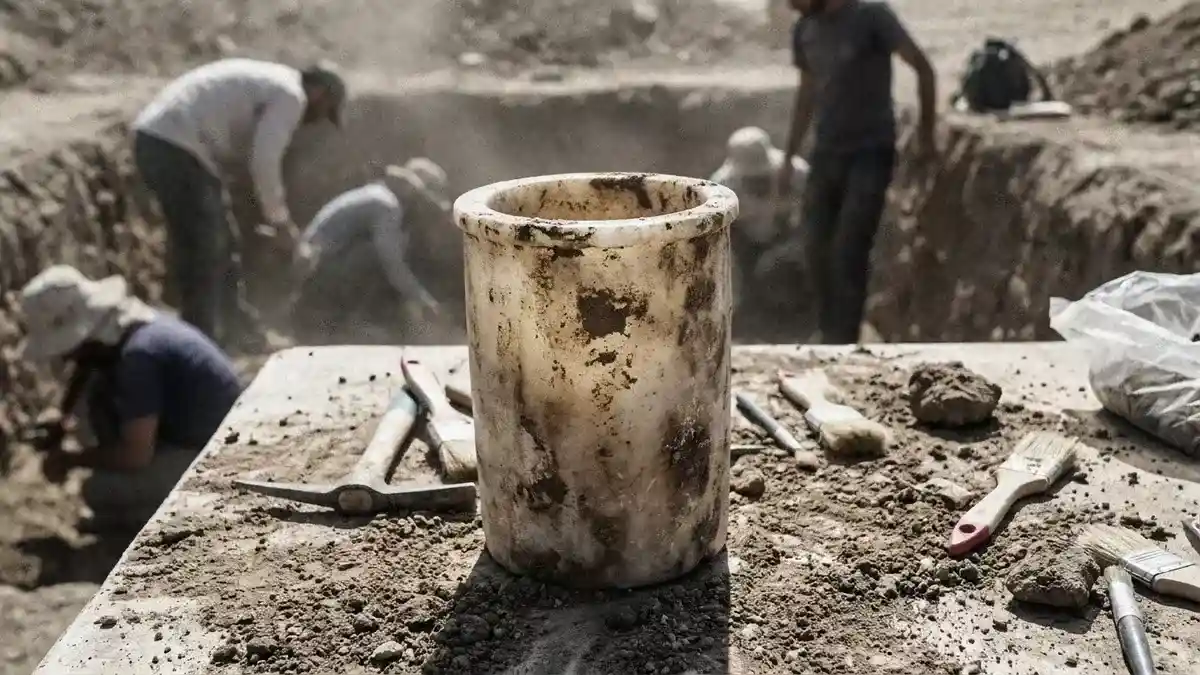
A groundbreaking study by the Yale Ancient Pharmacology Program (YAPP) has provided the strongest scientific evidence to date regarding the extensive role of opium in the ancient world. By analyzing an intact, 2,500-year-old inscribed alabaster vase from the Yale Babylonian Collection, researchers have uncovered a complex history of ancient medicine, luxury trade, and cultural rituals.
The artifact at the center of this discovery is a beautifully preserved vessel carved from calcite (Egyptian alabaster). What makes this specific vase extraordinary is its royal pedigree: it bears identical dedications to the Persian Achaemenid Emperor Xerxes I (who ruled from 486 to 465 BCE) inscribed in four different ancient languages. While historians have long admired the vessel’s craftsmanship, it is what was hidden inside the container th
at is rewriting history books.
Scientific Analysis of Ancient Persian Vase Confirms Widespread Opium Use

Unlocking a 2,500-Year-Old Chemical Signature
For centuries, archaeologists assumed that elegant alabaster containers—often called alabastra—were exclusively used by ancient elites to store high-end cosmetics, scented oils, or expensive perfumes. To test this theory, the YAPP research team utilized advanced, non-destructive sampling techniques developed specifically to extract organic traces left behind in ancient pottery and stone.
When scientists analyzed the dark, aromatic residues clinging to the interior walls of the Xerxes vase, they discovered a cocktail of highly specific chemical markers. The test results revealed the distinct presence of:
Morphine and Thebaine: Core alkaloid compounds that serve as the primary chemical fingerprint of raw opium.
Papaverine and Noscapine: Secondary organic compounds uniquely native to the opium poppy (Papaver somniferum).
Hydrocotarnine: A specific trace element that definitively confirms the presence of opiate derivatives.

This chemical profile marks the very first time that the physical contents of a legally inscribed, royal Egyptian alabaster vessel have been scientifically validated in a laboratory setting.
From Royal Palaces to Everyday Graves
The discovery inside the Xerxes vase does not stand in isolation. Instead, it confirms and expands upon previous archaeological finds. Earlier excavations led by the legendary pioneer Flinders Petrie at the site of Sedment, Egypt, turned up similar opiate signatures. Those older studies identified opium residues inside distinctive imported Cypriot ceramic juglets and plain, unadorned alabaster jars.
However, there is a massive societal contrast between these two sets of discoveries. While the Xerxes vase represents an ultra-luxury item belonging to the supreme ruler of a vast empire, the Sedment jars were uncovered in a cemetery belonging to ordinary, working-class citizens.
Mapping the Persian Empire’s Trade Networks
During the Achaemenid period, Persian rulers controlled an unprecedented expanse of territory stretching from the Mediterranean Sea all the way to Central Asia. Egypt was a vital, wealthy province within this global empire.
The fact that opium has now been verified in both imperial Persian courts and rural Egyptian graves indicates that opiate production, storage, and consumption were deeply woven into the fabric of everyday life. This was not a rare luxury reserved strictly for kings, nor was it a obscure medicine hidden away by secretive priests. It was a widespread cultural commodity available across different social classes.
The Strategic Choice of Egyptian Calcite
The study suggests that ancient craftworkers did not choose calcite merely because it looked beautiful. The physical and thermal properties of Egyptian alabaster made it uniquely suited for preserving delicate organic substances.
Calcite containers provided excellent insulation, keeping volatile botanical mixtures cool and protecting them from the degrading effects of light and heat. Over time, the unique shape, milk-white sheen, and distinct visual profile of these alabaster vessels likely became universally recognized across the Near East.
Much like specific glass pipes or specialized cases are immediately associated with tobacco use in modern society, an elegant alabaster alabastron in antiquity served as a clear visual marker of opiate consumption, carrying both functional utility and deep symbolic meaning.
Re-examining the Treasures of King Tutankhamun
Perhaps the most thrilling implication of this research concerns King Tutankhamun’s tomb. When Howard Carter famously uncovered the boy king’s burial chamber, he found an unparalleled collection of exquisite alabaster jars.
Many of those Pharaoh-era containers contained thick, dark, sticky residues. Unfortunately, early 20th-century chemical testing lacked the sophistication needed to accurately identify the degraded organic compounds. Interestingly, several of those jars had been carefully scraped clean by ancient tomb looters in antiquity. This implies that the contents inside the vessels were considered vastly more valuable than the precious stone jars themselves.
With this new scientific evidence establishing a continuous pattern of Egyptian opiate use spanning well over a thousand years, it is increasingly probable that a significant portion of Tutankhamun’s royal alabaster collection was originally packed with potent opium mixtures meant to accompany him into the afterlife.
Future Frontiers in Ancient Pharmacology
The team at Yale is not stopping with the Xerxes vase. Researchers are currently expanding their investigation by deploying a suite of cutting-edge analytical equipment, including portable X-ray Fluorescence (pXRF) and portable Fourier-Transform Infrared Spectroscopy (pFTIR).
By comparing the chemical data from historical artifacts against pure calcite reference samples sourced directly from the ancient Hatnub quarries in Egypt, scholars aim to map out precise ancient trade routes. The ultimate goal is to build a comprehensive historical framework showing exactly how the opium poppy was cultivated, how pharmacists prepared it for medical or ritual use, and why this specific stone became globally synonymous with the ancient world’s most powerful narcotic.
Frequently Asked Questions
What did scientists discover inside the 2,500-year-old Persian vase?
Scientists uncovered multiple chemical markers uniquely associated with opium, including morphine, thebaine, papaverine, noscapine, and hydrocotarnine. This confirms that the royal vessel was used to store opiates.
Who was Xerxes I and why is his name on the vase?
Xerxes I was a famous emperor of the Achaemenid Empire of ancient Iran, ruling from 486 to 465 BCE. The alabaster vase features a dedication to him inscribed in four different ancient languages, signifying its status as a high-value imperial object.
Was opium use limited only to wealthy elites in the ancient world?
No. While the Xerxes vase represents an elite imperial context, similar opiate residues have been found in plain alabaster jars and simple clay juglets within ordinary, working-class graves in Egypt, proving its use was widespread across all social classes.
Why did ancient people prefer alabaster/calcite jars for storing opium?
Calcite possesses specific material properties that made it ideal for storage. It offers natural insulation against temperature changes and shields organic mixtures from light degradation, preserving the potency of botanical medicines and narcotics.
Does this discovery have anything to do with King Tutankhamun?
Yes. Many alabaster vessels found in Tutankhamun’s tomb contained mysterious dark residues that early 20th-century technology could not identify. This new evidence makes it highly probable that some of the Pharaoh’s vessels originally held opium.