
Table of Contents
- 1. The El Argar Culture: An Ancient Powerhouse of Silver
- 2. Unlocking the Secrets of Grave 292
- 2.1. What is Lost-Wax Casting?
- 3. Flawed Masterpieces: The Social Value of Ancient Innovation
- 4. Redefining Prehistoric Technology and Skill Hierarchies
- 5. Conclusion
- 6. Frequently Asked Questions
- 6.1. What makes the El Argar silver bangle discovery so significant?
- 6.2. What was the El Argar culture?
- 6.3. Why did the El Argar people use silver instead of bronze?
- 6.4. What evidence proved that the bracelet was cast using the lost-wax method?
- 6.5. Where is the El Argar silver bangle kept today?
Bronze Age Silver Discovery Shatters Western European History
A groundbreaking archaeological study has fundamentally shifted our understanding of prehistoric metallurgy in Western Europe. Researchers examining a silver bracelet from southeastern Spain have uncovered the earliest known evidence of lost-wax silver casting in the region. This remarkable discovery pushes back the timeline for this highly sophisticated metalworking technique, proving that Early Bronze Age communities were experimenting with complex manufacturing processes centuries earlier than previously believed.
The artifact at the center of this historical rewrite belongs to the enigmatic El Argar culture, a society that dominated the southeastern Iberian Peninsula between 2200 and 1550 BC. While El Argar has long been celebrated for its unique social structure and wealth, this new metallurgical analysis reveals a level of technological innovation that caught researchers entirely by surprise.
Bronze Age Silver Discovery Shatters Western European History
The El Argar Culture: An Ancient Powerhouse of Silver
To understand the significance of this discovery, one must first look at the unique society that produced it. While most Western European Bronze Age cultures relied almost exclusively on copper and bronze, the El Argar civilization developed an extraordinary obsession with silver.

In the late 19th century, pioneering archaeologists Henri and Louis Siret excavated thousands of artifacts from El Argar tombs. Among their findings were rich funerary assemblages containing weapons, pottery, and an unprecedented amount of silver jewelry. The sheer volume of silver set the El Argar culture apart from its regional contemporaries, marking it as an early center of wealth and social stratification.
Most of these excavated treasures eventually found a home in the Royal Museums of Art and History in Brussels. For over a century, these artifacts were assumed to be the products of traditional hammering and basic casting techniques. However, modern scientific analysis has finally allowed one specific artifact to tell its true story.
Unlocking the Secrets of Grave 292
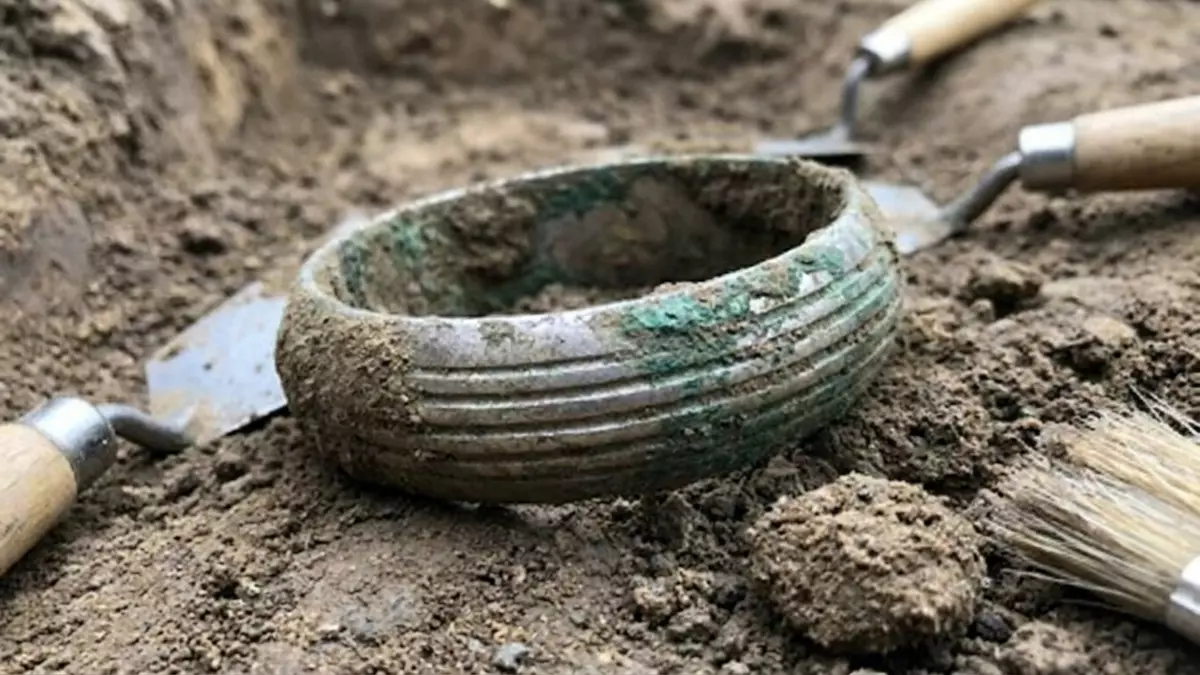
The object rewriting history is a distinctive silver bangle recovered from an elite burial known as Grave 292. On the surface, the bracelet features a continuous metallic strip adorned with parallel grooves running along its exterior. For decades, it was assumed that ancient smiths created these details by cold-hammering the silver into shape.

Recent detailed metallurgical examinations, however, revealed micro-structures and surface anomalies that traditional tools could never produce. Instead, scientists identified clear sprue and vent stubs—the telltale entry and exit channels used to pour molten metal into a mold.
What is Lost-Wax Casting?
The lost-wax process is an exacting, multi-step artistic and industrial technique that requires extreme precision. The ancient process generally followed these steps:
The Wax Model: A skilled artisan carves the exact shape of the desired object out of beeswax.
The Clay Mold: The wax model is encased in layers of clay, leaving small channels (sprues and vents) open to the outside.
The Firing: The clay mold is baked in a kiln. This hardens the clay and melts the wax, which drains away, leaving a perfect, hollow negative impression inside the ceramic shell.
The Cast: Molten silver is poured into the hollow clay mold through the sprue, while air escapes through the vents.
The Reveal: Once the metal cools and solidifies, the clay mold is smashed open to retrieve the finished silver piece.
While historians have long documented this technique in classical Greek and Roman sculptures, finding definitive proof of lost-wax silver casting in Early Bronze Age Western Europe completely upends the traditional timeline of ancient European technology.
Flawed Masterpieces: The Social Value of Ancient Innovation
Curiously, the metallurgical analysis revealed that the silver bangle from Grave 292 was not flawless. The surface shows distinct casting flaws partially covering the exterior grooves, an irregular internal surface, and even a preserved fingerprint of the ancient maker trapped in the metal’s history.
This juxtaposition raises a fascinating question: Why would an ancient society use such an incredibly difficult, time-consuming technique to produce an imperfect piece of jewelry?
The answer likely lies in the social dynamics of the El Argar elite. Archaeological evidence indicates that early experiments with lost-wax casting, along with remnants of raw beeswax, are found almost exclusively in high-status contexts and elite residential areas.
This suggests that the knowledge of lost-wax casting was a closely guarded secret, restricted to a specialized group of craftspeople working under the direct control of ruling households. In this prehistoric society, the immense social value and prestige of owning an object made via a mysterious, highly restricted process mattered far more than perfect workmanship. The process itself was a display of ultimate power.
Redefining Prehistoric Technology and Skill Hierarchies
This discovery shatters the traditional view of early Bronze Age craft organization in the Western Mediterranean. Historians frequently treated prehistoric metalworking as a uniform, slow-evolving skill set shared equally across a region.
The El Argar bangle proves otherwise. It indicates that metallurgy in ancient Spain was organized around a complex hierarchy of expertise. Rather than a single level of community skill, there were distinct tiers of specialized knowledge, continuous experimentation, and selective transmission of technology.
It is highly probable that other silver items from this region were created using the same lost-wax method. Unfortunately, thousands of years of soil corrosion and the historical loss of artifacts make definitive identification difficult. Nevertheless, this single bangle confirms that the technological sophistication of Bronze Age Iberia has been vastly underestimated.
Conclusion
The silver bangle of Grave 292 is no longer just a piece of ancient jewelry; it is a monument to human ingenuity. By pushing back the origins of lost-wax silver casting in Western Europe, this discovery reveals that our ancestors were far more innovative, technologically diverse, and socially complex than we ever imagined. The ancient smiths of El Argar were not just working metal—they were mastering the physical world to cement their place in history.
Frequently Asked Questions
What makes the El Argar silver bangle discovery so significant?
The discovery provides the earliest confirmed evidence of the lost-wax casting technique used for silver objects in Bronze Age Western Europe. It proves that sophisticated metallurgical techniques were being practiced centuries earlier than previously recognized by historians.
What was the El Argar culture?
The El Argar culture was an advanced Bronze Age society that flourished in southeastern Iberia (modern-day Spain) between approximately 2200 and 1550 BC. They were known for their distinct urban centers, hierarchical social structure, and extensive use of silver.
Why did the El Argar people use silver instead of bronze?
While they did utilize copper and bronze for tools and weapons, the El Argar culture possessed unique access to local silver sources. They used silver extensively in funerary objects and jewelry to signal elite social status, wealth, and political power.
What evidence proved that the bracelet was cast using the lost-wax method?
Detailed metallurgical analysis revealed structural details that could not be achieved by hammering. These included the remnants of sprues and vents (channels used to pour molten metal), casting flaws, and microscopic surface textures left behind by clay and wax.
Where is the El Argar silver bangle kept today?
The historic silver bangle was originally excavated in 1884 by the Siret brothers. Today, it is preserved and housed in the permanent collections of the Royal Museums of Art and History in Brussels, Belgium.