
Table of Contents
- 1. Unearthing the Heerlen Tablet: The Archaeology of Coriovallum
- 2. Deciphering the Lead: How Modern Tech Exposed Hidden Spells
- 2.1. The Three Components of the Spell
- 3. The Egyptian Connection: An Ancient Sorcerer in Lower Germania
- 3.1. Magic as a Household Necessity
- 4. Conclusion: A Globalized Empire Bound by Spells
- 5. Frequently Asked Questions
- 5.1. What is a Roman curse tablet?
- 5.2. Why is the Heerlen tablet considered unique?
- 5.3. How did researchers read the heavily damaged text?
- 5.4. Who are the individuals named on the artifact?
- 5.5. How did Egyptian magic end up in the Netherlands 2,000 years ago?
Ancient Egyptian Magic Found on Roman Curse Tablet in Netherlands
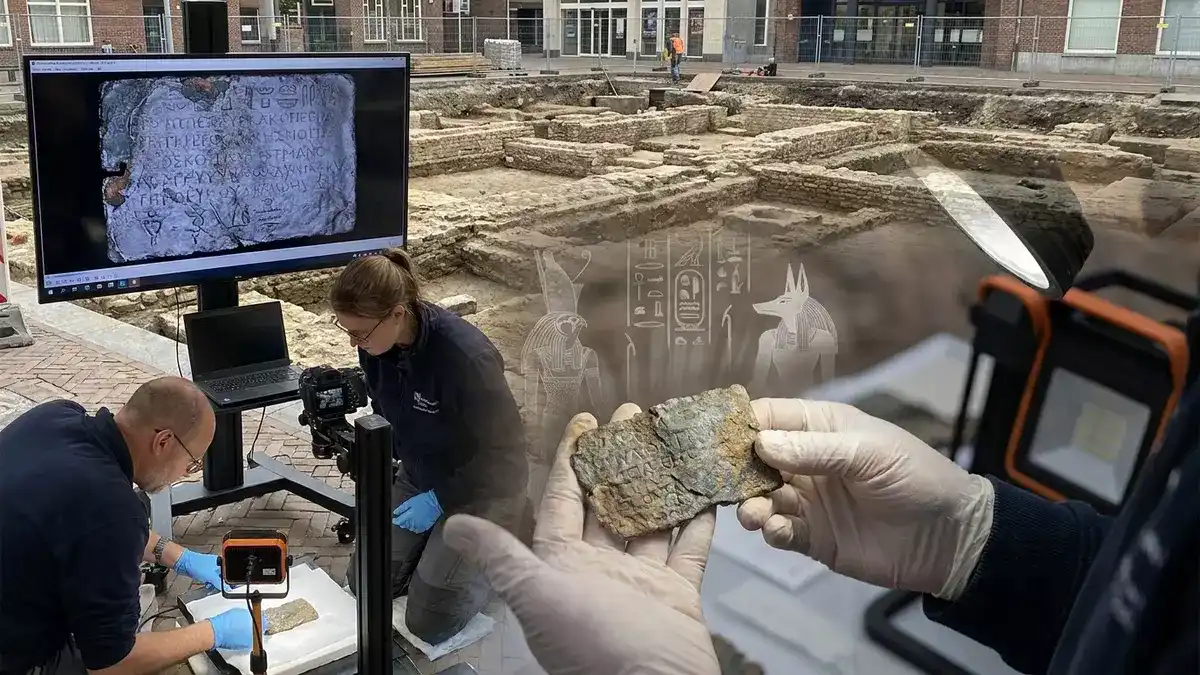
An extraordinary archaeological breakthrough in the Netherlands has revealed an unexpected blend of cultures at the fringes of the ancient world. Epigraphers at Heidelberg University have successfully deciphered a second-century CE Roman curse tablet found in the Dutch town of Heerlen. To the shock of researchers, the artifact does not feature local traditions written in Latin, but rather an exotic cocktail of ancient Egyptian mysticism written entirely in ancient Greek.
The discovery provides rare, tangible evidence of how religious ideas, magical practices, and people migrated thousands of miles across the sprawling Roman Empire, linking the hot deserts of North Africa to the chilly military outposts of northern Europe.
Ancient Egyptian Magic Found on Roman Curse Tablet in Netherlands
Unearthing the Heerlen Tablet: The Archaeology of Coriovallum
The artifact was recovered during a systematic urban excavation beneath Heerlen’s central town square. In the second century CE, this modern Dutch city was known as Coriovallum, a strategic Roman military and civilian settlement located in the imperial province of Lower Germania (Germania Inferior).
Measuring a modest 9.3 by 4.8 centimeters, the object is a traditional curse tablet, known scientifically as a defixio (in Latin) or a katadesmos (in Greek). Across the Greco-Roman world, everyday people used these thin sheets of lead to petition supernatural forces. Practitioners would scratch their intentions into the metal, roll or fold the sheet tight, and bury it in locations considered hotbeds of spiritual energy—such as fresh graves, battlefields, deep wells, or sacred springs.
Deciphering the Lead: How Modern Tech Exposed Hidden Spells
Because lead is a soft, malleable metal, centuries of moisture and soil pressure had severely degraded the Heerlen tablet’s surface. To the naked eye, the ancient incisions were almost entirely unreadable.

To unlock the text, the research team at Heidelberg University utilized an advanced imaging method known as Reflectance Transformation Imaging (RTI). This digital process compiles dozens of high-resolution photographs taken from fixed camera positions under shifting, multi-directional light sources. By mathematically analyzing how the light glints off the microscopic grooves, RTI generates a highly detailed interactive 3D model of the surface, exposing faint scratch marks that had been hidden for nearly two millennia.
The Three Components of the Spell
The RTI scan successfully isolated three distinct zones of information engraved on the lead sheet:
The Invocations: A dense section calling upon specific deities and demonic entities. Crucially, the styling and names belong directly to an Egyptian magical tradition, a phenomenon virtually unheard of in the Germanic provinces.
The Characteres: A sequence of three distinct characteres—abstract, non-linguistic symbols or shapes widely used by ancient sorcerers. These signs were viewed as a celestial shorthand or direct code meant to catch the attention of underworld spirits.
The Targets: A list featuring the names of four enslaved individuals. Two men possess traditional Latin names, while two women carry Greek names.
The Egyptian Connection: An Ancient Sorcerer in Lower Germania
The presence of Greek text and Egyptian theology in the far north of Europe is what makes the Heerlen tablet a historical anomaly. Most curse tablets recovered from northern Europe are written in Latin and appeal to localized Roman or Celtic deities.
| Attribute | Standard Northern European Tablets | The Heerlen Tablet Discovery |
| Language | Latin | Ancient Greek |
| Pantheon | Roman, Celtic, or Germanic | Traditional Egyptian |
| Script Style | Western Roman Cursive | Eastern Mediterranean Cursive |
The unique combination of names on the tablet provides a tantalizing clue as to how this spell came to be buried in Coriovallum. While the males carried Latin names, the females bore Greek names. The Heidelberg research team hypothesizes that one of these women may have been a displaced native of Roman Egypt. Traveling along the empire’s vast military and trade networks, she likely carried her homeland’s deeply rooted magical traditions, spellbooks, and language with her to the northern frontier.
Magic as a Household Necessity
In ancient Egyptian society, magic (known as Heka) was not viewed as an evil or marginal practice. Instead, it was an essential aspect of daily life, integrated tightly into medicine, protection, and religious orthodoxy. While state priests performed large-scale public rituals to keep the universe balanced, private individuals frequently commissioned specialized sorcerers or wrote their own hidden spells to resolve personal grievances, protect their families, or gain an upper hand over local rivals.
Conclusion: A Globalized Empire Bound by Spells
The true historical value of the Heerlen curse tablet lies in its vivid depiction of imperial globalization. The Roman Empire acted as a massive cultural blender; under the umbrella of Roman rule, ideas from the Near East, Egypt, and early Christian or Jewish sects traveled freely along trade routes and military highways.
The artifact proves that even in a remote military settlement like Coriovallum, the cultural boundaries were highly fluid. The Heerlen Museum is currently preparing a dedicated display to showcase the tablet to the public. Concurrently, the research team is finalizing the publication of the full, translated Greek inscription, allowing global scholars to study this rare bridge between the Nile Delta and the North Sea.
Frequently Asked Questions
What is a Roman curse tablet?
A curse tablet, known as a defixio or katadesmos, is a thin sheet of lead onto which ancient people scratched spells, curses, or prayers. They were folded up and buried in spiritually significant locations to ask gods or spirits to intervene in court cases, business rivalries, or romantic disputes.
Why is the Heerlen tablet considered unique?
Most curse tablets discovered in northern Europe are written in Latin and invoke local Roman or Celtic gods. The Heerlen tablet stands out because it is written in ancient Greek and utilizes magical traditions and deities native to ancient Egypt.
How did researchers read the heavily damaged text?
Scientists used Reflectance Transformation Imaging (RTI). This technology combines multiple digital photos taken under different lighting angles to create an enhanced map of the metal surface, revealing microscopic scratches that are invisible to the human eye.
Who are the individuals named on the artifact?
The tablet names four enslaved individuals: two men with Latin names and two women with Greek names. It is currently unclear whether the tablet was written to curse these four people or if it was written on their behalf to target an unnamed enemy.
How did Egyptian magic end up in the Netherlands 2,000 years ago?
The Roman Empire was highly globalized, allowing people, goods, and ideas to travel massive distances. Researchers believe one of the enslaved women named on the tablet may have migrated from Roman Egypt to Lower Germania, bringing her native language and spiritual traditions with her.