
Table of Contents
- 1. The Tønsberg Excavation: A Lucky Find Just Below the Surface
- 2. Masterful Byzantine and Anglo-Scandinavian Artistry
- 2.1. A Confluence of Ancient Styles
- 3. Divine Ward or Fashion Statement? The Power of Medieval Blue
- 4. Dating the Ring: Pinpointing a Royal Household
- 4.1. Who Wore the Ring?
- 5. A Monumentally Rare Archaeological Event
- 6. Frequently Asked Questions
- 6.1. How old is the gold ring found in Tønsberg?
- 6.2. Is the blue stone in the center a real sapphire?
- 6.3. What did the color blue symbolize to people in the Middle Ages?
- 6.4. What making the craftsmanship of this ring so unique?
- 6.5. Who is believed to have originally owned this ring?
Medieval Gold Ring Discovered in Tønsberg Rewrites Jewelry History
A routine infrastructure project in the heart of Tønsberg, Norway’s oldest town, has yielded a breathtaking portal into the spiritual world and aristocratic luxury of the High Middle Ages. Emerging from the dirt mere centimeters below a modern street surface, an intact medieval gold ring has left archaeologists stunned by its exquisite craftsmanship, cross-continental design influences, and the powerful magical protections it was believed to grant its wearer.
Uncovered by field researchers from the Norwegian Institute for Cultural Heritage Research (NIKU), this glittering artifact offers an incredibly rare glimpse into the lives of Norway’s medieval elite, providing a physical link to a time when jewelry was far more than mere decoration.
Medieval Gold Ring Discovered in Tønsberg Rewrites Jewelry History
The Tønsberg Excavation: A Lucky Find Just Below the Surface
The remarkable discovery unfolded during extensive urban excavations commissioned by the Municipality of Tønsberg to upgrade the city’s stormwater management system. The target area, nestled near Prestegaten and Storgaten, sits deep within Tønsberg’s historically protected core, resting right beneath the shadow of Tunsberghus, the former royal fortress.

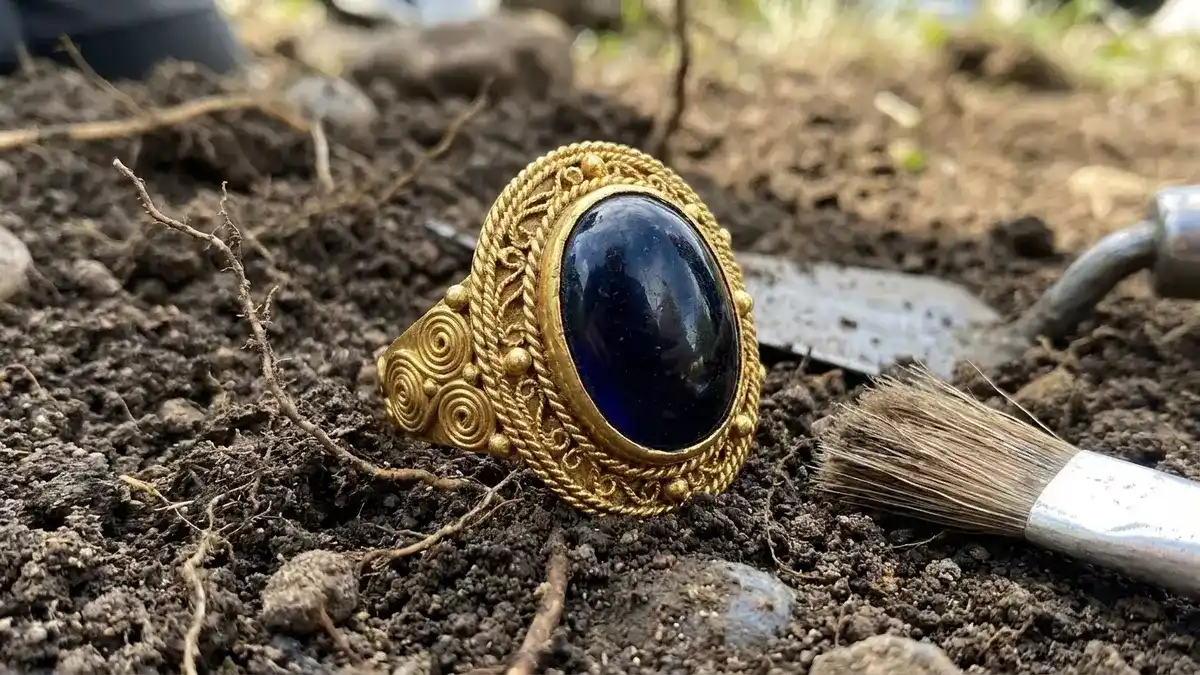
While digging through the historic layers—which have previously yielded structural remains of medieval homes, ancient wooden streets, and debris from catastrophic historic fires—archaeologist Linda Åsheim spotted a flash of brilliant gold. Lying an astonishingly shallow seven centimeters below the ground surface, the ring had miraculously survived centuries of urban development completely unharmed.
Masterful Byzantine and Anglo-Scandinavian Artistry
The Tønsberg ring is an absolute tour de force of medieval metalsmithing, showcasing a complex fusion of distinct European artistic traditions that traveled along northern trade routes.
The jewelry piece is forged from high-purity gold and features a striking oval, midnight-blue center stone. This central gem is meticulously framed by two highly sophisticated goldsmithing techniques:

Filigree: Microscopic wires of pure gold twisted and manipulated into delicate, repeating spiral motifs.
Granulation: Microscopic gold beads individual soldered onto the band to create a textured, shimmering border.
A Confluence of Ancient Styles
What makes the ring particularly fascinating to art historians is its eclectic design DNA. The spiral patterns on the gold band strongly echo traditional Anglo-Scandinavian motifs popular across Northern Europe and England between the 9th and 11th centuries.

However, the advanced combination of filigree and granulation represents an artistic shift, borrowing heavily from luxurious Carolingian and Byzantine jewelry styles. These prestigious Mediterranean techniques were brought north to Norway through royal gifts, trade partnerships, and returning elite travelers, culminating in this hybrid masterpiece.
Divine Ward or Fashion Statement? The Power of Medieval Blue
While the centerpiece looks like a flawless sapphire, initial assessments suggest the gem is actually highly polished, deeply colored medieval glass. To a modern observer, simulated glass might seem like a cheap substitute, but in the medieval economy, artisan-crafted colored glass was an incredibly precious, high-status commodity.
More importantly, in the medieval mindset, the inherent power of an object was tied strictly to its color, rather than its chemical composition. Blue was the ultimate celestial color, deeply associated with the Virgin Mary, moral purity, and heaven itself.
Powers of the Blue Stone: In medieval lapidaries (texts describing the magical properties of gems), blue stones were universally worn as protective amulets. They were firmly believed to cool excessive bodily heat, preserve the wearer’s chastity, ward off dark spiritual entities, and ensure continuous divine protection.
Dating the Ring: Pinpointing a Royal Household
Determining exactly when this treasure slipped from its owner’s finger required careful scientific analysis of the surrounding soil. While the dirt layer directly enclosing the ring couldn’t provide an exact date, organic material found in the layer immediately above it provided a crucial breakthrough.
A preserved spruce twig extracted from that upper layer underwent rigorous radiocarbon dating. The results came back with a precise historical window: between 1167 and 1269. Because the twig sat above the ring, archaeologists can confidently deduce that the gold jewel was dropped into the soil either before or during this late 12th-to-mid-13th-century timeframe.
Who Wore the Ring?
Given the ring’s remarkably small diameter, experts believe it was worn by a woman. Its costly materials and laborious, high-tier artistry indicate she was no ordinary citizen.
During the 1200s, Tønsberg was a bustling royal and ecclesiastical power center. The ring almost certainly belonged to a high-status woman married into the royal court at Tunsberghus fortress or connected directly to the powerful church elite who governed the ancient town. To her, this ring was an unyielding symbol of her immense wealth, political authority, and sacred bonds.
A Monumentally Rare Archaeological Event
To put the Tønsberg discovery into perspective, one only has to look at Norway’s overarching national artifact registry. Out of approximately 220 historic gold rings ever documented across the entire country, a meager 63 belong to the medieval period.
Furthermore, an artifact of this prestige and caliber hasn’t been recovered from Tønsberg’s soil in roughly 15 years. The ring stands as a crowning achievement for NIKU and a stark reminder that priceless, world-class history still sits quietly waiting just beneath the pavement of modern European cities.
Frequently Asked Questions
How old is the gold ring found in Tønsberg?
Based on radiocarbon dating of organic material found directly above the artifact, the ring was lost or deposited sometime between 1167 and 1269, placing it squarely in the High Middle Ages.
Is the blue stone in the center a real sapphire?
Initial examinations indicate the deep, midnight-blue center stone is likely made of highly crafted medieval colored glass rather than a genuine sapphire. However, in the Middle Ages, high-quality colored glass was considered immensely valuable and held identical symbolic worth.
What did the color blue symbolize to people in the Middle Ages?
The color blue was highly revered as a sacred, protective color. Medieval people believed blue stones possessed active magical and moral traits, including the ability to maintain a person’s chastity, lower dangerously high body heat, and offer a shield against evil spirits and illness.
What making the craftsmanship of this ring so unique?
The ring is a rare hybrid of multiple cultural styles. It features spiral designs originating from 9th-to-11th century Scandinavian and English traditions, combined with sophisticated filigree and granulation techniques that traveled to Norway from the Byzantine and Carolingian empires.
Who is believed to have originally owned this ring?
Due to the ring’s exceptionally small size and its immense material value, archaeologists believe it belonged to an elite, high-status woman. She was likely a member of the royal court at the nearby Tunsberghus fortress or an aristocratic family tied closely to the medieval church.