
Table of Contents
- 1. Unmasking the Genetic ‘Ghost’ of Yunnan Province
- 1.1. Life of a Neolithic Hunter-Gatherer
- 2. The Basal Asian Xingyi Lineage
- 3. Solving the Enigma of Tibetan Ancestry
- 3.1. 1. Long-Term Isolation
- 3.2. 2. The Admixture Event
- 3.3. 3. Migration and Preservation
- 4. Why Yunnan Province Holds the Key to Asian Prehistory
- 5. A Cautious Step Forward in Paleogenomics
- 6. Frequently Asked Questions
- 6.1. What is a “ghost lineage” in genetics?
- 6.2. Who was Xingyi_EN?
- 6.3. How does this discovery link to modern Tibetan people?
- 6.4. Is the Basal Asian Xingyi lineage related to Neanderthals or Denisovans?
- 6.5. Why did this ancient DNA survive without mixing for so long?
7,100-Year-Old Skeleton Unlocks Tibetan Origin Mystery
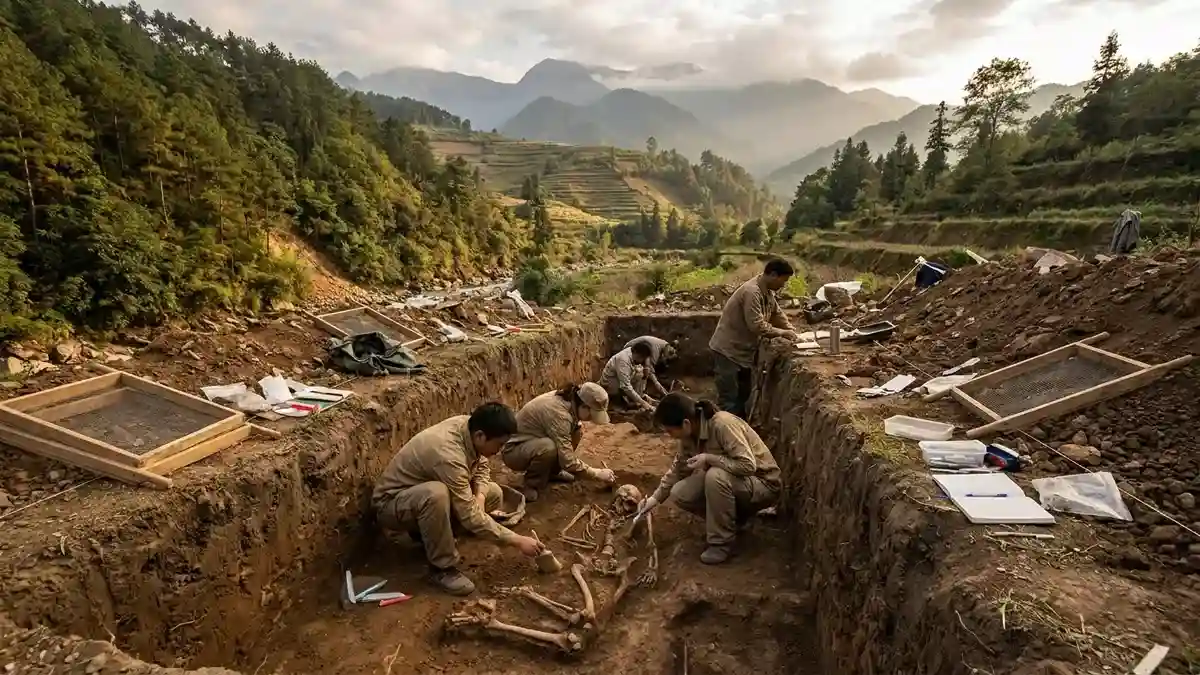
Deep within the soil of southwestern China, the skeletal remains of a woman who lived 7,100 years ago have provided scientists with a groundbreaking genetic breakthrough. For years, geneticists tracking the ancestry of modern Tibetan populations were consistently blocked by a biological anomaly: a significant portion of Tibetan DNA pointed toward a “ghost lineage”—a theoretical ancient human population known only through statistical modeling, with no physical fossil record.
Now, a major genomic study has finally given that ghost a physical identity. The discovery of this deeply diverged human lineage not only reshapes our understanding of East Asian prehistory but also provides the missing evolutionary link to the enigmatic peoples of the Tibetan Plateau.
7,100-Year-Old Skeleton Unlocks Tibetan Origin Mystery
 Catching the Scents of Ancient Egypt: Scientists Decode Mummy Embalming Recipes from Thin Air
Unmasking the Genetic ‘Ghost’ of Yunnan Province
The breakthrough occurred during an extensive genetic survey led by Qiaomei Fu, a paleogenomicist at the Institute of Vertebrate Paleontology and Paleoanthropology in Beijing. Fu and an international team of researchers analyzed 127 ancient human genomes recovered from southwestern China’s Yunnan province. Their findings, published in the journal Science, mapped out regional genetic shifts spanning more than seven millennia.
Among the analyzed remains, one individual stood out. Buried at the Xingyi archaeological site in central Yunnan, the skeleton of an Early Neolithic woman—designated by scientists as Xingyi_EN—was discovered beneath a sequence of later Bronze Age burials.
Life of a Neolithic Hunter-Gatherer
Archaeologists found that the woman was laid to rest without any accompanying grave goods, a stark contrast to the more elaborate burial practices of later eras. Through radiocarbon dating, the team determined she lived approximately 7,100 years ago.
To understand her lifestyle, scientists conducted an isotope analysis of her bones and teeth. By measuring the chemical signatures left behind by her diet, researchers concluded that she did not participate in early agricultural farming. Instead, she lived as a traditional hunter-gatherer, relying on wild plants and local game in the ecologically diverse landscapes of ancient Yunnan.
The Basal Asian Xingyi Lineage
While her lifestyle was typical for the Early Neolithic era, her genetic profile was entirely unexpected. Rather than clustering alongside ancient East or South Asian populations, the DNA of Xingyi_EN revealed a stark divergence. She belonged to a previously unrecorded branch of humanity that split from other Asian lineages at least 40,000 years ago. Scientists have officially named this branch the Basal Asian Xingyi lineage.
    [Main Asian Ancestral Split] (~40,000+ years ago)
               /                      \
              /                        \
    [Modern East/South Asians]    [Basal Asian Xingyi Lineage]
                                       |
                                       | (Isolated for Millennia)
                                       |
                                  [Xingyi_EN] (~7,100 years ago)
What makes this lineage extraordinary is its prolonged genetic isolation. For tens of thousands of years, the ancestors of Xingyi_EN managed to exist without interbreeding with neighboring human groups. This lack of genetic admixture (the mixing of previously isolated populations) allowed the ancient genetic signatures to remain pure, acting as a pristine biological time capsule.
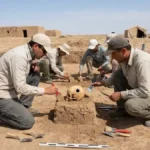 4,000-Year-Old Child’s Skull Surgery Uncovered in Uzbekistan Changes Ancient Medical History
“A ‘ghost population’ refers to a group of people who were not previously known from skeletal remains but whose existence has been inferred through statistical analysis of ancient and modern DNA.”
Solving the Enigma of Tibetan Ancestry
The discovery of the Basal Asian Xingyi lineage provides an invaluable piece of the puzzle regarding how the Tibetan Plateau was populated. Modern Tibetans possess a complex genetic architecture optimized for survival at extreme, low-oxygen altitudes. Previous demographic models indicated that while Tibetans share a massive genetic overlap with northern East Asians, a distinct portion of their genome belonged to an unidentified, deeply split ancestral source.
The genetic data from Xingyi_EN mirrors that exact mysterious source. The timeline constructed by the research team suggests the following sequence of events:
1. Long-Term Isolation
The Basal Asian Xingyi lineage developed in geographic isolation for over 30,000 years, safeguarding its distinct genetic markers from merging into the broader East Asian gene pool.
2. The Admixture Event
At some point following the lifetime of Xingyi_EN, members of this isolated lineage came into contact and interbred with expanding populations of East Asian ancestry.
3. Migration and Preservation
This newly blended population eventually migrated toward the highlands of the Tibetan Plateau. Over generations, the unique genetic traits inherited from the Basal Asian Xingyi lineage became fixed within the Tibetan population, aiding their adaptation to high-altitude environments.
Why Yunnan Province Holds the Key to Asian Prehistory
It is no coincidence that this missing genetic link was discovered in Yunnan province. Even today, Yunnan boasts the highest ethnic and linguistic diversity in China, acting as a geographic crossroads between East Asia, Southeast Asia, and the rugged terrain of the Tibetan Plateau.
The region’s unique geography—characterized by deep river valleys, dense tropical forests, and towering mountain ranges—historically served as both a natural refuge for isolating small human groups and a corridor for major migrations. The layers of burials uncovered at the Xingyi archaeological site demonstrate that Yunnan has been a dynamic melting pot of human activity for thousands of years.
A Cautious Step Forward in Paleogenomics
While the implications of the study are profound, the research team emphasizes the need for scientific caution. Because the Basal Asian Xingyi lineage has currently been identified in only a single individual, it represents a limited sample size.
Further archaeological excavations and successful DNA extractions from the region are required to determine how widespread this population truly was. Finding more individuals belonging to this lineage will help scientists map the exact geographic boundaries of their historic territory and pinpoint precisely when they began interbreeding with the ancestors of modern Tibetans.
Nevertheless, the unmasking of this ancient ghost lineage changes the paradigm of East Asian evolutionary history. It proves that our ancestors’ world was far more biologically diverse and interconnected than previously imagined, and that the keys to understanding modern human adaptation are still waiting to be uncovered beneath the earth.
Frequently Asked Questions
What is a “ghost lineage” in genetics?
A ghost lineage is an ancient population that scientists know existed based on statistical patterns and variant anomalies found in modern or ancient DNA, even though no physical fossils or skeletal remains of that specific group have yet been identified.
Who was Xingyi_EN?
Xingyi_EN is the scientific designation given to a 7,100-year-old female skeleton discovered at the Xingyi archaeological site in Yunnan province, China. Isotope data indicates she lived as a hunter-gatherer during the Early Neolithic period.
How does this discovery link to modern Tibetan people?
Modern Tibetans carry a unique genetic signature that did not match any previously known ancient human group. The DNA of Xingyi_EN matches this exact mystery signature, proving her population is the long-sought ancestral source that contributed to the modern Tibetan gene pool.
Is the Basal Asian Xingyi lineage related to Neanderthals or Denisovans?
No. While Neanderthals and Denisovans are well-known ancient hominins that contributed DNA to modern humans, the Basal Asian Xingyi lineage is a distinct, deeply split branch of modern humans (Homo sapiens) that diverged roughly 40,000 years ago.
Why did this ancient DNA survive without mixing for so long?
Researchers believe that geographic or social isolation kept the Basal Asian Xingyi population physically separated from neighboring East and South Asian populations for tens of thousands of years, preventing the interbreeding that would have diluted their unique genetic markers.