
Table of Contents
- 1. The Discovery at Tell al-Uhaimir
- 2. Translating the Voice of Babylon’s King
- 2.1. The Royal Titles and Divine Appointment
- 2.2. The Structural Assessment
- 2.3. The Restoration and Dedication
- 3. Validating the Archaeological Record
- 4. Aligning with the Prestigious Past
- 5. Frequently Asked Questions
- 5.1. What is a ziggurat?
- 5.2. Where is Kish located, and why was it important?
- 5.3. Why did Nebuchadnezzar hide these cylinders in the walls?
- 5.4. What deities was the Kish ziggurat dedicated to?
- 5.5. How did scientists date the cylinders?
Inscribed Clay Cylinders Confirm Nebuchadnezzar II’s Restoration of the Kish Ziggurat
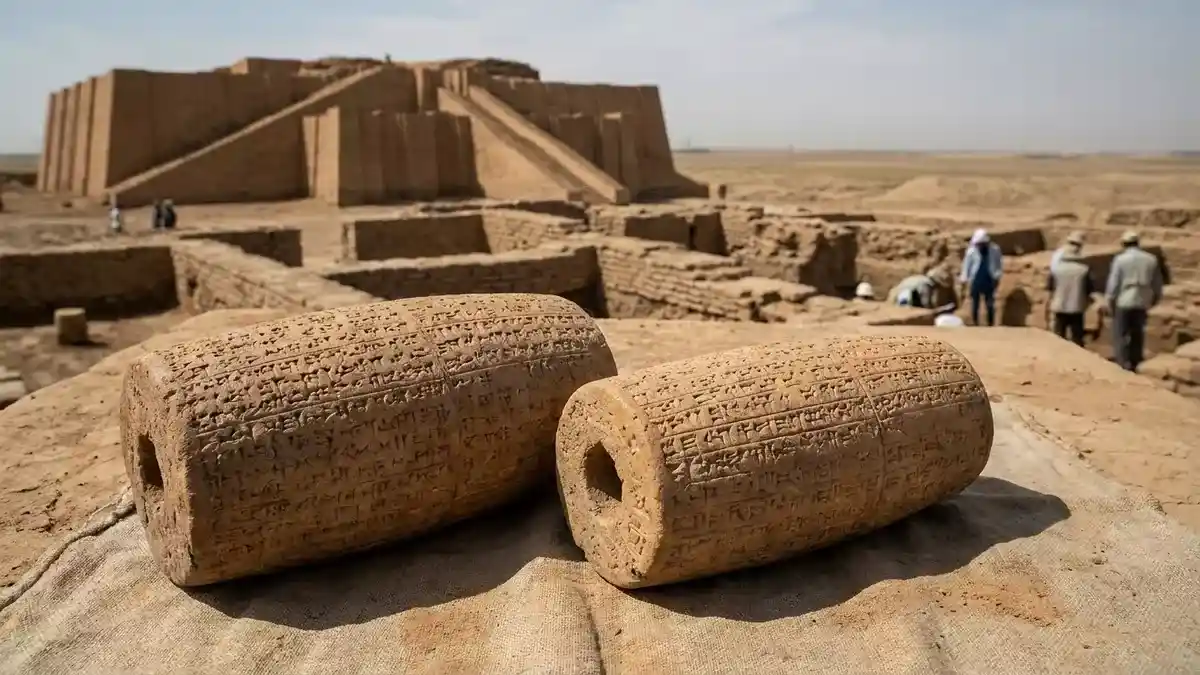
A major discovery in Cuneiform epigraphy has provided the first direct textual evidence of King Nebuchadnezzar II’s extensive restoration of the grand ziggurat of Kish. The breakthrough centers on two inscribed clay cylinders recovered from central Iraq, offering a rare look at how one of Babylon’s most legendary rulers used the renewal of ancient sacred architecture to solidify his political legitimacy and religious authority.
The peer-reviewed study, published in the journal Iraq, details the translation of these barrel-shaped artifacts. While historians have long suspected Babylonian intervention at the site, these twin foundation cylinders serve as explicit, imperial confirmation of Nebuchadnezzar’s direct architectural patronage over one of Mesopotamia’s oldest religious monuments.
Inscribed Clay Cylinders Confirm Nebuchadnezzar II’s Restoration of the Kish Ziggurat
The Discovery at Tell al-Uhaimir
The recovery of the artifacts traces back to December 2013, when local residents discovered the ancient clay objects eroding out of the surface at Tell al-Uhaimir—the archaeological mound that preserves the ruins of ancient Kish. Recognizing their historical value, the residents handed them over to Iraq’s State Board of Antiquities and Heritage (SBAH).

Following years of photographic documentation, high-resolution 3D scanning, and translation, researchers confirmed that both objects date precisely to the Neo-Babylonian Empire during the reign of Nebuchadnezzar II (604–562 BCE).
Neo-Babylonian Architectural Commemoration:
[King Orders Restoration] ──► [Scribes Inscribe Clay Barrels] ──► [Cylinders Buried in Foundations]
The artifacts belong to a long-standing Mesopotamian tradition known as royal foundation inscriptions. Neo-Babylonian kings routinely commissioned these small, baked-clay barrels to be buried within or beneath the foundations of major public works. They were never meant to be read by contemporary citizens; instead, they were intentionally hidden away as permanent messages directed toward the gods and future rulers who might later excavate the site.
Translating the Voice of Babylon’s King
The two cylinders are almost entirely identical in their cuneiform wording, indicating they were stamped or copied from a master imperial template. The narrative follows a strict, highly stylized formula typical of the Neo-Babylonian court, moving seamlessly from royal propaganda to architectural assessment and divine supplication.
 100,000-year-old Homo sapiens bones from Ethiopia may preserve earliest evidence of human cremation
The Royal Titles and Divine Appointment
The text begins by exalting Nebuchadnezzar II, listing his imperial titles and presenting him as a pious shepherd chosen directly by Marduk (the patron deity of Babylon) and Nabû (the god of wisdom) to safeguard the sacred landscapes of Mesopotamia.
The Structural Assessment
The inscriptions then address the condition of the Kish ziggurat—a towering, stepped mud-brick pyramid dedicated to the ancient war god Zababa and the goddess Ishtar. The text notes that while an earlier monarch had built the original structure and another had subsequently repaired it, the ravages of time, wind, and rain had severely weakened its thick walls, reducing the sacred monument to a state of serious disrepair.
Textual Chronology of the Kish Ziggurat:
├── Phase 1: Original Construction (Archaic Mesopotamian King)
├── Phase 2: Intermediary Repair Phase (Succeeding Monarch)
└── Phase 3: Imperial Overhaul (Nebuchadnezzar II, ~600 BCE)
The Restoration and Dedication
Nebuchadnezzar describes his imperial response to this structural decay. The text outlines how his builders reinforced the crumbling core, rebuilt the collapsed external tiers, and heavily improved the exterior facade. This monumental effort ensured the ziggurat could once again stand tall as a proper, pristine dwelling place for its resident deities.

The text concludes with a standard royal prayer, asking Zababa and Ishtar to grant Nebuchadnezzar a long life, military victory against foreign enemies, and continued divine favor for his family. The language is entirely ceremonial and theological, omitting specific administrative metrics, workforce tallies, or technical engineering details in favor of religious messaging.
Validating the Archaeological Record
The translation of these two cylinders is highly significant because it provides written confirmation of long-standing physical evidence observed in the field. Excavations conducted at Kish throughout the 20th century had already proved that the massive ziggurat underwent at least three separate, major construction and repair overhauls.
Furthermore, previous field archaeologists had recovered thousands of loose, stamped mud-bricks bearing Nebuchadnezzar II’s name scattered around the ruins. However, until this latest study, no official foundation text had ever been recovered to explicitly tie the king to a dedicated, systematic restoration program at Kish.
Aligning with the Prestigious Past
Beyond confirming historical data, this discovery emphasizes the strategic mindset behind Neo-Babylonian kingship. Nebuchadnezzar II did not just focus his vast wealth on building up his capital city of Babylon; he systematically poured resources into repairing the religious structures of much older Sumerian and Akkadian city-states like Kish.
By restoring these ancient monuments, Nebuchadnezzar effectively aligned his young empire with the prestigious, deep history of Mesopotamia’s earliest cities. It sent a clear message to his subjects and rivals alike: the current king of Babylon was the ultimate protector of the ancient cosmic order, chosen by the gods to breathe life back into the sacred landmarks of the past.
Frequently Asked Questions
What is a ziggurat?
A ziggurat is a massive, stepped tower built of sun-dried mud-bricks, characteristic of ancient Mesopotamian religious complexes. Unlike Egyptian pyramids, which served as tombs, ziggurats were built as multi-tiered platforms designed to connect heaven and earth, featuring a small temple sanctuary at the very top.
Where is Kish located, and why was it important?
Kish is located at the archaeological site of Tell al-Uhaimir in central Iraq, roughly 12 miles east of Babylon. It was one of the most prominent city-states of ancient Sumer and Akkad, boasting a legendary history that dated back thousands of years before the rise of Nebuchadnezzar’s empire.
Why did Nebuchadnezzar hide these cylinders in the walls?
Foundation cylinders were not meant for the public eye. They were buried deep inside the masonry or foundations as a ritual communication directed toward the gods. They also served as historical time capsules meant to be discovered by future kings who might eventually restore the building centuries later.
What deities was the Kish ziggurat dedicated to?
The text confirms that the grand ziggurat at Kish was dedicated primarily to Zababa, an ancient Mesopotamian god of war, and Ishtar, the powerful goddess of love, fertility, and political warfare.
How did scientists date the cylinders?
The cylinders were dated through epigraphic analysis of the cuneiform script and the specific royal formulas used in the text. The inscriptions explicitly identify King Nebuchadnezzar II by name and list his standard royal titles, placing their creation firmly between 604 and 562 BCE.