
Table of Contents
- 1. The Dual Burial of Djarkutan
- 2. A Multidisciplinary Scientific Effort
- 3. Stone and Bone: The Tech Behind Bronze Age Surgery
- 4. Why Operate on a Child?
- 5. The Oxus Civilization: A Hub of Ancient Innovation
- 5.1. A Crossroad of Ancient Ideas
- 6. The End of an Era and Next Scientific Steps
- 7. Conclusion
- 8. Frequently Asked Questions
- 8.1. 1. What is trepanation and how was it performed 4,000 years ago?
- 8.2. 2. Why is the Djarkutan skull surgery discovery considered historic?
- 8.3. 3. What was the Oxus Civilization where the child lived?
- 8.4. 4. Why did the ancient surgeon perform brain surgery on this child?
- 8.5. 5. Did the child survive the skull surgery?
4,000-Year-Old Child’s Skull Surgery Uncovered in Uzbekistan Changes Ancient Medical History
A monumental archaeological discovery in Central Asia has rewritten the timeline of ancient neurosurgery. While excavating the ancient urban center of Djarkutan in present-day Uzbekistan, an international research team uncovered the 4,000-year-old remains of a young child bearing clear signs of a highly delicate, successful skull operation.
This remarkable find represents the oldest known evidence of cranial surgery in Central Asia and stands as one of the earliest recorded examples of the procedure anywhere on the Asian continent. The discovery offers a shocking look into the sophisticated medical knowledge possessed by Bronze Age societies long before the advent of modern tools or text-based medical manuals.
4,000-Year-Old Child’s Skull Surgery Uncovered in Uzbekistan Changes Ancient Medical History
The Dual Burial of Djarkutan
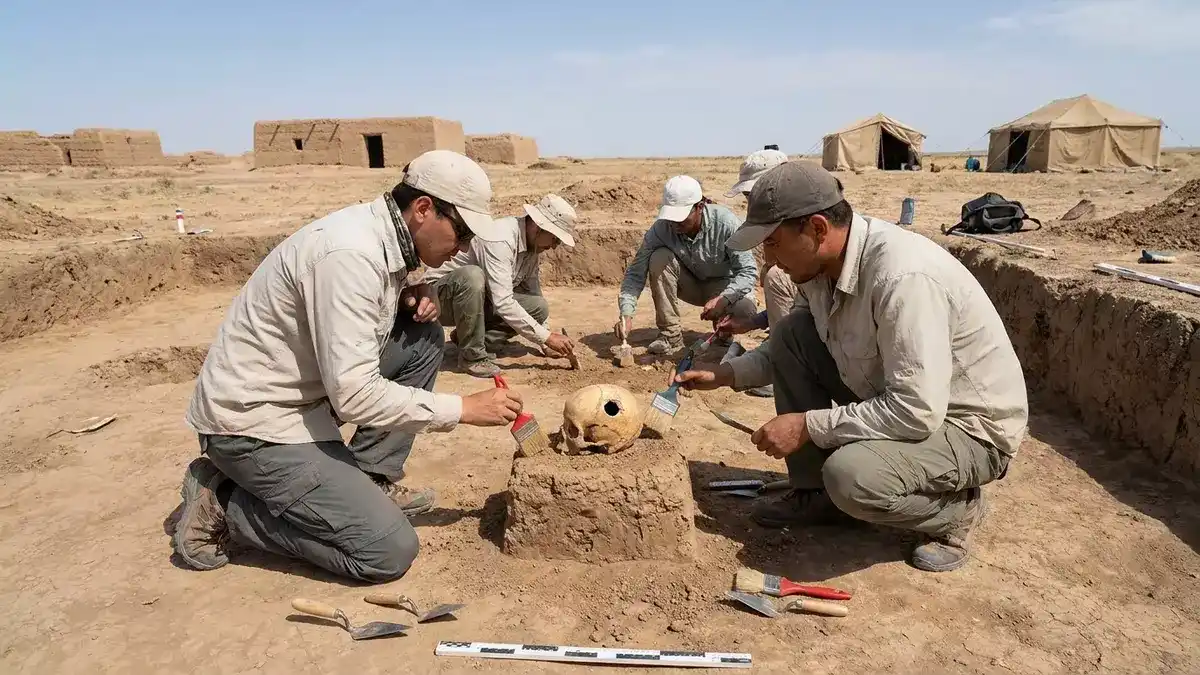
The groundbreaking discovery occurred during targeted field excavations at the historic site of Djarkutan. Archaeologists working on the project uncovered a single grave containing two young children laid to rest side by side. Forensic analysis determined that the younger child was approximately three years old at the time of death, while the older child was roughly five years old.
When physical anthropologists cleared the sediment from the five-year-old child’s skull, they noticed a highly unusual, clean-edged opening. Upon closer laboratory examination, specialists identified the unmistakable marks of trepanation—a historic surgical intervention where a precise section of bone is intentionally drilled, cut, or scraped away from the skull.
The smoothness and structural characteristics of the bone surrounding the incision indicate that the procedure was performed while the child was still alive, rather than as a post-mortem ritual or autopsy.
A Multidisciplinary Scientific Effort
The recovery of these ancient remains is the result of an ongoing, highly collaborative international initiative. The excavation brings together elite scientific minds from several prominent institutions, including:
The University of Salento (Italy)
Termez State University (Uzbekistan)
The Samarkand Institute of Archaeology (Uzbekistan)
The broader research project began in 2024 and utilizes a multi-angled approach to unlock the secrets of the region. Experts in physical anthropology, paleogenetics, archaeobotany, and archaeozoology are working in tandem to piece together the daily lives, health profiles, and environmental conditions of the people who built this ancient society.
Stone and Bone: The Tech Behind Bronze Age Surgery
The reality of a five-year-old undergoing brain surgery 4,000 years ago raises a critical question: how did ancient practitioners manage such a delicate task without steel scalpeled instruments, modern anesthesia, or sterile operating rooms?
Researchers believe that the prehistoric surgeons at Djarkutan relied entirely on incredibly sharp blades crafted from stone (such as obsidian or flint) or highly polished animal bone. Using a combination of rhythmic scraping and gradual drilling, the practitioner carefully bored through the thick cranial bone while taking extreme care not to pierce the dura mater—the delicate, outermost membrane protecting the human brain.
While trepanation has been documented in various prehistoric cultures globally, finding a well-executed example from this early period in Central Asia is exceptionally rare.
Why Operate on a Child?
The exact underlying medical emergency that prompted this high-stakes operation remains the subject of intense scientific debate. In the ancient world, physical illnesses and neurological conditions were rarely viewed through a purely clinical lens; instead, they were treated with a blend of practical medicine and spiritual intervention.
Historians and pathologists suggest that the surgery may have been a desperate attempt to treat a variety of severe ailments, including:
Traumatic head injuries or fractures causing intracranial pressure
Chronic, debilitating epilepsy or seizures
Severe, persistent headaches or migraines
Advanced neurological conditions or sudden behavioral disorders
The child’s age makes the find even more extraordinary. While adult trepanations are scattered across the global archaeological record, performing such a high-risk operation on a five-year-old child is virtually unheard of for this era. It points to a profound level of social care and a willingness to deploy the community’s absolute best technological resources to save a young life.
The Oxus Civilization: A Hub of Ancient Innovation
To understand how this advanced medical knowledge developed, one must look at the setting. Djarkutan was not a primitive, isolated village; it stood at the very heart of the Oxus Civilization, also known to historians as the Bactria-Margiana Archaeological Complex (BMAC).
This highly advanced Bronze Age culture flourished between roughly 2500 and 1500 BCE, stretching across parts of modern-day Uzbekistan, Turkmenistan, northern Afghanistan, and eastern Iran.
Djarkutan is recognized as one of the civilization’s premier urban centers. The city featured meticulously planned residential districts, massive monumental architecture, fortified public structures, and extensive evidence of highly specialized craftsmanship, including advanced metallurgy and pottery. The discovery of the trepanated skull confirms that complex medical science can now be added to the list of the Oxus Civilization’s societal achievements.
A Crossroad of Ancient Ideas
Djarkutan occupied an invaluable geographical position. The city functioned as a vital trading hub along a network of routes connecting Central Asia with eastern Iran, the prosperous Indus Valley Civilization, the rugged terrain of Tajikistan, and the vast northern Eurasian steppes.
For centuries, this intersection witnessed a constant flow of exotic goods, raw materials, and agricultural technologies. Crucially, it also served as a highway for ideas. It is highly probable that medical techniques, anatomical observations, and surgical practices were shared and refined through these deep interregional connections.
The End of an Era and Next Scientific Steps
Despite its impressive architectural and scientific heights, the Oxus Civilization collapsed rapidly after 1500 BCE. Most environmental scientists and archaeologists attribute this sudden decline to severe climate shifts. Changes in regional river systems disrupted the water supplies required to sustain large-scale agriculture and dense city populations, forcing the inhabitants to abandon great centers like Djarkutan.
The story of the five-year-old child from Djarkutan is far from over. Scientists are currently conducting comprehensive anthropological and high-throughput genetic testing on the recovered remains. These incoming DNA and isotopic analyses promise to reveal critical data regarding the child’s biological sex, exact family lineage, underlying nutritional deficiencies, and potentially the precise illness that led to history’s earliest Central Asian brain surgery.
Conclusion
The tiny, scarred skull of Djarkutan stands as an incredible testament to human ingenuity, compassion, and resilience. It proves that the ancient peoples of the Central Asian Bronze Age were not merely passive observers of disease and injury. Instead, they actively pushed the boundaries of anatomy and surgical intervention, demonstrating a level of sophisticated medical daring that challenges our entire perspective on the capabilities of prehistoric mankind.
Frequently Asked Questions
1. What is trepanation and how was it performed 4,000 years ago?
Trepanation is an ancient surgical procedure where a hole is intentionally cut, drilled, or scraped into a living person’s skull. Four thousand years ago, before the invention of metal surgical tools, ancient practitioners used incredibly sharp instruments fashioned from stone (like flint or obsidian) or heavily modified animal bone to gradually wear away the cranial bone.
2. Why is the Djarkutan skull surgery discovery considered historic?
The discovery is historic because it represents the oldest confirmed evidence of skull surgery ever found in Central Asia, and is among the oldest examples in all of Asia. Furthermore, finding evidence of this highly dangerous procedure performed on a young child rather than an adult is incredibly rare for this time period.
3. What was the Oxus Civilization where the child lived?
The Oxus Civilization, also known as the Bactria-Margiana Archaeological Complex (BMAC), was a highly advanced Bronze Age culture that thrived between 2500 and 1500 BCE. Located across modern Uzbekistan, Turkmenistan, Afghanistan, and Iran, it was characterized by planned cities, monumental architecture, advanced crafts, and international trade.
4. Why did the ancient surgeon perform brain surgery on this child?
While the exact reason is impossible to know without written records, archaeologists believe the operation was performed to treat an urgent medical issue. Potential reasons include relieving pressure from a head injury, treating severe epilepsy or chronic headaches, or addressing a sudden neurological or behavioral disorder.
5. Did the child survive the skull surgery?
Yes, initial examinations of the bone edges indicate that the child survived the operation. The smooth, healing characteristics of the bone around the surgical opening show that the cut was made while the child was alive and that the body began the process of biological healing before death ultimately occurred later.