
**Tree Rings Re-Date Poland’s Ancient ‘Princess’ Coffin**
A remarkable archaeological mystery from northwestern Poland has finally been solved thanks to the precision of tree-ring science. The so-called “Princess of Bagicz,” whose oak log coffin emerged from a crumbling coastal cliff in 1898, has been securely placed in the early second century CE. This multidisciplinary breakthrough resolves a decades-long conflict between different dating methods and offers deeper insight into life during the Roman Iron Age in the Baltic region.
The discovery and re-analysis of this rare burial highlight how modern scientific techniques can rewrite our understanding of ancient individuals, their diets, origins, and the cultures they belonged to.
Tree Rings Re-Date Poland’s Ancient ‘Princess’ Coffin

### The Dramatic Discovery on Pomerania’s Coast
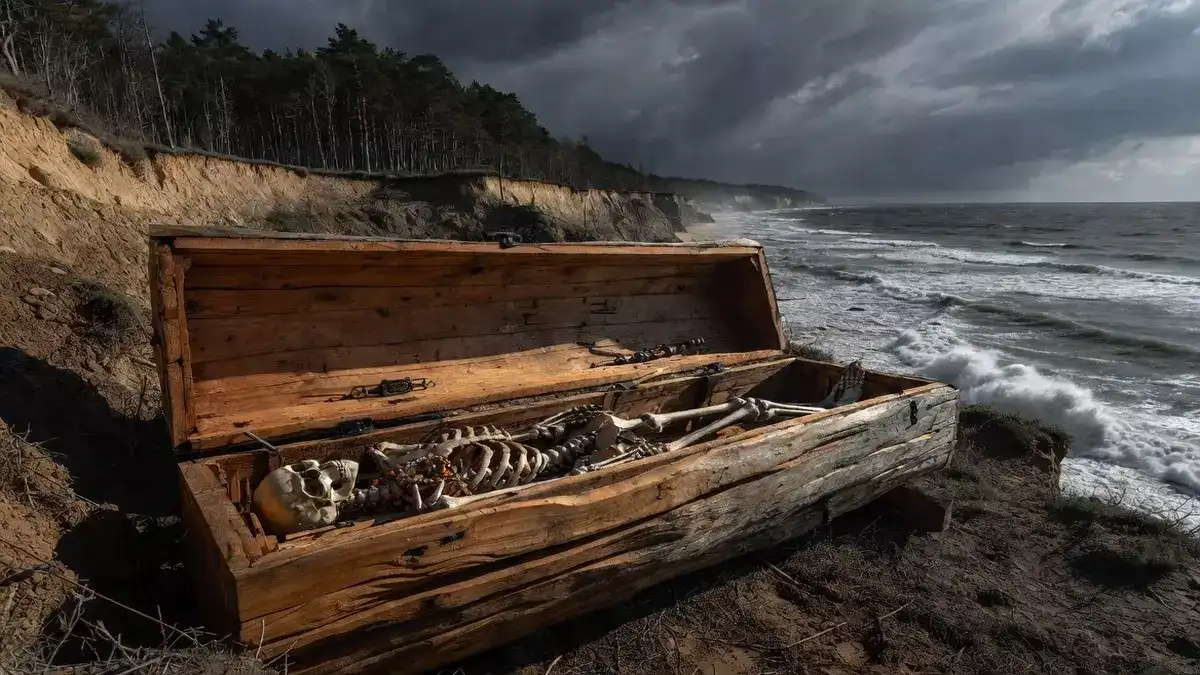
In 1898, relentless waves and wind eroded a section of the shoreline near Bagicz, causing part of a coastal cliff to collapse. This natural process, which can retreat up to one meter per year in the area, revealed a hollowed-out oak log coffin from the Roman Iron Age. Inside rested the well-preserved skeleton of a young woman.
The Wielbark culture, active roughly from the first to fourth centuries CE, frequently used log coffins or twig-lined graves. However, wood rarely survives in Pomerania’s sandy soils, making this coffin an exceptional find—the only well-preserved example of its kind in the region.

The woman was laid to rest with a bronze fibula (cloak pin), another pin, two bronze bracelets, and a striking necklace of glass and amber beads. Early accounts also noted a small wooden stool and cattle hide, though these organic items did not endure. The isolated nature of the burial and the presence of fine ornaments initially led researchers to describe her as a “princess,” evoking images of high status.
Later investigations revealed a larger nearby cemetery, showing she was part of an established burial ground rather than a solitary elite interment. Still, the grave goods clearly marked her as someone of notable standing within her community.
### Decades of Dating Challenges
Determining the exact age of the burial proved surprisingly difficult. In the 1980s, experts relied on the style of the artifacts and dated the grave to between approximately 110 and 160 CE. This fit well with known Wielbark culture patterns.
Then, in 2018, radiocarbon dating on one of her teeth produced a conflicting result: 113 BCE to 65 CE. The nearly century-long discrepancy puzzled researchers and highlighted limitations in single-method dating approaches.
A comprehensive new study published in *Archaeometry* in 2026 has now resolved the issue through dendrochronology—the scientific analysis of tree rings. By examining the oak coffin’s growth patterns and matching them against regional master chronologies, scientists determined the tree was felled around 120 CE, with a margin of error of just seven to eight years. This aligns closely with the original archaeological estimate and confirms the radiocarbon date was offset.
### Why Radiocarbon Dating Went Astray
The research team carefully investigated the older radiocarbon result. Stable isotope analysis of the woman’s bones revealed a diet rich in animal protein, including significant consumption of freshwater fish. Fish from rivers and lakes in limestone-rich areas can incorporate ancient carbon from dissolved geological sources. When humans eat these fish regularly, the carbon in their tissues appears older than their actual lifetime—creating a “reservoir effect” that skews radiocarbon dates earlier.
Local environmental conditions likely amplified this issue. The region’s moderately hard water supports aquatic life that absorbs older carbon, which then moves up the food chain. This dietary and ecological explanation elegantly accounts for the discrepancy without invalidating the radiocarbon method itself.
The study demonstrates an important lesson for archaeologists: in areas with hard water or diets heavy in aquatic resources, multiple lines of evidence are essential for accurate chronology.
**The Princess of Bagicz’s oak log coffin** on display today, offering visitors a direct connection to Roman Iron Age Poland.
### Insights into Her Life and Possible Origins
Beyond dating, the team explored other aspects of the woman’s biography. Strontium isotope analysis of her remains produced values similar to those found in parts of Scandinavia, including the island of Öland. However, glacial deposits in Pomerania create overlapping signatures, making it challenging to definitively determine whether she was a local or a migrant.
This ambiguity reflects the mobility and interconnectedness of Wielbark culture communities. Trade networks, alliances, and population movements linked the Baltic coast with broader European regions during the Roman Iron Age, including interactions with the Roman Empire itself.
Her burial goods—particularly the amber beads—further underscore these connections. Amber from the Baltic Sea was highly prized across the ancient world and traded as far as the Mediterranean.
### The Significance of Log Coffin Burials in Wielbark Culture
The Wielbark culture, named after a key site in Poland, represents a fascinating chapter in the transition from the late Iron Age toward the Migration Period. Its people are often associated with early Germanic groups and played roles in larger cultural shifts across Central and Northern Europe.
Log coffin burials were a distinctive but fragile tradition. The exceptional preservation at Bagicz allows researchers to study construction details, burial positioning, and associated rituals that are usually lost to time. The careful placement of ornaments around the body suggests deliberate funerary practices meant to honor the deceased’s identity and status.
The nearby cemetery context shows these practices were part of a broader community tradition rather than an anomaly. Over generations, families and leaders returned to the same burial grounds, reinforcing social memory and territorial claims.
### Broader Implications for Roman Iron Age Studies
This re-dating has ripple effects for understanding cultural timelines in northern Poland. It tightens the chronology of Wielbark material culture and helps synchronize it with neighboring groups and Roman historical records.
The multidisciplinary approach—combining dendrochronology, radiocarbon dating, stable isotopes, and traditional archaeology—sets a strong example for future research. In regions with poor organic preservation, every available scientific tool becomes crucial for building reliable histories.
Tree-ring dating, in particular, provides calendar-year precision that radiocarbon cannot match, especially when calibrated against local sequences. The success here may encourage similar analyses on other wooden artifacts from the Baltic area.
### Preserving Poland’s Coastal Archaeological Heritage
The Bagicz find also draws attention to the urgent threats facing coastal archaeology. Erosion driven by storms, rising sea levels, and natural processes is accelerating the loss of sites along the Pomeranian coast. Many important remains may be disappearing before they can be studied.
Efforts to document and protect such vulnerable locations are increasingly vital. The “Princess of Bagicz” serves as a powerful reminder of what can be gained when science and timely intervention come together.
Today, the oak coffin and associated artifacts are preserved and displayed, allowing the public to engage with this compelling story. Exhibits help visitors appreciate the craftsmanship, beliefs, and daily realities of people who lived nearly 1,900 years ago.
### What the ‘Princess’ Reveals About Ancient Society
Though the “princess” label was romanticized, the burial clearly belonged to a woman of elevated status. Fine jewelry, personal adornments, and the investment in a substantial oak coffin indicate resources and respect allocated to certain individuals.
Her protein-rich diet, including freshwater fish, suggests access to diverse and valued food sources. This may reflect both personal privilege and the productive capacity of Wielbark communities, who combined agriculture, animal husbandry, and fishing.
The case also illustrates how individual life histories intersect with larger cultural narratives. From possible Scandinavian connections to participation in amber trade networks, her story embodies the dynamic nature of the Roman Iron Age Baltic world.
### Advancing Bioarchaeological Techniques
The study exemplifies the growing sophistication of bioarchaeology. By integrating dendrochronology with isotope ecology and radiocarbon modeling, researchers can now address complex chronological puzzles that once seemed intractable.
Future work may involve ancient DNA analysis to explore kinship, health conditions, or genetic affinities more fully. Such techniques continue to humanize ancient remains, transforming them from anonymous bones into individuals with stories.
**Conclusion**
The re-dating of the “Princess of Bagicz” using tree rings has resolved a long-standing mystery and reaffirmed the value of combining multiple scientific methods in archaeology. This young woman, buried in a rare oak log coffin around 120 CE, emerges as a fascinating figure from the Wielbark culture—someone whose life reflected both local traditions and wider European connections during the Roman Iron Age.
Her story enriches our understanding of prehistoric Poland, highlights the challenges of accurate dating in aquatic-influenced environments, and underscores the fragility of coastal heritage. As new technologies illuminate the past, discoveries like this continue to captivate us, bridging millennia and reminding us of the enduring human desire to honor the dead with dignity and beauty.
**FAQ**
**Q: Who was the “Princess of Bagicz”?**
A: She was a young woman buried in a hollowed oak log coffin near Bagicz, Poland, during the Roman Iron Age. Her grave goods suggest she held notable status within Wielbark culture society.
**Q: How was the burial re-dated?**
A: Dendrochronology on the oak coffin precisely dated the tree felling to around 120 CE. This resolved conflicts with earlier radiocarbon results affected by her fish-heavy diet.
**Q: Why did radiocarbon dating give an earlier result?**
A: The reservoir effect from consuming freshwater fish in hard-water environments introduced older carbon, making her remains appear roughly 100 years older than they actually were.
**Q: What artifacts were found with her?**
A: Bronze fibula, pin, bracelets, and a necklace of glass and amber beads. Early reports mentioned a wooden stool and cattle hide that did not survive.
**Q: What culture did the burial belong to?**
A: The Wielbark culture, known for distinctive burial practices including log coffins, active in northern Poland between the 1st and 4th centuries CE.
**Q: Why is this discovery important?**
A: It provides a rare well-preserved wooden coffin, demonstrates the power of multidisciplinary dating, and offers insights into diet, status, and mobility in the Roman Iron Age Baltic region.
**Q: Where can the coffin be seen today?**
A: The coffin and associated finds are preserved and on display in Poland, allowing public access to this significant archaeological treasure.
This compelling case continues to inspire research into the rich prehistory of Central and Northern Europe, showcasing how one individual’s burial can illuminate centuries of cultural development.