
1,000 Hidden Nottingham Caves Discovered Beneath English Streets
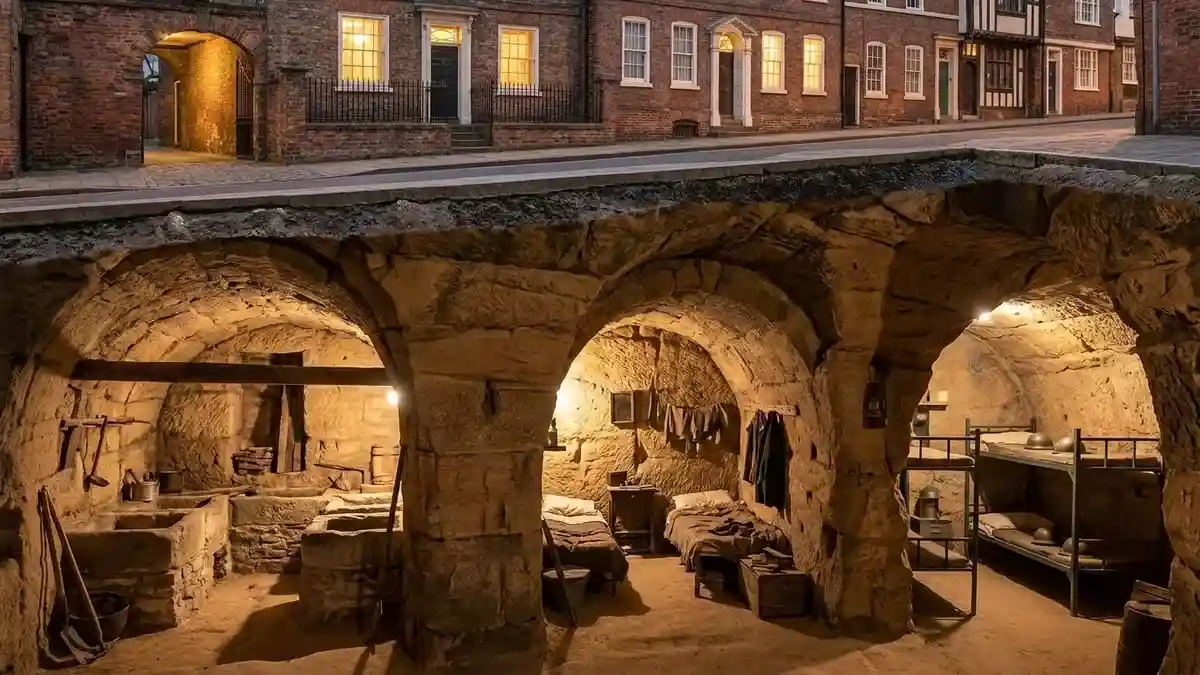
Deep beneath the bustling modern streets of Nottingham, England, lies a sprawling, subterranean world that has fascinated historians for centuries. In a major archaeological milestone, researchers have officially recorded the 1,000th cave in this massive underground network. This historic achievement is the culmination of decades of meticulous field research, archival tracking, and urban exploration.
The city of Nottingham is uniquely built on a foundation of soft, pliable sandstone. For more than a millennium, generations of residents have carved out these subterranean spaces, adapting them to meet the shifting needs of society. From medieval workshops and industrial tanneries to cramped Victorian homes and World War II air raid shelters, these hidden chambers offer an unprecedented look into the evolution of English urban life.
1,000 Hidden Nottingham Caves Discovered Beneath English Streets
The Soft Sandstone Foundation of Nottingham
To understand why Nottingham has so many subterranean spaces, one must look at the local geology. The city sits on a thick layer of soft sandstone, which is structurally stable yet remarkably easy to carve with basic hand tools. Rather than hauling heavy stone to the surface to build upward, Nottingham’s early inhabitants found it much more efficient to excavate downward.
This unique geological feature completely shaped the city’s architectural identity. While other historic cities grew exclusively skyward, Nottingham expanded in two directions at once. The ease of excavation allowed ordinary citizens, merchants, and authorities to create bespoke underground spaces tailored to their immediate survival, commercial ventures, and daily routines.
A History Dating Back to the First Millennium
The relationship between Nottingham and its subterranean network is deeply rooted in ancient history. The earliest written accounts of these structures date back to the first millennium. In the ninth century, a Welsh monk and chronicler named Asser famously described the settlement as Tig Guocobauc, which translates directly to “House of Caves.”
 Vikings (Quiz)
This early historical marker proves that the subterranean network e for a wide variety of civic and private uses.was not a temporary trend, but a fundamental characteristic of the region’s earliest settlements. By the time the medieval period arrived, digging into the sandstone had become standard practic
How the Cave Network Evolved Through the Centuries
As Nottingham transformed from a modest early medieval settlement into a thriving industrial hub, the usage of the caves shifted dramatically. Each era left its own distinctive mark on the sandstone walls, creating a multi-layered historical archive beneath the feet of modern commuters.
[9th Century: Early Settlement]
       │
       ▼
[Medieval Period: Trade & Industry] ──► Storage, Tanning, Malting
       │
       ▼
[19th Century: Industrial Revolution] ──► Overcrowded Residential Slums
       │
       ▼
[1940s: World War II] ──► Air Raid Shelters
       │
       ▼
[Modern Era: 2020s] ──► 1,000+ Documented Sites & Preservation
Medieval Trade, Tanning, and Malting
During the medieval era, the underground chambers became crucial to the city’s economic survival. The natural insulation of the sandstone kept the caves at a remarkably constant, cool temperature year-round. This made them ideal for the storage of perishable goods, food, and ale.

Beyond storage, the caves served as active workspaces for highly specialized and chemically intense industries. Artisans used the underground chambers for:
Industrial Tanning: Leather workers utilized the deep pits carved into the stone to cure hides, a process that benefited from the controlled underground environment.
Malting Operations: The consistent temperature and humidity levels provided the perfect conditions for germinating grain to produce malt for brewing.
Pub Cellars: Public houses across the city dug deep cellars to keep beer barrels cold, a tradition that many historic Nottingham pubs still maintain today.
The Victorian Era and Subterranean Slums
The Industrial Revolution brought a massive influx of workers to Nottingham, leading to severe surface overcrowding. During the nineteenth century, the city’s poorest residents were forced to seek shelter underground.
In areas like Drury Hill and Narrow Marsh, families lived in dark, poorly ventilated cave-like rooms carved directly into the hillsides. These subterranean slums highlight the desperate measures taken by citizens during periods of rapid, unchecked urban expansion.
World War II and Wartime Survival
In the twentieth century, the network was repurposed once again to protect the population from modern warfare. During the Blitz of World War II, massive sections of the cave system were reinforced and converted into public air raid shelters. Thousands of Nottingham residents crowded into these ancient sandstone chambers to escape aerial bombardment, adding yet another layer of historical significance to the city’s underground heritage.
The Modern Race to Document Nottingham’s Subterranean World
The effort to systematically catalog every single cave beneath Nottingham is a relatively recent endeavor. In the late 2000s, the official registry of known cave sites stood at a modest 425. Since then, dedicated archaeological initiatives have more than doubled that figure, officially crossing the 1,000-cave threshold.
Leading this massive archival and field initiative is city archaeologist Scott Lomax. The documentation process relies on a combination of advanced technological mapping and deep historical research, including the analysis of:
Ancient Property Deeds: Tracking changes in land ownership over hundreds of years often reveals references to forgotten cellars and vaults.
Municipal Boundary Records: Historic city maps frequently contain clues about older structures that were paved over during modern urban renewal.
Modern Redevelopment Projects: Active construction and demolition projects consistently break through into previously unrecorded chambers, revealing everything from eighteenth-century sand mines to nineteenth-century commercial cellars.
Because hundreds of historical references and archival documents remain unprocessed, experts fully expect the official count to rise significantly higher in the coming years.
Safety, Structural Stability, and Tourism
For modern property owners in Nottingham, discovering a cavern beneath their home or business can be an unexpected surprise. While the concept of a hollow foundation might sound alarming, comprehensive structural engineering assessments indicate that the vast majority of these ancient cave systems remain incredibly stable.
       ┌────────────────────────────────────────────────────────┐
       │             NOTTINGHAM CAVE PRESERVATION               │
       ├────────────────────────────────────────────────────────┤
       │ Modern development requires extensive archaeological   │
       │ mapping before construction begins. This reduces the   │
       │ risk of accidental structural damage and ensures that  │
       │ these historical treasures are preserved for the future.│
       └────────────────────────────────────────────────────────┘
In fact, many residents and business owners have embraced their property’s hidden history. With proper inspection, ventilation, and structural reinforcement, several private caves have been safely converted into unique modern spaces, including home recreation rooms, wine cellars, and unique commercial venues.
For the general public, the history of this subterranean network is kept alive through dedicated tourism sites. The popular “City of Caves” attraction, located underneath the former Broadmarsh shopping district, allows visitors to wander through preserved sections of the medieval tanneries, Victorian homes, and wartime shelters, offering an immersive look at life beneath the surface.
Conclusion
Reaching the milestone of 1,000 recorded caves is a testament to Nottingham’s rich, layered history and the tireless efforts of local archaeologists. These spaces are far more than mere holes in the ground; they represent a continuous, thousand-year timeline of human ingenuity, economic adaptation, and survival. As research continues and more documents are analyzed, Nottingham’s underground landscape will undoubtedly keep revealing its secrets, proving that the city’s past is just as deep as it is fascinating.
Frequently Asked Questions
How were the Nottingham caves originally made?
The caves were carved by hand using basic tools like picks, chisels, and wedges. Because Nottingham is built on a foundation of soft sandstone, early residents found it relatively easy to excavate deep into the rock without the need for advanced mining machinery.
Can the public visit the underground caves today?
Yes, parts of the network are open to the public. The most famous accessible location is the City of Caves attraction, accessible near the former Broadmarsh shopping area. Additionally, several historic pubs throughout Nottingham offer patrons access to their ancient underground cellars.
Are the caves beneath Nottingham structurally safe?
Yes. Despite being carved centuries ago, geological and structural assessments show that the sandstone chambers are remarkably stable. Local planning policies require detailed archaeological mapping before any major surface construction begins to ensure the integrity of the caves is maintained.
Do people still live in the Nottingham caves?
No, the caves are no longer used as residential spaces. While impoverished families lived in some of the cave rooms during the height of Victorian-era overcrowding in the nineteenth century, modern health, safety, and housing regulations have long since prohibited subterranean living.
How do archaeologists find newly recorded caves?
Discoveries are made through a mix of archival research and active field inspection. Researchers analyze historic maps, tax records, and property deeds for clues. Furthermore, modern construction and utility work frequently uncover sealed chambers that have been hidden from view for generations.