
Table of Contents
- 1. Unearthing a Century-Old Mystery Beneath the Nile Silt
- 2. Architectural Ambition Across a Thousand Square Meters
- 2.1. An Unparalleled Ancient Design
- 2.2. Harnessing the Power of the Nile
- 3. Artifacts of Sacred Calendars and Everyday Life
- 3.1. The Lifecycle of a Sacred Complex
- 3.2. A Snapshot of Early Domestic Leisure
- 4. Frequently Asked Questions
- 4.1. What makes an Egyptian sun temple different from a typical pyramid complex?
- 4.2. Why did it take over 120 years to fully excavate this specific site?
- 4.3. What is the historical value of the inscribed stone threshold?
- 4.4. What does the presence of the Senet game pieces tell archaeologists?
- 4.5. How many Fifth Dynasty sun temples have been discovered in total?
4,400-Year-Old Sun Temple of King Nyuserre Unearthed at Egypt’s Abusir Necropolis
An extraordinary archaeological discovery at the ancient Abusir necropolis in Egypt is reshaping our understanding of the Old Kingdom’s architectural and spiritual landscape. Researchers have uncovered the long-lost remains of a valley temple belonging to the sprawling solar complex of King Nyuserre, one of the most prominent pharaohs of the Fifth Dynasty, who ruled more than 4,300 years ago.
The breakthrough, achieved by an Italian archaeological mission working in Abu Ghurab, stands as one of the most monumental advancements in the field of Egyptology and the study of sun temples over the past century.
4,400-Year-Old Sun Temple of King Nyuserre Unearthed at Egypt’s Abusir Necropolis
Unearthing a Century-Old Mystery Beneath the Nile Silt
The presence of the legendary temple was initially posited by German Egyptologist Ludwig Borchardt in 1901. However, early 20th-century excavation efforts quickly ground to a halt due to dangerously high groundwater levels across the site. Thanks to modern shifting environmental conditions and technological advancements, researchers finally broke ground on the long-hidden complex.

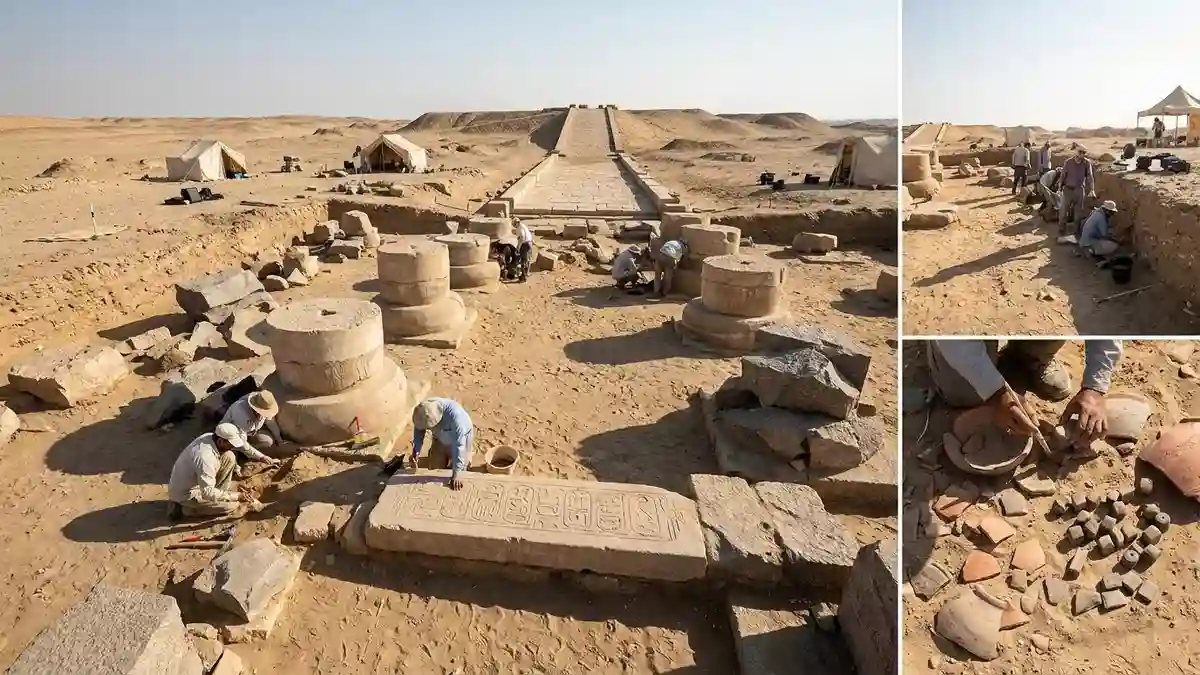
The entrance to the temple was found buried beneath roughly 1.2 meters of heavy Nile River silt, accumulated over thousands of years of seasonal flooding. As teams carefully extracted the sediment, they exposed the temple’s original floor alongside a massive limestone column base and shattered fragments of a granite column. These structures likely formed a grand entrance portico, flanked by structural granite door frames and heavy lintels that remained in their original structural positions.
Architectural Ambition Across a Thousand Square Meters
To date, excavations have successfully exposed more than half of the temple’s original floor plan, revealing a monumental layout that covers over 1,000 square meters.
An Unparalleled Ancient Design
The structural blueprint of this complex is entirely unique among known valley temples in the Memphite region. It emphasizes the profound architectural ambitions of King Nyuserre’s solar cult. The discovery is exceptionally rare because, out of the multiple sun temples documented in ancient texts, only two have ever been conclusively located and verified by modern archaeology.
Harnessing the Power of the Nile
The temple design highlights a calculated relationship with the surrounding natural environment. Archaeologists uncovered intact sections of fine stone casing that once lined the long passageway connecting the entrance to a monumental causeway leading toward the main solar sanctuary.
Previous seasons revealed a well-preserved quartzite gateway paired with an internal staircase designed to access the temple roof, confirming a secondary entrance on the northwest facade. Furthermore, engineers detected a distinct sloping ramp extending from the complex toward the historical path of the Nile River, showcasing how pharaohs used water-bound transit networks to integrate sacred ceremonies with the life-giving river.
Artifacts of Sacred Calendars and Everyday Life
Beyond the structural walls, the temple site yielded a wealth of historic artifacts that bridge the gap between grand state religious functions and the intimate reality of everyday human life.

The Lifecycle of a Sacred Complex
The archaeological layers tell a fascinating story of how the site shifted in function as central power dynamics fluctuated across ancient Egypt:
┌────────────────────────────────────────────────────────┐
│             HISTORICAL TIMELINE OF NYUSERRE'S TEMPLE   │
│                                                        │
│  [c. 2400 BCE] ─────────────────────► [c. 2100 BCE]     │
│        │                                     │         │
│        ▼                                     ▼         │
│  Late Old Kingdom                    First Intermediate Period │
│  • Fully functional sun temple       • Solar cult abandoned    │
│  • Formal royal festival calendars   • Reused as local village │
│  • Sacred ritual offerings           • Dominated by daily life │
└────────────────────────────────────────────────────────┘
The Imperial Era (Old Kingdom): During its zenith, the temple operated as a bustling center of state religion. The most notable artifact recovered from this phase is a massive stone threshold inscribed with vivid hieroglyphic characters. The text preserves an extensive, formal festival calendar explicitly referencing the religious obligations of King Nyuserre.
The Era of Collapse (First Intermediate Period): As central royal authority weakened across Egypt, the formal solar cult ceased operations. The abandoned temple was subsequently repurposed by local populations into a small, informal domestic settlement.
A Snapshot of Early Domestic Leisure
Excavations yielded thousands of domestic pottery vessels dating from the late Old Kingdom through to the early Middle Kingdom, with an overwhelming concentration from the First Intermediate Period—an era historically shrouded in mystery due to a lack of written records.
Among the domestic debris, archaeologists recovered delicate wooden gaming pieces belonging to the ancient Egyptian board game Senet. Finding a popular leisure activity inside a space built for divine solar worship provides a stunning look at how common citizens adapted grand imperial infrastructure to serve their immediate daily needs.
Fieldwork will continue in upcoming seasons, as international teams work to map out the full perimeter of the complex and decode the ritual mechanics of the Fifth Dynasty’s solar cults.
Frequently Asked Questions
What makes an Egyptian sun temple different from a typical pyramid complex?
Pyramid complexes were designed primarily as burial tombs to preserve the deceased body of the pharaoh for eternity. Sun temples, conversely, were open-air monuments dedicated to worshiping the supreme solar deity, Ra, while simultaneously celebrating the living pharaoh’s divine right to rule.
Why did it take over 120 years to fully excavate this specific site?
Although Ludwig Borchardt identified the site’s footprint in 1901, the proximity of the temple to historical Nile flood channels meant the local water table was incredibly high. Attempting to dig would have flooded the trenches and destroyed the artifacts. Recent changes in the regional water table finally made excavation possible.
What is the historical value of the inscribed stone threshold?
The threshold features hieroglyphic writing that records a highly detailed “festival calendar.” This calendar provides historians with direct evidence of the specific seasonal rituals, offerings, and administrative dates tied to the pharaoh’s reign, confirming King Nyuserre’s direct ownership of the site.
What does the presence of the Senet game pieces tell archaeologists?
The game pieces show that after the central Egyptian government fractured and the state-sponsored solar cult dissolved, ordinary citizens moved into the abandoned religious site. It offers proof of how sacred imperial structures were organically repurposed into secular, domestic villages.
How many Fifth Dynasty sun temples have been discovered in total?
While historical records indicate that at least six pharaohs built dedicated sun temples during the Fifth Dynasty, only two have been discovered and archaeologically confirmed by modern science, including this newly exposed structure at Abu Ghurab.