New CT Scans Reveal Hidden Secrets of 2,300-Year-Old Egyptian Mummies

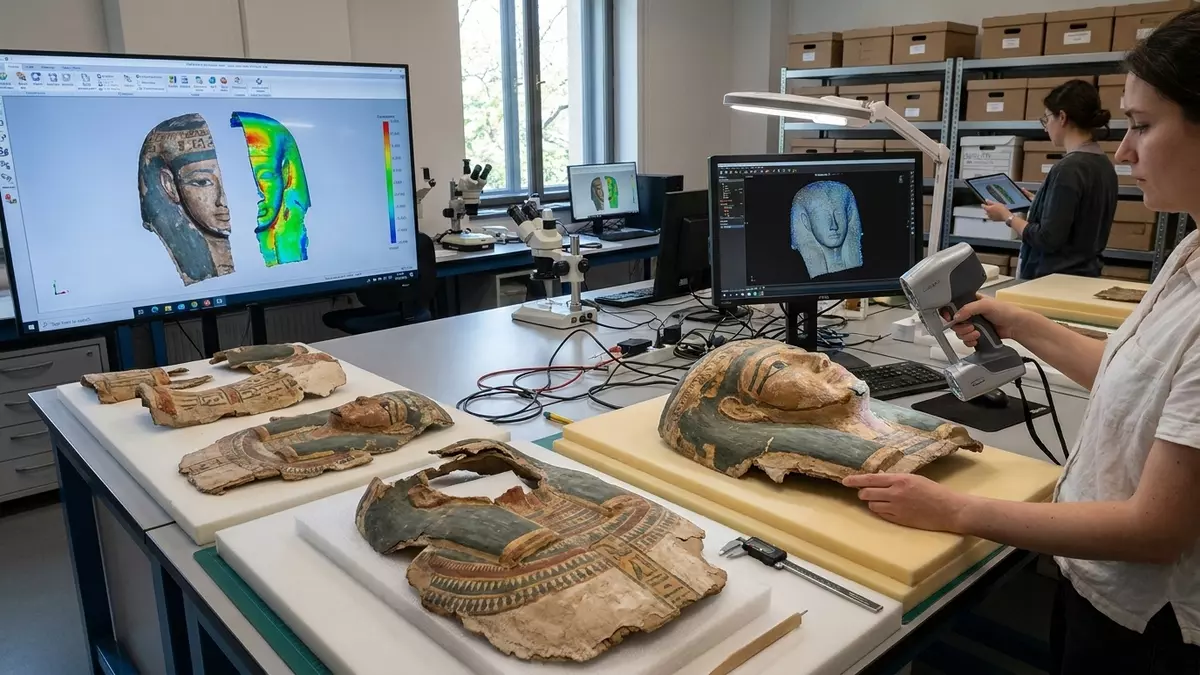
**New CT Scans Reveal Hidden Secrets of 2,300-Year-Old Egyptian Mummies** Advanced CT imaging is uncovering remarkable new details about ancient Egyptian mummies, giving scientists and history enthusiasts a clearer picture of life, health, and death practices from more than two millennia ago. Researchers in Hungary used cutting-edge photon-counting CT technology to re-examine mummified remains at … Read more

Nile Stability Powered Rise of Ancient Kushite Capital

**Nile Stability Powered Rise of Ancient Kushite Capital** A major new study reveals how the Nile River’s long period of stability helped transform a modest riverside location into the powerful ancient city of Napata, heart of Sudan’s Kushite kingdom. Researchers from the University of Michigan, working closely with Sudanese colleagues, uncovered geological evidence showing that … Read more

AI Recreates Face of Pompeii Victim from Vesuvius Eruption

**AI Recreates Face of Pompeii Victim from Vesuvius Eruption** Archaeologists and digital experts have brought a tragic figure from ancient history back into view. Using artificial intelligence and detailed excavation data, researchers have created a striking facial reconstruction of a man who perished during the catastrophic eruption of Mount Vesuvius in 79 CE. This powerful … Read more

Coral Dating Unlocks Colonial Secrets in Pacific Islands

**Coral Dating Unlocks Colonial Secrets in Pacific Islands** Archaeologists have discovered a powerful new tool for uncovering the hidden timelines of colonial-era sites in the Pacific: dating the coral blocks used in historic buildings. This innovative approach is transforming how researchers understand construction and cultural changes in remote islands like French Polynesia, where traditional records … Read more

Rare 9th-Century Copy of Earliest English Poem Found

**Rare 9th-Century Copy of Earliest English Poem Found** Scholars have made an exciting breakthrough in the history of English literature with the discovery of a previously overlooked copy of Cædmon’s Hymn in a manuscript at Rome’s National Central Library. This early ninth-century find represents one of the oldest surviving versions of what many consider the … Read more

DNA Study Reveals Small Migrations Reshaped Europe After Rome

**DNA Study Reveals Small Migrations Reshaped Europe After Rome** A groundbreaking ancient DNA analysis is rewriting the story of what happened after the Western Roman Empire collapsed in Central Europe. Far from the massive barbarian invasions often depicted in popular accounts, the research shows that smaller movements of families and communities, combined with gradual integration, … Read more

Medieval Art Triggered Sounds in Pilgrims’ Minds

**Medieval Art Triggered Sounds in Pilgrims’ Minds** New research reveals that medieval manuscripts and religious images were far from silent experiences. Instead, intricate illustrations in sacred texts actively sparked imagined sounds in the minds of viewers, creating rich multisensory encounters during the early Middle Ages in England. This fresh perspective transforms how we understand medieval … Read more

Ancient Belgian Grave Reveals Post-Roman Trade Secrets

**Ancient Belgian Grave Reveals Post-Roman Trade Secrets** Archaeologists in Belgium have uncovered compelling evidence of how everyday commerce adapted after the Roman Empire’s monetary system collapsed in northwestern Europe. A 5th-century grave at the Roman coastal fort of Oudenburg contained a remarkable purse assemblage of old bronze coins and scrap metal, shedding new light on … Read more

700-Year-Old Mummy Reveals Scarlet Fever in Pre-Columbian Americas

**700-Year-Old Mummy Reveals Scarlet Fever in Pre-Columbian Americas** Archaeologists and scientists have made a stunning discovery that rewrites the timeline of infectious diseases in the Western Hemisphere. DNA extracted from a 700-year-old mummy in Bolivia confirms that the bacterium behind scarlet fever and strep throat was already circulating among Indigenous populations in South America long … Read more

5,000-Year-Old Scottish Crannog Predates Stonehenge

**5,000-Year-Old Scottish Crannog Predates Stonehenge** Archaeologists have revealed astonishing new details about a 5,000-year-old artificial island submerged in a Scottish loch, proving that sophisticated Neolithic engineering thrived in Britain centuries before the construction of Stonehenge. This ancient crannog on the Isle of Lewis showcases the remarkable ingenuity of early communities who shaped their watery landscapes … Read more