
Table of Contents
- 1. The Case Pente Project: From Empty Field to Historical Goldmine
- 2. Inside the Prehistoric Settlement: Huts of the Early Bronze Age
- 2.1. The Mechanics of Stone Age Architecture
- 2.2. The Sacred Necropolis
- 3. The Roman Thermal Baths: Architecture and Ancient Lifeways
- 3.1. Engineering Ancient Luxury
- 4. A Multi-Disciplinary Alliance for Heritage Preservation
- 4.1. Advanced Laboratory Testing
- 5. Bridging the Gap: Public Outreach and Education
- 6. Frequently Asked Questions (FAQ)
- 6.1. How was the Case Pente site discovered?
- 6.2. What did the Bronze Age village look like?
- 6.3. What are the main features of the Roman bath complex?
- 6.4. Will the artifacts and ruins be destroyed by the gas station construction?
- 6.5. What scientific tests are being performed on the human remains?
Massive Italian Excavation Unveils Bronze Age Village and Roman Baths
An expansive preventive archaeology project in central Italy has dramatically rewritten the historical timeline of the Abruzzo region. During a massive excavation at the Case Pente site near the town of Sulmona, researchers exposed a sprawling subterranean landscape of human history spanning thousands of years. The astonishing discoveries include a vast prehistoric settlement containing dozens of ancient dwellings, a sacred burial ground, and a beautifully preserved Roman thermal bath complex.
What began as a routine environmental clearance survey for a modern infrastructure project has transformed into one of the most critical archaeological campaigns in modern Italian history, offering an unparalleled look at how a single geographic corridor evolved over millennia.
Massive Italian Excavation Unveils Bronze Age Village and Roman Baths
The Case Pente Project: From Empty Field to Historical Goldmine
The systematic archaeological campaign commenced in March 2023. The project was initiated as a legally mandated preventive conservation operation ahead of the construction of a planned gas compression station by the energy infrastructure operator Snam. Prior to the arrival of mechanical excavators and scientific field teams, the 12-hectare agricultural plot was widely considered by regional planners to hold little to no historical value. Aside from a handful of isolated, poorly documented artifacts pulled from the topsoil by local farmers during the 19th century, the deep historical potential of the location remained completely hidden.
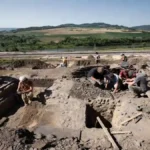
As archaeological technicians systematically stripped away the agricultural topsoil, they exposed a vast, uninterrupted footprint of ancient human activity. The cross-disciplinary investigation has completely transformed prevailing theories regarding the early human carrying capacity and demographic density of the Peligna Valley. Rather than a sparsely populated mountain pass, the valley is now understood to have functioned as a highly organized, continuously occupied cultural crossroads for thousands of years.
Inside the Prehistoric Settlement: Huts of the Early Bronze Age
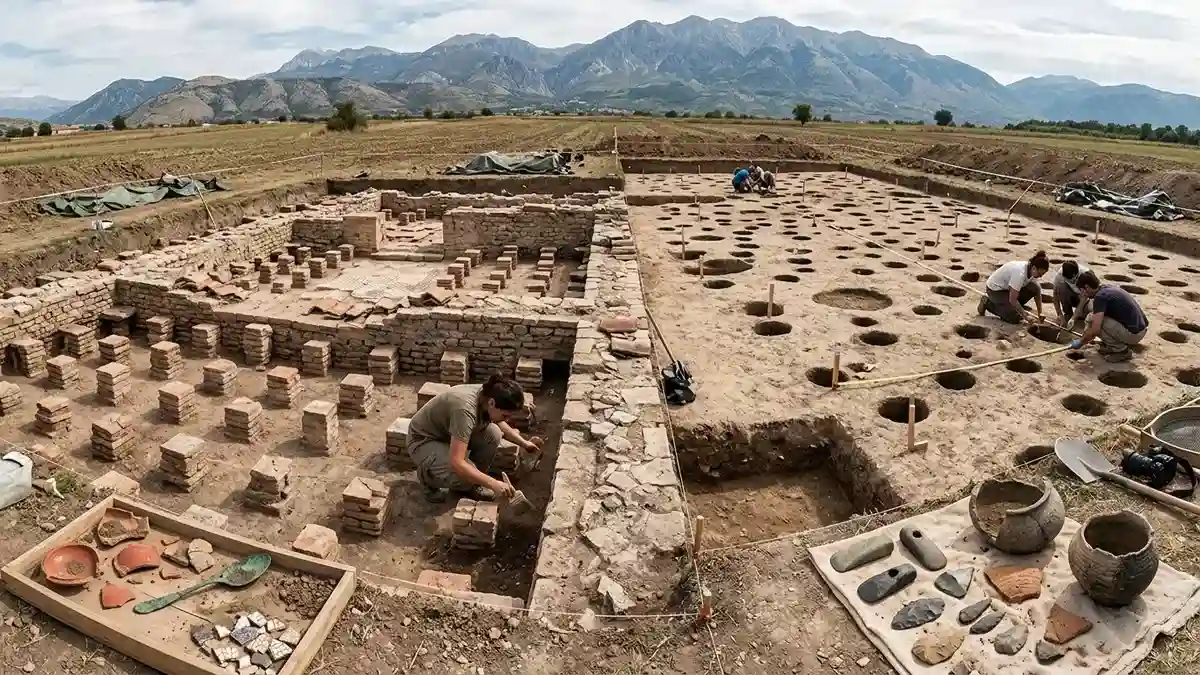
The deepest structural layers exposed at the Case Pente site date back to the twilight of the Chalcolithic period (the Copper Age) and the dawn of the Early Bronze Age. Across the expansive workspace, archaeologists painstakingly mapped out the distinct structural foundations of 52 prehistoric huts, revealing the orderly layout of a surprisingly large village.
The Mechanics of Stone Age Architecture
Because the organic building materials used to construct these dwellings—such as timber pillars, woven branches, and mud plaster—perished long ago, scientists relied on negative architectural features to reconstruct the settlement. The layout of the village was preserved via hundreds of circular postholes cut directly into the ancient subsoil. By mapping the exact alignment, depth, and spatial orientation of these postholes, architectural historians can visualize the structural engineering of the community.
The prehistoric residents utilized heavy vertical wooden beams to support durable, thatched-roof huts. The high concentration of 52 distinct structures indicates a highly organized, sedentary community that possessed sophisticated communal planning principles and a stable agricultural economy capable of supporting hundreds of individuals simultaneously.
The Sacred Necropolis
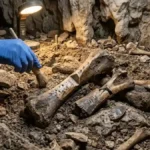
Immediately adjacent to the residential village sector, field teams uncovered a sprawling prehistoric cemetery (necropolis) intimately tied to the initial Bronze Age community. The burial grounds also feature multiple stratified layers of human interments from subsequently younger historical eras. This continuous mortuary use proves that subsequent cultural groups chose to place their dead immediately alongside the ancient tombs of the original ancestors, maintaining the sacred status of the Case Pente landscape for centuries.
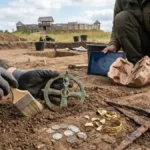 10th-Century Bronze Cross Found in Germany Reveals Early Christian Influence on Slavic Tribes
Under the guidance of Italian heritage protection statutes, the prehistoric zone of the site has been fully excavated, cataloged, and scientifically documented. Every unique feature was digitally preserved using advanced 3D mapping and high-resolution photography before protective engineering backfilling was completed, ensuring the preservation of the scientific record while allowing necessary industrial infrastructure development to move forward in designated zones.
The Roman Thermal Baths: Architecture and Ancient Lifeways
In addition to the extensive Bronze Age footprint, Case Pente yielded an exceptional collection of classical Roman architecture. Situated immediately adjacent to a heavily trafficked ancient transport highway that dictated commercial travel through the Peligna Valley for generations, archaeologists unearthed the structural remains of a substantial rural masonry building and a sophisticated thermal bath complex.
Engineering Ancient Luxury
The uncovered Roman bathhouse features an array of specialized architectural elements typical of high-end imperial engineering:
The Hypocaust System: Excavators uncovered the intact stone and brick pillars (pilae) that elevated the floors of the bathhouse, allowing superheated air generated by an external furnace (praefurnium) to circulate beneath the rooms.
The Caldarium and Tepidarium: The foundations outline hot-room and warm-room bathing chambers, highlighting that even in rural valley outposts, Roman citizens maintained a high standard of living, physical hygiene, and social relaxation.
Because of the extraordinary preservation and unique architectural value of these masonry ruins, the regional heritage authority has determined that the Roman structures will not be removed or backfilled. Instead, the stone walls and subterranean heating chambers will remain permanently in situ (in their original positions). They are currently being integrated into a custom-designed public visitor trail, providing travelers with a rare opportunity to view an authentic Roman bath complex directly within its original environmental context once permanent conservation shelters are complete.
A Multi-Disciplinary Alliance for Heritage Preservation
The ongoing management of the Case Pente site represents a highly successful collaboration between the Italian state archaeological authority—the Soprintendenza Archeologia, Belle Arti e Paesaggio per le Province di L’Aquila e Teramo—and the energy company Snam. Under a formal conservation agreement, specialized restoration firms are working to stabilize the structural masonry of the Roman baths and chemically conserve the thousands of artifacts pulled from the soil.
To enhance public education and tourism value, the collaborative project includes plans to reconstruct a full-scale, historically authentic replica of one of the 52 Bronze Age huts directly alongside the standing stone ruins of the Roman bathhouse. This side-by-side display will provide future visitors with a dramatic, highly tangible visual tool to comprehend exactly how human technology, domestic architecture, and landscape utilization evolved across the Peligna Valley over thousands of years.
Advanced Laboratory Testing
Concurrently, an international network of laboratories is executing a comprehensive suite of scientific tests on the biological materials recovered from the tombs. These investigations include:
Ancient DNA (aDNA) Sequencing: Tracing the genetic lineages, familial relationships, and migratory origins of the prehistoric and Roman individuals buried at the site.
Stable Isotope Analysis: Analyzing skeletal remains to determine the specific dietary habits, nutritional health, and geographic childhood origin of the valley’s inhabitants.
Archaeozoological and Archaeobotanical Studies: Examining preserved animal bones, ancient seeds, and fossilized pollen grains to reconstruct the local environment, livestock composition, and farming techniques.
Radiocarbon Dating: Using carbon-14 isotopes to establish an absolute chronological timeline for the transition between the prehistoric village and the subsequent Roman occupation.
Once these laboratory studies reach completion, the comprehensive findings will be published in peer-reviewed international scientific journals, culminating in a major public museum exhibition displaying the finest recovered artifacts.
Bridging the Gap: Public Outreach and Education
From its inception, the Case Pente project has prioritized local community engagement. In celebration of European Archaeology Days, the active excavation site opened its secure gates to the public, allowing small tour groups to view the active dig sites under controlled conditions. Visitors stood directly on the viewing platforms, watching field specialists utilize trowels and brushes to clear earth away from ancient walls and skeleton remains.
Every phase of the multi-year operation has strictly aligned with Italy’s comprehensive cultural heritage protection rules. By ensuring that every wall, artifact, and biological sample is systematically recorded, conserved, and protected, the project sets a new benchmark for modern preventive archaeology, demonstrating that critical public infrastructure upgrades can proceed hand-in-hand with the preservation of ancient history.
Frequently Asked Questions (FAQ)
How was the Case Pente site discovered?
The site was located through a routine preventive archaeology survey conducted ahead of the construction of a planned gas compression station managed by the company Snam. Prior to this mandatory survey, the 12-hectare area was not believed to possess significant historical value.
What did the Bronze Age village look like?
The village consisted of at least 52 timber-frame huts with thatched roofs. While the wood decayed over thousands of years, the exact layout, size, and positions of the structures were perfectly preserved by a network of hundreds of postholes carved directly into the ancient subsoil.
What are the main features of the Roman bath complex?
The Roman site includes the masonry foundations of a rural estate house and a public thermal bath facility. It contains remnants of an advanced hypocaust under-floor heating system, including brick pillars designed to circulate hot air beneath the heated bathing rooms.
Will the artifacts and ruins be destroyed by the gas station construction?
No. The prehistoric elements have been completely excavated, recorded, and protected according to Italian law. The structurally significant Roman stone buildings are being left exactly where they were found and will be preserved inside a new public visitor park featuring a reconstructed Bronze Age hut.
What scientific tests are being performed on the human remains?
Anthropologists are performing advanced ancient DNA (aDNA) sequencing to map regional genetics, stable isotope analysis to determine historical diets and geographic origins, and precision radiocarbon dating to anchor the site’s chronology.