
Table of Contents
- 1. Unlocking the Secrets of the Bedale Hoard
- 1.1. Geochemical Fingerprinting
- 2. Travelling the Eastern Way: How Islamic Dirhams Reached England
- 3. The Bullion Economy and Advanced Metallurgy
- 3.1. Value Measured by the Scales
- 3.2. Domestic Production and Hybrid Art
- 4. Re-evaluating the Medieval World
- 5. Frequently Asked Questions
- 5.1. 1. What exactly is the Bedale Hoard?
- 5.2. 2. How did scientists prove the silver came from Iran and Iraq?
- 5.3. 3. What is a dirham and why did the Vikings want them?
- 5.4. 4. Did the Vikings raid the Middle East to get this silver?
- 5.5. 5. What does “hack-silver” mean in a bullion economy?
Hidden Silver Hoard Proves Vikings Had Ancient Links to the Middle East
The popular image of the Viking Age is often one of sudden, brutal raids on isolated coastal monasteries. While plunder was undeniably a significant pillar of the early medieval Scandinavian economy, a groundbreaking archaeological study is turning this one-dimensional historical narrative on its head. Advanced scientific analysis of a spectacular treasure trove discovered in North Yorkshire, England, has revealed that Norse settlers were embedded in a sophisticated, highly globalized web of international commerce.
By examining the chemical signatures locked deep within the precious metal, researchers have traced a direct economic line stretching from the small villages of northern England all the way to the bustling markets of modern-day Iran and Iraq. This discovery highlights the role of Norse communities as global merchant traders, connecting distant empires through thousands of miles of overland and maritime trade routes.
Hidden Silver Hoard Proves Vikings Had Ancient Links to the Middle East
Unlocking the Secrets of the Bedale Hoard
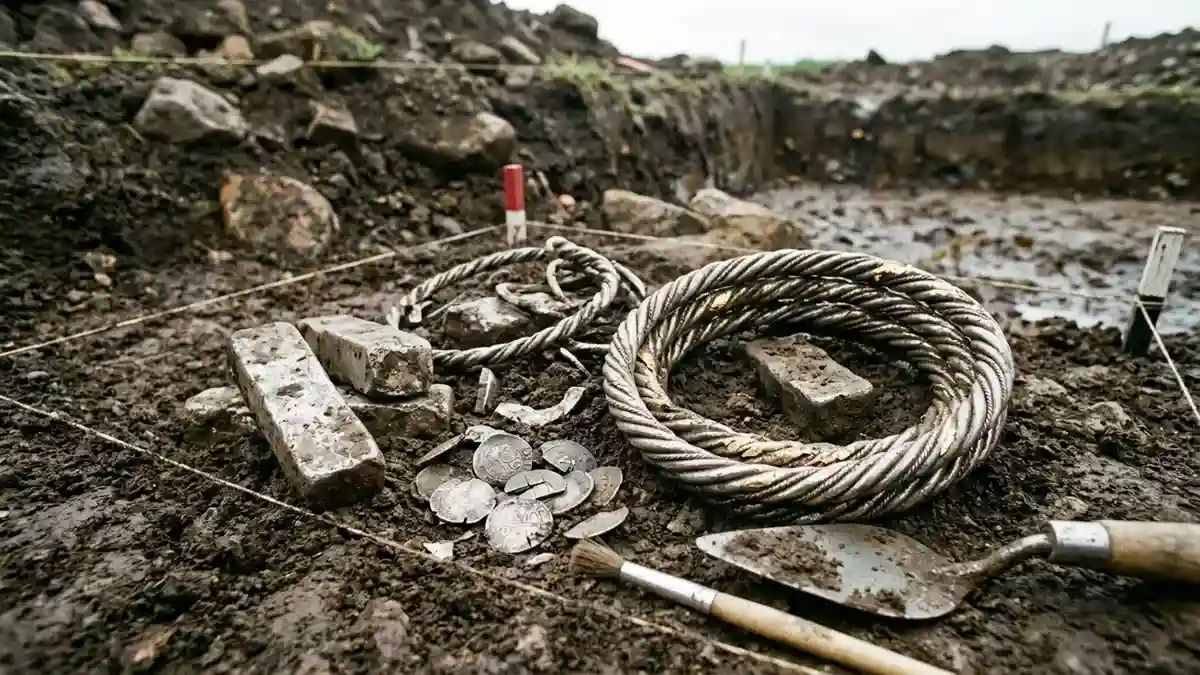
The focus of this scientific breakthrough is the Bedale Hoard, an extraordinary collection of Viking Age silver unearthed by metal detectorists in North Yorkshire in 2012. Deposited during a turbulent period in British history—the late ninth or early tenth century—the hoard represents a snapshot of an era when Anglo-Saxon kingdoms and Norse settlers were actively fighting for control of the English landscape.

To understand exactly where this immense wealth originated, a research team led by Dr. Jane Kershaw, an Associate Professor of Viking Age Archaeology at the University of Oxford, collaborated with the British Geological Survey. The team conducted a comprehensive geochemical audit of 29 silver ingots alongside several intricately crafted, heavy neck-rings found within the treasure cache.
Geochemical Fingerprinting
Using advanced laboratory techniques, including lead isotope analysis and trace element profiling, scientists were able to create a unique chemical “fingerprint” for each object. This process allows archaeologists to determine the geographic origin of the raw ore used to produce the silver. The testing uncovered three primary raw material streams within the cache:
Western European Currency: Silver derived from melted Anglo-Saxon and Carolingian (Frankish) coins.
Near Eastern Bullion: High-purity silver originating directly from Islamic mints.
Hybrid Blends: Recycled metal mixtures combining European and Middle Eastern silver sources.
While a significant portion of the hoard likely consisted of local English and continental European coins gathered through warfare, tribute, or ransom, nearly a third of the analyzed ingots were traced directly back to the Abbasid Caliphate.
Travelling the Eastern Way: How Islamic Dirhams Reached England
The presence of Near Eastern silver in a quiet English county provides definitive physical proof of the Austrvegr, or the “Eastern Way.” This vast network of river systems and overland trails was carved out by Scandinavian merchants—often referred to in Eastern Europe as the Rus—who traveled southward from the Baltic Sea.
[Baghdad Minting] ➔ [River Routes: Volga & Dnieper] ➔ [Baltic Sea Ports] ➔ [Viking England]
Norse traders navigated longboats down major waterways like the Volga and Dnieper rivers, establishing thriving trading posts along the way. In places like Kiev and Novgorod, they exchanged Northern luxuries—such as high-grade furs, amber, honey, and enslaved laborers—for high-quality Islamic silver coins known as dirhams.
Minted in the administrative hubs of the Middle East, these dirhams were carried back to Scandinavia. The new metallurgical evidence proves that when Norse populations moved westward to establish permanent settlements in the Danelaw (the region of England under Viking rule), they brought vast quantities of this hard-earned Islamic bullion with them, integrating it directly into the local British economy.
The Bullion Economy and Advanced Metallurgy
To understand why these foreign coins were melted down, it is necessary to examine how wealth was measured in the early medieval Scandinavian world. Unlike the Anglo-Saxons, who relied strictly on a regulated system of stamped coins with fixed values, the Vikings operated within a fluid “bullion economy.”
Value Measured by the Scales
In this weight-based system, money was worth only the purity and mass of the precious metal itself, regardless of what face or symbols were stamped onto the surface. Foreign coins, broken jewelry, and raw silver were routinely chucked into melting pots and recast into standardized, un-stamped ingots or wearable jewelry. If a merchant wanted to purchase goods at a market, they would use small scales to weigh out the silver, frequently hacking off pieces of rings or ingots (known as “hack-silver”) to achieve the exact weight required for the transaction.
Domestic Production and Hybrid Art
The Bedale Hoard highlights a fascinating blending of cultures, artistic styles, and regional technologies. One of the standout artifacts in the collection is a massive, multi-strand twisted neck-ring inlaid with delicate gold foil. The geochemical analysis revealed that this unique piece of jewelry was manufactured using a hybrid blend of both Western European and Middle Eastern silver.
Furthermore, the study proved that Viking silversmiths operating in northern England weren’t just melting down imported goods; they were actively mining and refining metals locally. The researchers discovered that local artisans utilized lead sourced directly from the nearby North Pennines to purify and process their silver. This demonstrates a sophisticated command of metallurgy and points to a well-organized network of local industrial production right inside England.
Re-evaluating the Medieval World
The full study, published in the scientific journal Archaeometry, adds to a growing body of academic evidence demonstrating that the early medieval period was far more interconnected than traditional histories suggest. The Vikings were uniquely positioned as a geopolitical bridge, linking the wealth, resources, and cultures of the British Isles, Western Europe, the Baltic region, Central Asia, and the Middle East.
Ultimately, the Bedale Hoard shows that the expansion of the Norse world was driven just as much by commercial ambition and trade agreements as it was by the edge of a sword.
Frequently Asked Questions
1. What exactly is the Bedale Hoard?
The Bedale Hoard is a significant collection of silver and gold artifacts dating to the late ninth or early tenth century. Discovered by metal detectorists in North Yorkshire, England, in 2012, it contains 29 silver ingots, unique multi-strand neck-rings, an Anglo-Saxon sword pommel, and pieces of gold foil, representing a massive accumulation of wealth from the Viking Age.
2. How did scientists prove the silver came from Iran and Iraq?
Researchers utilized lead isotope and trace element analysis. Because silver ore from different geographical regions contains distinct ratios of lead isotopes and unique trace chemical impurities, scientists can compare the data from the artifacts to known ancient mining locations, matching the Bedale silver directly to coins minted in the Islamic Caliphate.
3. What is a dirham and why did the Vikings want them?
A dirham was a high-purity silver coin minted by the Islamic Caliphate. The Vikings valued them immensely because of their consistent weight and exceptionally high silver content. Rather than spending them as coins, the Norse communities treated them as valuable silver bullion, often melting them down into jewelry or bars.
4. Did the Vikings raid the Middle East to get this silver?
While some military clashes occurred, the vast majority of Islamic silver was obtained through peaceful commercial trade. Scandinavian merchants traveled down Eastern European river systems to trade northern commodities like premium furs, amber, and honey directly with Middle Eastern merchants in exchange for millions of silver dirhams.
5. What does “hack-silver” mean in a bullion economy?
In a bullion economy, items were valued strictly by their weight in precious metal. If a transaction required an amount of silver smaller than a whole ingot or neck-ring, the trader would use a knife or axe to chop off a piece of the silver item. These fragmented, cut-up pieces of precious metal are referred to by archaeologists as hack-silver.