
Table of Contents
- 1. Over 400 Years of Imperial Engineering
- 2. Lost Belongings and Sacred Offerings
- 3. The Master Carpenter’s Lost Tool
- 4. Frequently Asked Questions
- 4.1. How did the wooden bridge piles survive for 2,000 years without rotting?
- 4.2. What was the historical purpose of this specific Roman bridge?
- 4.3. How did scientists figure out exactly when the bridge was built?
- 4.4. Why were there so many coins and weapons found underneath the bridge?
- 4.5. What is the most unique artifact found during the Zihl River excavation?
2,000-Year-Old Roman Bridge Discovered Under Swiss Riverbed
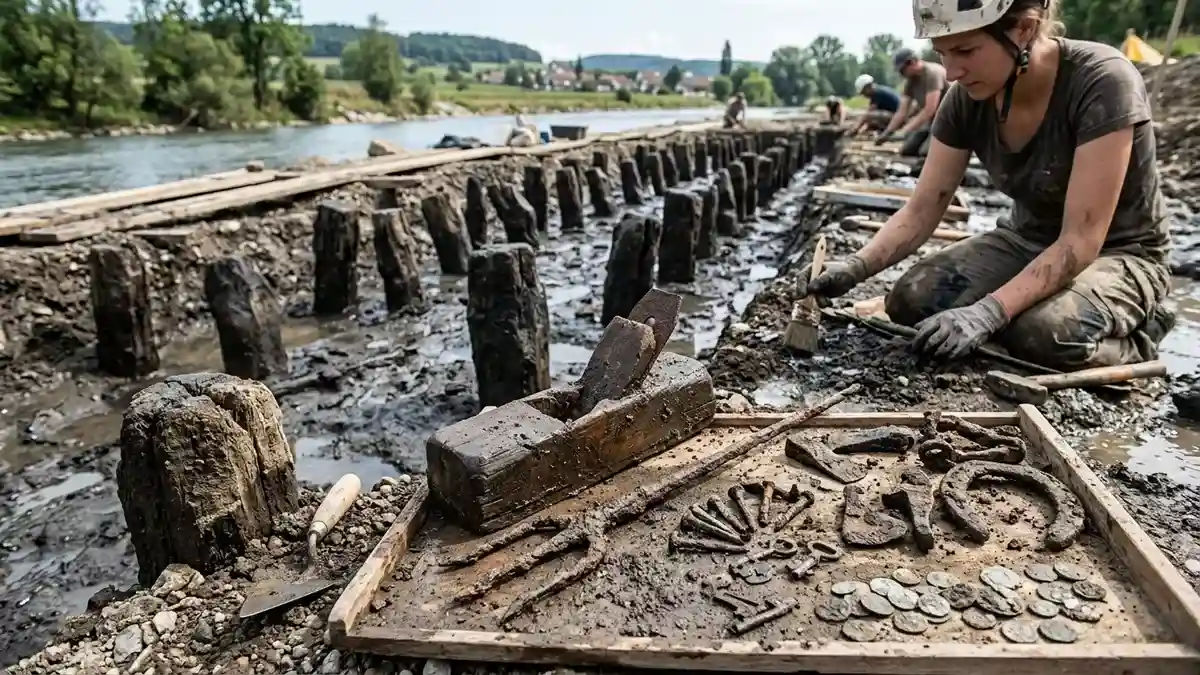
During routine construction work in Aegerten, within the Canton of Bern, Swiss archaeologists have unearthed the extraordinarily well-preserved remains of a massive Roman bridge. Submerged within the waterlogged silt of the former River Zihl, the discovery has exposed more than 300 ancient oak piles driven deep into the riverbed—a structural testament to Rome’s engineering prowess north of the Alps.
The bridge was a vital hub for the Roman Jura Transversal, a critical transport network that linked the land and water routes of the Swiss Plateau to the Jura Mountains and onward to Augusta Raurica, one of Rome’s oldest colonies along the Rhine. Strategically positioned just outside the Roman station settlement of Petinesca (modern-day Studen), the bridge served to protect and facilitate the movement of troops, merchants, and travelers heading toward the Rhine frontier defenses.
2,000-Year-Old Roman Bridge Discovered Under Swiss Riverbed
Over 400 Years of Imperial Engineering
Because the wood remained trapped in a damp, oxygen-poor environment, the timber tips—some measuring several meters long—never rotted. Specialized dendrochronological (tree-ring) analysis has allowed researchers to chart the bridge’s long, continuous lifecycle across four centuries of Roman history:

Phase 1 (~40 BCE): The earliest construction phase dates back to shortly after Rome’s conquest of the local Helvetii Celtic confederation, establishing a permanent imperial footprint in the territory.
Continuous Maintenance: The bridge underwent centuries of heavy modifications, structural repairs, and component updates to survive the river’s currents and heavy military traffic.
Final Phase (369 CE): The last recorded structural overhaul occurred under the reign of Emperor Valentinian I. This massive fortification effort was part of Rome’s systemic consolidation of its northern borders in direct response to escalating Germanic tribal incursions.
[40 BCE: Founding Phase] ──> 400 Years of Upkeep ──> [369 CE: Valentinian Border Defenses]
Lost Belongings and Sacred Offerings
The silt surrounding the bridge timbers acted as a natural sediment vault, trapping an incredibly dense collection of items dropped, lost, or thrown from the bridge deck over hundreds of years.
The recovered artifacts showcase a vivid snapshot of everyday life and travel along the imperial highway:
Military Gear: Iron hobnails torn from the soles of standard-issue Roman sandals (caligae).
Transit Hardware: Heavy iron horseshoes, ornate harness fittings, ax heads, and security keys.
Commerce & Daily Life: A diverse assortment of ancient coins, lost household keys, and a unique iron fishing trident.

Archaeologists note that while some items were undoubtedly accidental losses slipped through the bridge floorboards, a significant portion of the coins and weapons appear to have been intentionally thrown into the waters. This reflects a common provincial custom where travelers left votive offerings to river deities to ensure safe passage across the water.
The Master Carpenter’s Lost Tool
Among the most spectacular and pristine individual finds salvaged from the riverbed is a large, fully intact Roman carpenter’s plane. Carved masterfully from a single block of wood and still holding its original iron cutting blade, the tool measures 41 centimeters long, 7 centimeters wide, and 5 centimeters high.
The plane’s structural preservation is incredibly rare, offering tool historians an exact look at the precise carpentry instruments used by state engineers to build and maintain Rome’s transport infrastructure.
The entire collection of timbers and artifacts has been transferred to the laboratories of the Archaeological Service of the Canton of Bern. Specialists are currently applying advanced chemical conservation treatments to stabilize the waterlogged wood and iron, ensuring these rare glimpses into Roman frontier engineering can be preserved for future public display.
Frequently Asked Questions
How did the wooden bridge piles survive for 2,000 years without rotting?
The oak piles survived because they were driven deep into the waterlogged sediment of the riverbed. This damp, muddy environment is completely oxygen-poor (anaerobic), which prevents bacteria and fungi from breaking down and rotting the organic wood fibers.
What was the historical purpose of this specific Roman bridge?
The bridge was a crucial link in the Roman Jura Transversal, a key transport corridor connecting trade routes across the Swiss Plateau to the Rhine frontier defenses. It allowed Rome to quickly deploy military forces, collect taxes, and facilitate trade across the region.
How did scientists figure out exactly when the bridge was built?
Archaeologists utilized dendrochronology, a scientific method that analyzes the unique growth ring patterns inside the preserved oak timbers. By matching these rings against established regional tree-ring timelines, scientists determined the bridge was first built around 40 BCE and last repaired in 369 CE.
Why were there so many coins and weapons found underneath the bridge?
While many smaller items like horseshoes and sandal nails were accidentally lost by daily commuters, the high volume of coins and tools suggests intentional activity. Travelers frequently threw valuable objects into rivers as religious votive offerings to appease local water deities and secure safe journeys.
What is the most unique artifact found during the Zihl River excavation?
The most extraordinary find is a 41-centimeter-long Roman carpenter’s plane. Made from a single piece of wood and complete with its iron blade, it is one of the best-preserved examples of Roman woodworking technology ever discovered in Europe.