
Table of Contents
- 1. The Battle That Birthed an Empire
- 2. Anatomy of a Masterpiece: The Montefortino Helmet
- 3. Unlocking a Layered Underwater Archive
- 3.1. Advanced Radiology on the Sea Floor
- 4. A Multi-Layered Crossroad of History
- 5. Frequently Asked Questions
- 5.1. What makes this specific Roman helmet discovery so unique?
- 5.2. What was the Battle of the Aegates?
- 5.3. Where does the name “Montefortino” come from?
- 5.4. How do scientists look inside heavily encrusted weapons pulled from the ocean?
- 5.5. What else have archaeologists found on this ancient naval battlefield?
2,200-Year-Old Intact Roman War Helmet Recovered From the Mediterranean Sea
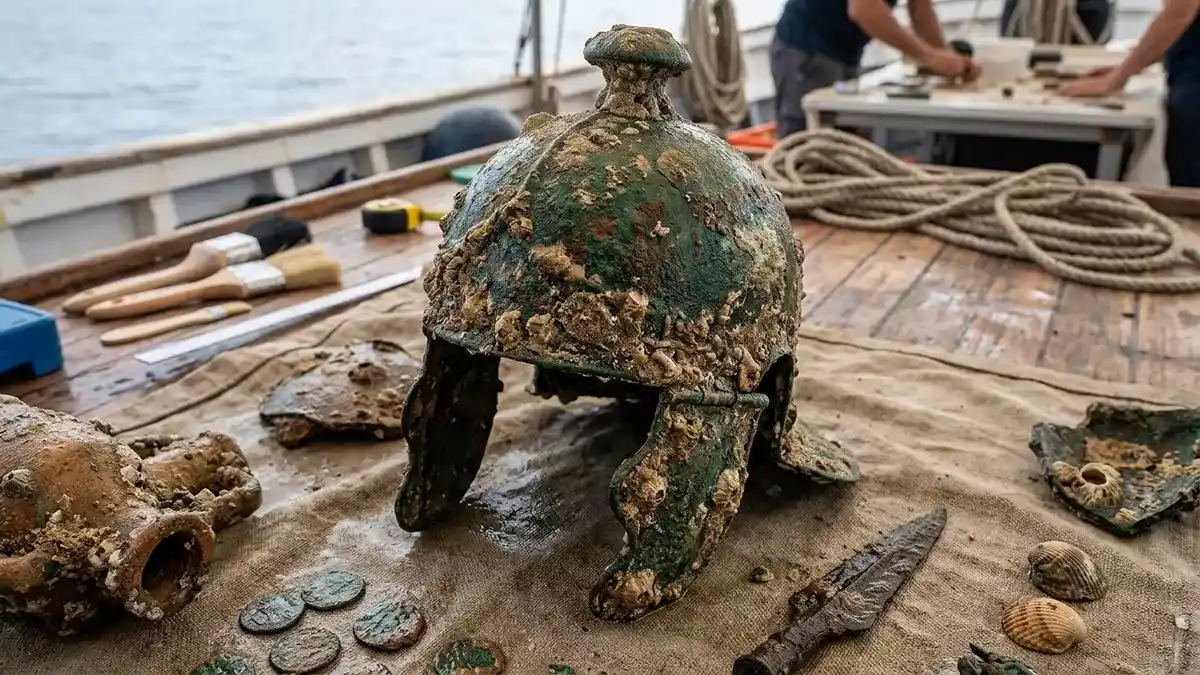
In a stunning deep-sea recovery, marine archaeologists have retrieved an exceptionally well-preserved Roman bronze helmet from the seafloor off Sicily’s Egadi Islands. The rare military artifact dates back directly to the Battle of the Aegates (or Egadi Islands) in 241 BCE—the epic, decisive naval clash that brought a definitive end to the first Punic War between the ancient superpowers of Rome and Carthage.
Discovered during an underwater exploration campaign, the armor has been identified as a Montefortino-type helmet. What makes this find an absolute triumph for maritime archaeology is its miraculous state of preservation: after spending more than 2,200 years submerged on the seabed, the bronze helmet emerged with its matching protective cheek guards completely intact.
2,200-Year-Old Intact Roman War Helmet Recovered From the Mediterranean Sea
The Battle That Birthed an Empire
To understand the historical weight of this artifact, one must look back to March 10, 241 BCE. For 23 grueling years, the Roman Republic and the Carthaginian Empire had been locked in the First Punic War, a bloody war of attrition for absolute economic and military dominance over the western Mediterranean.
The conflict culminated in the waters surrounding the Egadi Islands, west of Sicily. Although historical accounts suggest the Carthaginian fleet initially outnumbered the Romans, the better-trained and aggressively prepared Roman navy achieved a total victory, sinking dozens of enemy warships and capturing many more.
The catastrophic defeat forced Carthage to surrender, pay crippling financial reparations, and cede control of Sicily. As Rome’s very first overseas territory, Sicily became the cornerstone of what would eventually expand into the monumental Roman Empire, shifting the geopolitical balance of the ancient world forever.
Anatomy of a Masterpiece: The Montefortino Helmet
The newly recovered artifact is a classic example of the Montefortino helmet design. Originally introduced to the Italian peninsula by Celtic tribes, the style was rapidly adopted, refined, and mass-produced by the Roman military, remaining the standard headgear choice from the 4th century BCE through the 1st century CE.

The Montefortino design was highly practical, characterized by:
A fluidly spin-formed, rounded bronze dome bowl.
A mushroom-shaped central knob at the crown used to anchor decorative horsehair plumes.
A flared rim forming a short visor at the front and a protective neck guard at the back.
Hinged metal cheek plates designed to hang down and shield the sides of the soldier’s face.
While fragment components of these helmets are frequently discovered at ancient camp sites, finding an intact specimen with its original cheek guards still attached is an extraordinary rarity. Most examples found underwater have had their facial plates ripped away by centuries of shifting marine currents or fishing nets.
Unlocking a Layered Underwater Archive
The salvage operation was coordinated by Sicily’s specialized Superintendency of the Sea in close collaboration with high-water divers from the Society for the Documentation of Submerged Sites (SDSS) and international support from the RPM Nautical Foundation.
For over 15 years, this multi-institutional project has systematically surveyed the marine battlefield. The regional seabed acts as a pristine, underwater time capsule, yielding an unparalleled archaeological record of ancient naval warfare:
| Category of Recovered Artifacts | Total Estimated Count | Historical Significance |
| Montefortino Bronze Helmets | More than 30 specimens | Illustrates the personal defensive gear and uniform standards of the infantry. |
| Bronze Naval Rams (Rostra) | 27 intact rams | Heavy battering weapons fixed to warship prows used to punch through enemy hulls. |
| Hand-to-Hand Weaponry | Dozens (Swords, Spears, Javelins) | Discovered heavily encrusted in mineral blocks; details the reality of boarding combat. |
| Everyday Maritime Goods | Amphorae, Pottery, and Coins | Tracks the logistics, cargo capacities, and daily diets of ancient sailors. |
Advanced Radiology on the Sea Floor
Because these weapons have spent millennia resting in a mineral-rich marine environment, they are frequently trapped inside thick, rock-like concretions of sand, shells, and iron rust. To study these artifacts without causing irreversible physical damage, researchers have turned to advanced Computed Tomography (CT) scanning in Trapani.
These noninvasive X-ray scans allow weapons experts to digitally peer inside the heavy encrustations, mapping the exact dimensions and conditions of hidden swords, spears, and javelins.
Furthermore, recent chemical conservation work on a previously salvaged naval ram exposed a rare piece of wartime administration. Cleaned surfaces revealed a clear Latin inscription reading the name of a Roman official, Servius Sulpicius, a quaestor who officially approved the manufacturing quality of the warship’s ramming prow before it left dock.
[CT Scan of Concretion] ──> Digital Separation ──> Reveals Iron Swords & Javelins ──> Damage-Free Analysis
A Multi-Layered Crossroad of History
The Egadi archipelago is a multi-layered historic landscape. Proving that these waters remained a vital commercial highway long after the Punic Wars, divers also investigated a 5th-century CE shipwreck colloquially known as the “fish shoal.”
From this late-Roman/Byzantine era wreck, teams pulled up a beautifully crafted, substantial bronze handle of uncertain use. The presence of this high-quality luxury item amidst separate historic trade debris underscores that the waters of Sicily never stopped serving as the central highway where European, African, and Near Eastern civilizations interacted, traded, and clashed across the ages.
Frequently Asked Questions
What makes this specific Roman helmet discovery so unique?
While archaeologists have found several ancient helmets over the years, this specimen stands out because it is nearly complete. Crucially, its matching hinged cheek guards are fully intact and preserved alongside the main bronze bowl—a condition that is exceptionally rare for armor submerged for over 2,000 years.
What was the Battle of the Aegates?
The Battle of the Aegates (or Egadi Islands) was the final and deciding naval engagement of the First Punic War, fought on March 10, 241 BCE. The comprehensive Roman victory over the Carthaginian fleet forced Carthage to surrender control of Sicily, marking the dawn of Rome’s military dominance across the western Mediterranean.
Where does the name “Montefortino” come from?
The name “Montefortino” is an archaeological classification derived from a region in Italy where this specific style of helmet was first documented in large numbers. It features a conical or rounded dome, a small top knob for decorative crests, a small neck guard, and facial cheek plates.
How do scientists look inside heavily encrusted weapons pulled from the ocean?
Scientists utilize advanced noninvasive Computed Tomography (CT) scans. This diagnostic imaging technology uses powerful X-rays to generate detailed 3D models of the artifacts, allowing researchers to see the exact shapes of iron swords, spears, and javelins hidden inside rock-like mineral crusts without damaging them.
What else have archaeologists found on this ancient naval battlefield?
Over 15 years of systematic mapping around the Egadi Islands has revealed the world’s only scientifically documented ancient naval battlefield. Discoveries include more than 30 military helmets, 27 bronze naval battering rams (rostra), personal combat weapons, transport pottery (amphorae), and ancient coins.